This makes for interesting reading in light of what Thornton wrote about the mound. http://www.thelamarinstitute.org/images/PDFs/publication_47.pdf
Tuesday, December 27, 2011
Kenimer Mound
Norman Muller emails:


Stone Mound in AL
Also from Norman Muller:
Attached is a scan of a map that Harry Holstein prepared for a report he did, titled “A Preliminary Archaeological Investigation of the Morton Hill Stone Structure Complex, 1CA671, Calhoun County, Alabama,” for Jacksonville State University Archaeological Resource Laboratory, Research Series Number 5, March 2010. Compare this map with the one produced in the Loubser and Frink article [click here]
Attached is a scan of a map that Harry Holstein prepared for a report he did, titled “A Preliminary Archaeological Investigation of the Morton Hill Stone Structure Complex, 1CA671, Calhoun County, Alabama,” for Jacksonville State University Archaeological Resource Laboratory, Research Series Number 5, March 2010.
 Compare this map with the one produced in the Loubser and Frink article [click here]
Track Rock Gap from Norman Muller
Norman emails:
A link to a negative view of the claims of Mesoamerican presence in the Southeast.:
http://danelliott.wordpress.com/


Although the attention about Track Rock Gap has focused on the stone walls, little has been said about the site that gave the gap its name. This link, written by Loubser, provides some answers:
A link to a negative view of the claims of Mesoamerican presence in the Southeast.:
http://danelliott.wordpress.com/
Some other photos:


(Norman Muller)
Also:Although the attention about Track Rock Gap has focused on the stone walls, little has been said about the site that gave the gap its name. This link, written by Loubser, provides some answers:
Armageddon Online says:
"Googling "Archaeological Site 9UN367" yields more info, too, such as this paper (pdf)
"AN ARCHAEOLOGICAL AND ETHNOHISTORICAL APPRAISAL OF A PILED STONE FEATURE COMPLEX IN THE MOUNTAINS OF NORTH GEORGIA"
(which a quick scan reveals it doesn't go into the Mayan connection Thornton speaks of, but he mentions that)
and this interesting blog on stone structures in New England and SE United States, Rock Piles, which shares a picture here.
 http://forums.armageddononline.org/threads/33640-Massive-1-100-year-old-Mayan-site-discovered-in-Georgia-s-mountains
"AN ARCHAEOLOGICAL AND ETHNOHISTORICAL APPRAISAL OF A PILED STONE FEATURE COMPLEX IN THE MOUNTAINS OF NORTH GEORGIA"
(which a quick scan reveals it doesn't go into the Mayan connection Thornton speaks of, but he mentions that)
and this interesting blog on stone structures in New England and SE United States, Rock Piles, which shares a picture here.

Piper Rd Rock Piles - Acton MA
 For those enthusiasts who are reassured, as am I, to know they are commuting past rock piles, I just added a new site for people who drive on Rt 2 in Acton. The site is on Piper Rd, just beyond the corporate buildings to the south, as the road heads uphill and there is a small woods to the left - behind the buildings and before the houses. If you look in there, you can see rock piles as you drive bye. For example:
 It is a bit messy.

 But there are rock piles in there. Perhaps a bit like marker piles and a bit like breakout wetland ceremonies.
 One interesting feature was a very faintly defined stone "wall" that goes uphill briefly:
 At the top it turns a corner and becomes a more regular structure.
 Note the parallelism with the rock pile in the background. Is this a recent or colonial manifestation? Perhaps. But other piles at this site and other clusters are typical Native American:


 Some rock-on-rocks from there. I like their aesthetic.

 Every rock takes on significance.
Monday, December 26, 2011
Last artifact find, 2011
This is likely to be my last find for a while. I wish I could show something as wonderful as that lovely quartz spearpoint a reader found recently but I was not so lucky (though I am still thrilled by any find of any kind). This piece is more typical of local artifacts, a crude triangular point, also quartz, but shaped using hard hammer percussion flaking, rather than the fine pressure flaking of that spearpoint.


I found this on Friday, I got out of work early and raced to a place I wanted to search, a farm field on this occasion. Unfortunately for me, the farmer has used some kind of fertilizer that covers the ground in most places, there was little hope of finding anything, so I got back into my car and spent some time in a favorite spot, where I found this. It was mostly buried with just a tiny piece peeking out of the ground. Today I spent hours searching in four different places, I waded through mud and splashed around in the water and it was windy and all I found was one fragment of something so badly broken I am not sure what kind of tool it was. A typical day.

It is missing the tip and looks like it might have taken a hit to the lower right corner but most of it is there. It is about twice as thick as most points of this size that I find. I think it probably was resharpened down from something bigger and most likely was used as a knife.

Sunday, December 25, 2011
Saturday, December 24, 2011

Friday, December 23, 2011
Quartz Spearpoint from Marshfield
Via a reader Brian B: 

"My son C. & I were clamming in Marshfield last week and dug up this incredible arrowhead in the muck."
More re Mayan's building stone mounds in Georgia
A reader Kathe B. writes:
In regards to this page http://rockpiles.blogspot.com/2010/06/archaeological-and-ethnohistorical.html on your site that I found while trying to find more information on this http://www.rawstory.com/rs/2011/12/22/1100-year-old-mayan-ruins-found-in-north-georgia/ and this http://www.examiner.com/architecture-design-in-national/massive-1-100-year-old-maya-site-discovered-georgia-s-mountains
I thought you might find them an interesting read considering your blog (which I've only just found).
(PWAX) I strongly recommend that last link. It is much more detailed and convincing that there actually is a Mayan presence in Georgia. Of course, let me be the first to say, that things like small flat topped pyramids in Fitchburg might have a connection to those people as well. The only problem I see with the argument of Mayans coming directly to the eastern US, is that so many cultures between Mexico and the eastern US have the same kind of arrowheads as the Maya - so it should be viewed [I think] as a continuum from Mexico to here.
In regards to this page http://rockpiles.blogspot.com/
I thought you might find them an interesting read considering your blog (which I've only just found).
(PWAX) I strongly recommend that last link. It is much more detailed and convincing that there actually is a Mayan presence in Georgia. Of course, let me be the first to say, that things like small flat topped pyramids in Fitchburg might have a connection to those people as well. The only problem I see with the argument of Mayans coming directly to the eastern US, is that so many cultures between Mexico and the eastern US have the same kind of arrowheads as the Maya - so it should be viewed [I think] as a continuum from Mexico to here.
Google Earth images of Western PA rock piles
by Kathy K. (aka: theseventhgeneration)
This is a follow up to the Tuesday, December 20, 2011 post "Western PA rock pile". Tim asked, in what direction was the first photo taken?
I hope reader Bill C. doesn't mind my taking the liberty to look this site up on Google Earth, but in light of the mining activity, I think it's imperative that this site is looked at seriously, before it is destroyed.
First, a look at the entire site, aerial view. The rock shelter is in the center of the strip mine. I marked the end of the tree line because it is so clearly visible in Bill's first photo. Note, this image is faced due north (compass in upper right). Next, a close up of the rock pile site between Evans Hill and the rock shelter (looking southwest). I believe rock pile #5 is the one with the standing stone, although I would need Bill C. to confirm this. I have not been out to this site.
 Last, Google Earth's simulation of the sunset on the 2011 Winter Solstice. The sun passes right over Evans Hill.
 There are more photos at Laurel Hill Walks, including some other structures at this site which look to be in danger from mining.
This is a follow up to the Tuesday, December 20, 2011 post "Western PA rock pile". Tim asked, in what direction was the first photo taken?
I hope reader Bill C. doesn't mind my taking the liberty to look this site up on Google Earth, but in light of the mining activity, I think it's imperative that this site is looked at seriously, before it is destroyed.
First, a look at the entire site, aerial view. The rock shelter is in the center of the strip mine. I marked the end of the tree line because it is so clearly visible in Bill's first photo. Note, this image is faced due north (compass in upper right).
 Next, a close up of the rock pile site between Evans Hill and the rock shelter (looking southwest). I believe rock pile #5 is the one with the standing stone, although I would need Bill C. to confirm this. I have not been out to this site.
 Last, Google Earth's simulation of the sunset on the 2011 Winter Solstice. The sun passes right over Evans Hill.
 There are more photos at Laurel Hill Walks, including some other structures at this site which look to be in danger from mining.
Thursday, December 22, 2011
1,100-year-old Mayan ruins found in North Georgia
by JimP
Click here for story:1,100-year-old Mayan ruins found in North Georgia
Archaeologists have discovered the ruins of an ancient Mayan city in the mountains of North Georgia believed to be at least 1,100 years old. According to Richard Thornton at Examiner.com, the ruins are reportedly what remains of a city built by Mayans fleeing wars, volcanic eruptions, droughts and f...
Visit to the Robbins Museum
I have a friend, Tom Todd, whose grandfather gave an arrowhead collection to what became the Robbins Museum in Middleboro (see here) and so, yesterday, he and his brother and I drove down to the museum. By pre-arrangement we were going to take a look at that collection. Middleboro is a bit out of the way, unless you are driving to Cape Cod, but WOW! That museum is a building filled with hundreds of arrowheads and other treasures worth going out of the way for.
We ended up spending several hours more than I expected looking at arrowheads and talking with the museum staff. To my pleased surprise, long time NEARA member Ted Ballard was there as one of the interpreters and also Curtis Hoffman. Curtis is the current editor of the bulletin of the MAS, chair of an archeology/anthropology department at Bridgewater State and one of Massachusetts' only archeologists who both has practical experience with digging sites and arrowheads as well as an interest in rock piles. I alternated between chatting with these old colleagues, looking at the museum's exhibits, and going into the room where they were unwrapping the Todd collection. This family comes from Concord and many of the arrowheads are from Concord. Apparently some more of the collection got moved to the Concord Museum. Much of what we saw at the Robbins Museum was broken and I wonder: where is the good stuff? Maybe in Concord.
Let me make some comments about the museum. A lot of the collection is magnificent. They have "whale tale" atlatl weights made of banded slate and others made of jade-like stone that are exceptional. They have bird stones, boat stones, celts, and gouges. They have examples of the only inscribed pendants I have seen using representative art (pictures of turtles or of figures). They have lots of grooved axes. They also have a few random non-New England artifacts mixed in with parts of the collections. I saw a couple of points made from materials that I have never seen elsewhere. I saw a small jade celt that looked like a pretty good match for some things I have seen from China. Looking at some of the cases of a hundred or so examples of the same small quartz triangular point shape, I had the feeling that excessive numbers tend to denature the beauty of the single item. I got the same feeling at the Louvre where Napolean's bounty is crammed in together with every other item ever collected by the French Empire. I wonder if this is the best way to display the beauty and the information of these arrowhead collections? In any case if you want to have your fill of Massachusetts arrowheads, the Robbins Museum is very much worth the trip. I had arrowhead images dancing in front of my eyes all evening and still this morning.
In my own collection I have examples of many of the types of item they showed at the museum. I do have some kind of atlatl weights, I have gouges, and I have grooved axes (which I did not find but got from my in-laws). I have examples of many of the basic arrowhead types and materials. I do not have a celt although I hope I find one someday. I have considered buying one in the meantime. The museum also showed examples of some cruder items - called "hoes" or "choppers" and I have a few items like that also. But I have a large number of crude old stone tools, like axes, hatchets, and large pebble choppers that were in no way represented at the museum. Sure enough, these old crude tools are still flying beneath the archeological radar. Similarly, although Curtis Hoffman is working at the Museum, there is no acknowledgement of the rock pile as an archeological artifact. It would be nice to see the museum represent these artifacts as well, to give a more complete picture of what you can find out there on the ground.
Ramapo Rock Shelter
An acidental find while watching the Evan's Hill videos:
http://youtu.be/VTsbftE5SOo
followed by this sort of disturbing one:
http://youtu.be/buvKWu3YjVI
http://youtu.be/VTsbftE5SOo
followed by this sort of disturbing one:
http://youtu.be/buvKWu3YjVI
Tuesday, December 20, 2011
A Bunch of Stuff about Fences and Stone Rows
(And Meer Stones too)

George Henry Durrie: Gathering Wood for Winter (New Haven CT) 1855
Found at http://b-womeninamericanhistory19.blogspot.com/2010/12/snowy-19th-century-american-countryside.html
where there are more paintings of farmers gathering wood than building stone walls...
Stone lined springs, short stretches of wall, etc...
A couple of stray photos from a bit of woods in Lincoln, where there were certainly plenty of signs of farming activity and a few signs of something less certain:

 Some similar items from Pepperell (although the short stretch of wall here seems much older than the one from Lincoln, while this spring was obviously modern):

 There was a smattering of rock piles at both places. Eg in Lincoln:


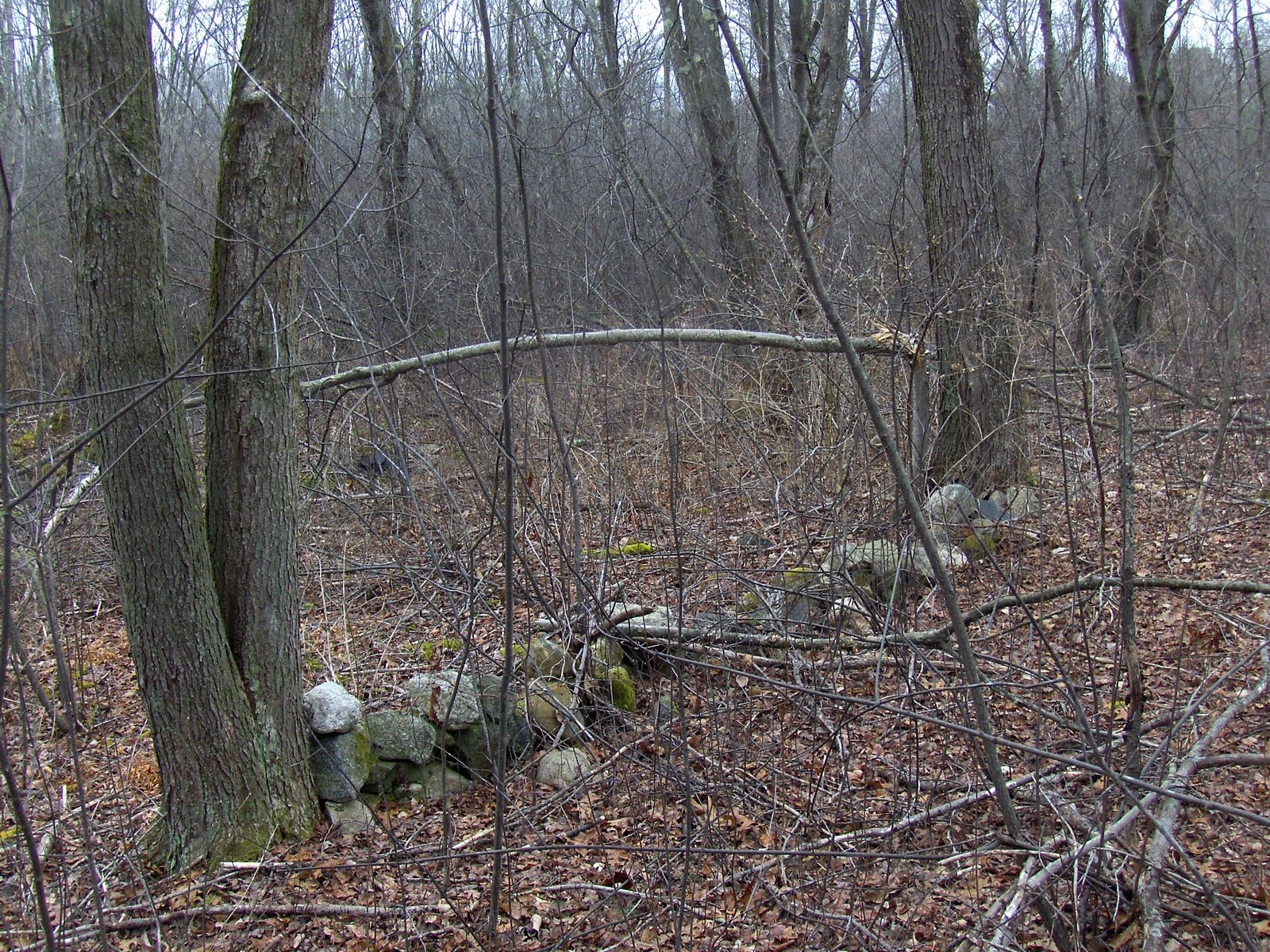 Some similar items from Pepperell (although the short stretch of wall here seems much older than the one from Lincoln, while this spring was obviously modern):

 There was a smattering of rock piles at both places. Eg in Lincoln:

Western PA rock pile
Reader Bill C. writes:
...here's a few photos I took yesterday near Brush Valley,Pa. Laurel Hill walks has been in this area of mine but hasn't seen this interesting rock pile in person yet. This is a front and back view.
 Update: Those photos were actually from screen shots of video I took that day,this photo is from a still and shows more detail. The video can be seen at this YouTube address http://www.youtube.com/watch?
v=t9GAfavVG2E
...here's a few photos I took yesterday near Brush Valley,Pa. Laurel Hill walks has been in this area of mine but hasn't seen this interesting rock pile in person yet. This is a front and back view.

 Update: Those photos were actually from screen shots of video I took that day,this photo is from a still and shows more detail. The video can be seen at this YouTube address http://www.youtube.com/watch?
Monday, December 19, 2011
Light posting
No new finds of significance last weekend means a quiet week here on the blog. But the snow has held off and I'll be getting out Christmas week, provided the weather continues to be nice.
Sunday, December 18, 2011
Thursday, December 15, 2011
Another way into Estabrook Woods
 Going in the Newbury Land in Concord next to Lowell Rd. there is a trail to the left that becomes a wide trail through the woods. Somewhere a little below the cross-hair on the map fragment, after 100 yards or so on the trail, there is a nice rock pile on the left:
 Other views:

 A split rock a few feet away:
 With reference to my official topo maps at home, I see that there are a few more rock piles across the "gully" to the southeast from here but I did not go in that direction, this time.
I went further east, deeper in the woods, to the origins of that gully. Here is a spring with two small rock piles visible:
 Closeup:
 This gives a good feel for what a spring would have been like around here, back when.
Subscribe to:
Posts
(
Atom
)


