Tuesday, June 12, 2012
Deep in the woods in Sterling
Where man has not made the going difficult with sloppy logging, nature obliges with its own downed trees, laurel, and rocks offering an easy broken ankle.
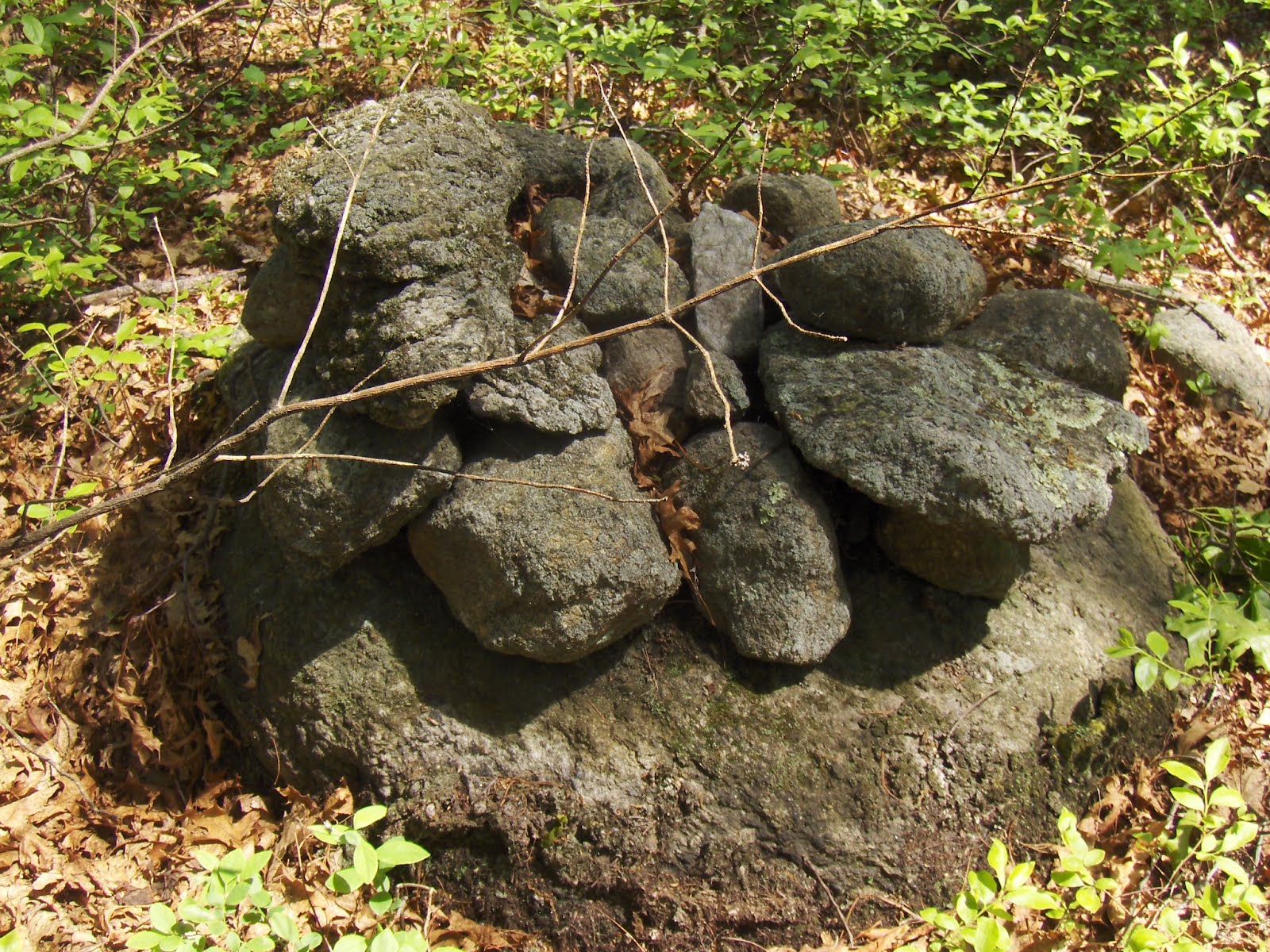
But you get to some places and it's nice to get there thinking no one else has been there, this generation. And you see occasional stone structures deep in the swamp:

That no one is likely to see. And nice colors:
Simple rock pile with a tail?
Sunday, June 10, 2012
Thursday, June 07, 2012
Arrowhead odyssey
Someone recently asked me how I got started collecting arrowheads. I have never really considered myself to be an arrowhead collector, my hobby is really more about looking for them than collecting them (or even finding them, most of the time). But it is certainly true, I have a collection of these things, and I spend a lot of time trying to add to the collection. The story of how I got started is kind of a long one. I have always been interested in history- holding old things, visiting old
places, hearing stories about the past, all these things have always sparked my
imagination. Even as a child I collected rusty old nails and pieces of crockery I found, and I treasured old books
I found in my father's bookcase. I have an aunt and uncle in California and my
uncle told me about a friend there who had found lots of nice arrowheads on his
property. He gave me an obsidian blade that I still have. Maybe that is why I
always assumed that arrowheads were things that could be found out West, not
here in Massachusetts. I thought that finding an arrowhead near where I live
would be a freak once-in-a-lifetime find that could only happen by some lucky
chance. As I got older I would go exploring in the woods most weekends, often finding stone structures I
thought might have been made by Indians, but I never dreamed of finding an
ancient stone tool, it seemed impossible. Then in 2008 I saw on this blog pictures of arrowheads that Peter W. had found. The amazing things he had collected in the state where I live filled me
with wonder. How could it be possible, that one person could find not just one
arrowhead, but a whole collection? The thought of being able to be the person
to find an arrowhead after all this time was something I could barely fathom.
Weeks went by and I found myself spending more and more time imagining what it
might feel like to find an arrowhead in some place where it had been left behind
long ago. One of the posts here mentioned that someone finding an
arrowhead was not really a rare thing. I couldn't believe it, I started asking some
friends and sure enough, some of them knew of some places where artifacts had
been found. I got the (very wrong) idea, at that time, that arrowheads were maybe even
actually easy to find, abundant. I started idly and half-heartedly looking in ridiculous places like next to my driveway. By the beginning of 2009 I was e-mailing anyone I thought could help and asking
for tips on how to find arrowheads. At that time I thought if I put in a little
effort over a couple of weekends that I could find one, and the quest would end,
and I would be happy with just one, even if it was broken. Many of the people I e-mailed did not respond, there were three people that did and that patiently answered all of my questions and were
helpful. I must have read those e-mails a thousand times, in fact I have saved
many of them and I still look at them from time to time. The advice I got from everyone was always more or less the same: Look for places near water where the ground is exposed, walk slowly, look carefully, examine a lot of rocks. Well, I
got out there and started looking and I didn't find anything. I walked streams,
I followed dirt trails in the woods, I picked along riverbanks and lakeshores
and I spent hours on the computer looking for places that seemed like they might be good to search. I did a lot of research and noticed that some areas had more documented sites than others, I started to focus on areas where there might have been a lot of Indians long ago. I started knocking on doors, asking landowners if I could look on their property. My first day out talking to landowners, two people told me arrowheads had been found on their property in the
past. A huge success for me, a great feeling of achievement that I had been able to identify places to look where there was stuff to be found. But of course, I still needed
to learn when to look, and how to look; there were some people who helped me with those questions too
and encouraged me when I was taking pictures of any vaguely pointy broken rock
thinking it might be a tool. They told me to go after it rained, to learn about the different materials used locally for making tools, to look for chips and flakes and concave flaking on broken edges. All spring and summer I spent what felt like
hundreds of hours searching and not finding anything. I learned that there are a
lot of rocks on the ground, and that very many of them are triangular but are
not arrowheads. I learned how leaves and goose turds and dragonfly wings and spider webs and plastic trash could
look just like arrowheads. But in all that time I found no tools. There were times I thought about just giving up but I kept telling myself that some day I could find one and then I could go back to my regular life and pasttimes. Finally, in October 2009 I found my first broken artifact. It was
an incredible feeling of accomplishment, I smiled for a week. My curiosity and
my idle daydreams about finding an arrowhead had become an intense personal
mission. And now I had something, and the quest was over, or so I thought...
Then I decided I wanted to find one whole one. And when I found a whole one, an
argillite stemmed point in spring 2010, I wanted a whole quartz one. I found one
of those, a triangle, in July 2010. But by then I was hooked. The adrenaline
rush of finding an arrowhead is the most addictive thing I have known. I now
spend almost no time in the woods, looking for arrowheads consumes most of my
free time. The rhythm of the seasons and the changes in the places I look
control how I spend my time. I see meaning in every stream and river, every hill
and valley. I eagerly look at the weather forecast every day, planning
obligations around rainstorms. Now I can't imagine not looking for arrowheads, it is part of my life.
Some time has passed and I have found some good places to search. I return to these places over and over. But very often I will get out and try new places, where I have not looked before. This reminds me of when I first started, picking up every broken rock, not knowing what type of materials I might be looking for, or if in fact there is anything there to find at all. Most of the time these places are void and I don't find anything. But from time to time I will find something in a new place, these finds are very rewarding. My friend Dave who found the Adena point while we were searching for stuff over the weekend told me about a new spot that looked like a likely place, but it is a big area and seemed like it might be a little overwhelming. It has been raining so much and it rained yesterday, I needed to get out after work and hoped to have some luck. I wanted to head to a familiar place but Dave convinced me to try out the new place instead. We both spent a couple of hours there carefully looking but not finding anything. The conditions were good but there was hardly any sign of ancient activity, I picked up some broken pieces but found it hard to say if they were chips from making tools, or just rocks. At one point we were getting ready to leave but then Dave found a tiny broken quartz projectile point tip, really just a tiny fragment but it was encouraging and we decided to keep looking. I'm glad we did! I found this at the end of the night as it was just starting to get dark. Dave and I were both in the same area when I spotted it, I'm lucky he didn't spot it first! It was only partially exposed and resting on a little pedestal of dirt. I couldn't tell it it was whole or broken or just what it was. It could have been a little broken triangle or a big Clovis.
When I picked it up I felt a little resistance that told me there was more in
the ground, a good sign! I was thrilled to find it whole. At first I thought it
was a big Levanna but looking closely I can see little notches near the base of
the blade on both sides, I believe this is a Brewerton Notched Triangle. Someone I showed pictures to suggested Hardaway. Whatever it is, it is old. This is one of my best finds, maybe my best ever.
A nice reward at the end of the day...
Before we walked out I also spotted a broken piece sticking out of the dirt. I could see that it had flaking but also that it was broken. I thought it might be the blade part of a large projectile point, point down in the ground, missing the base.
I reached to pick it up and was amazed to see more and more rock coming up as I pulled it out of the ground, it was huge! It turned out that what was visible on the surface was just one small exposed part of a big quarry blank or preform, unfortunately broken.
I couldn't stop smiling last night as I went to sleep and I was still smiling this morning when I woke up. Zero Brewertons in a couple of years, then two in a week. The fact is that no matter how productive a spot is, no matter how experienced one is in scanning the ground, it all ultimately still comes down to luck. You could find nothing or you could make the find of a lifetime. You just need to be in the right place at the right time.
Some time has passed and I have found some good places to search. I return to these places over and over. But very often I will get out and try new places, where I have not looked before. This reminds me of when I first started, picking up every broken rock, not knowing what type of materials I might be looking for, or if in fact there is anything there to find at all. Most of the time these places are void and I don't find anything. But from time to time I will find something in a new place, these finds are very rewarding. My friend Dave who found the Adena point while we were searching for stuff over the weekend told me about a new spot that looked like a likely place, but it is a big area and seemed like it might be a little overwhelming. It has been raining so much and it rained yesterday, I needed to get out after work and hoped to have some luck. I wanted to head to a familiar place but Dave convinced me to try out the new place instead. We both spent a couple of hours there carefully looking but not finding anything. The conditions were good but there was hardly any sign of ancient activity, I picked up some broken pieces but found it hard to say if they were chips from making tools, or just rocks. At one point we were getting ready to leave but then Dave found a tiny broken quartz projectile point tip, really just a tiny fragment but it was encouraging and we decided to keep looking. I'm glad we did! I found this at the end of the night as it was just starting to get dark. Dave and I were both in the same area when I spotted it, I'm lucky he didn't spot it first! It was only partially exposed and resting on a little pedestal of dirt. I couldn't tell it it was whole or broken or just what it was. It could have been a little broken triangle or a big Clovis.
A nice reward at the end of the day...
Before we walked out I also spotted a broken piece sticking out of the dirt. I could see that it had flaking but also that it was broken. I thought it might be the blade part of a large projectile point, point down in the ground, missing the base.
I reached to pick it up and was amazed to see more and more rock coming up as I pulled it out of the ground, it was huge! It turned out that what was visible on the surface was just one small exposed part of a big quarry blank or preform, unfortunately broken.
I couldn't stop smiling last night as I went to sleep and I was still smiling this morning when I woke up. Zero Brewertons in a couple of years, then two in a week. The fact is that no matter how productive a spot is, no matter how experienced one is in scanning the ground, it all ultimately still comes down to luck. You could find nothing or you could make the find of a lifetime. You just need to be in the right place at the right time.
Wednesday, June 06, 2012
Tuesday, June 05, 2012
And another lucky day!
Yesterday at work I was dismayed by the nasty weather, lots of wind and cold rain. I had been hoping to head out and look for arrowheads right after work but I didn't have a warm jacket or rain gear and I wasn't looking forward to driving through a dreary rain storm to get to a muddy place to look. Rain exposes artifacts but it's generally not fun to look while it is still raining if you are not prepared. When 5:00 finally came I reluctantly decided to go out and look anyway. I'm glad I did! As it happened, the weather was not really that bad out there, just enough drizzle to keep the ground wet. All the rocks stood out plainly on the ground surface in the bare areas. I saw this:
That is the base of an argillite blade sticking out of the ground. With excitement I picked it up only to find out it was a true "heartbreaker," broken in half with the break just hidden by the dirt. But better than nothing, certainly. I looked for a while longer and was thrilled to spot this from several feet away, it was lying totally exposed:
I also found another one of those little quartz triangles that are now so familiar. This one was intact and mostly exposed on the ground. It is still sharp after thousands of years in the ground. The Brewerton shows more weathering, the material is not as hard as quartz.
That is the base of an argillite blade sticking out of the ground. With excitement I picked it up only to find out it was a true "heartbreaker," broken in half with the break just hidden by the dirt. But better than nothing, certainly. I looked for a while longer and was thrilled to spot this from several feet away, it was lying totally exposed:
Another view, the rain had left this nice tool sitting on a little pedestal just waiting to be picked up.
This is the first Brewerton I have ever found. Before I ever found my first broken artifact, I dreamed of finding a Brewerton, the classic arrowhead shape is really appealing. It is made of rhyolite. The adrenaline rush I get when finding something like this is really addictive and makes all the hours of fruitless searching worthwhile.I also found another one of those little quartz triangles that are now so familiar. This one was intact and mostly exposed on the ground. It is still sharp after thousands of years in the ground. The Brewerton shows more weathering, the material is not as hard as quartz.
Monday, June 04, 2012
Recent finds, a lucky day yesterday
I have been spending a lot of time out searching for artifacts and finding mostly just broken pieces and fragments. My best find from Memorial Day weekend was this nice thin intact quartz Wading River point, my first whole arrowhead from Rhode Island. The water in the background is the Atlantic Ocean. Nicely made thin quartz points like this were really difficult to make, quartz is a very hard material to work that most modern flintknappers won't touch.
Saturday I stayed home all day listening to the wind and rain outside. Heavy rain and storms fill me with anticipation, I think about places where artifacts might be eroding out of the ground and I plan out places to go, always trying to go to the most likely and productive places first. There is one spot I go to that is very dusty, where the exposed soil quickly hides exposed rocks when conditions are dry. I decided that would be my first stop on Sunday, I wanted to look there before it dried out.
When I got out of my car first thing Sunday morning I was a little disappointed, there didn't seem to be much new exposure and everything looked more or less the same as it did the last time I went there. I don't know if it didn't rain heavily there Saturday, or if it just wasn't enough rain to wash out much new stuff. Despite this I still spent two and a half hours carefully searching. I spotted this little piece of broken quartz and stapped a picture before picking it up, really expecting it to be just another chip or flake, having found very many of those in this place where Indians must have lived long ago.
When I picked it up it came out with a clump of dirt, I rubbed the dirt away and was very pleased to find that the exposed part was the tip of a nice small triangular arrowhead.
This is a nice find for me, it is not too crude and it is small and was not easy to spot. And it is not broken. After I found this I poked around a little more and left. I met up with my friend Dave, he enjoys searching for old objects with a metal detector and he has found some nice artifacts while out exploring. Dave told me about a place he had found on a farm this year where the farmer had plowed some ground that Dave hadn't seen plowed before. I thought it would be worth checking but found it to be very muddy, not the type of well-drained sandy soil that Indians seem to have liked to camp on. I didn't expect to find anything but looked for a little while anyway in the drier spots, I was very surprised when I spotted this:
That's a quartz arrowhead trying to hide under a little piece of dirt. Unfortunately it is broken.
It's really too bad about the damage as this is very finely made out of a wonderful clear quartz material. I don't know if I have ever found a tool made from a better quality quartz, it is like glass. I was happy to find it.
We both looked carefully in that place for a while but I didn't find even one other artifact, not even one of the ubiquitous quartz chips and flakes. Maybe this was not a place where people lived, perhaps this piece was lost during a hunt long ago, an isolated find. Dave and I went to another place not far away where I have found stuff before. I concentrated on searching a slope where I found stuff in the past while Dave carefully looked in another area where I have looked before but never found anything. I had an average outing finding only broken pieces, a felsite midsection fragment and a narrow point missing the tip and base made from a very strange material I have not found before, pink with purple spots! I think it is a type of rhyolite.
Meanwhile, in the area I have been ignoring, Dave found these...
They are both broken but are still knockouts made from lovely non-local materials. The big one is an Adena point made of an exotic flint, probably from the Ohio River valley. I have never found anything like that! I am a little jealous but won't hesitate to search that area in the future, maybe there is another one there for me to find, someday... The people who made these Adena points were a different culture from the people who make the tools I usually find. They are rare in this area.
Saturday I stayed home all day listening to the wind and rain outside. Heavy rain and storms fill me with anticipation, I think about places where artifacts might be eroding out of the ground and I plan out places to go, always trying to go to the most likely and productive places first. There is one spot I go to that is very dusty, where the exposed soil quickly hides exposed rocks when conditions are dry. I decided that would be my first stop on Sunday, I wanted to look there before it dried out.
When I got out of my car first thing Sunday morning I was a little disappointed, there didn't seem to be much new exposure and everything looked more or less the same as it did the last time I went there. I don't know if it didn't rain heavily there Saturday, or if it just wasn't enough rain to wash out much new stuff. Despite this I still spent two and a half hours carefully searching. I spotted this little piece of broken quartz and stapped a picture before picking it up, really expecting it to be just another chip or flake, having found very many of those in this place where Indians must have lived long ago.
When I picked it up it came out with a clump of dirt, I rubbed the dirt away and was very pleased to find that the exposed part was the tip of a nice small triangular arrowhead.
This is a nice find for me, it is not too crude and it is small and was not easy to spot. And it is not broken. After I found this I poked around a little more and left. I met up with my friend Dave, he enjoys searching for old objects with a metal detector and he has found some nice artifacts while out exploring. Dave told me about a place he had found on a farm this year where the farmer had plowed some ground that Dave hadn't seen plowed before. I thought it would be worth checking but found it to be very muddy, not the type of well-drained sandy soil that Indians seem to have liked to camp on. I didn't expect to find anything but looked for a little while anyway in the drier spots, I was very surprised when I spotted this:
That's a quartz arrowhead trying to hide under a little piece of dirt. Unfortunately it is broken.
It's really too bad about the damage as this is very finely made out of a wonderful clear quartz material. I don't know if I have ever found a tool made from a better quality quartz, it is like glass. I was happy to find it.
We both looked carefully in that place for a while but I didn't find even one other artifact, not even one of the ubiquitous quartz chips and flakes. Maybe this was not a place where people lived, perhaps this piece was lost during a hunt long ago, an isolated find. Dave and I went to another place not far away where I have found stuff before. I concentrated on searching a slope where I found stuff in the past while Dave carefully looked in another area where I have looked before but never found anything. I had an average outing finding only broken pieces, a felsite midsection fragment and a narrow point missing the tip and base made from a very strange material I have not found before, pink with purple spots! I think it is a type of rhyolite.
Meanwhile, in the area I have been ignoring, Dave found these...
They are both broken but are still knockouts made from lovely non-local materials. The big one is an Adena point made of an exotic flint, probably from the Ohio River valley. I have never found anything like that! I am a little jealous but won't hesitate to search that area in the future, maybe there is another one there for me to find, someday... The people who made these Adena points were a different culture from the people who make the tools I usually find. They are rare in this area.
Sunday, June 03, 2012
Presentation at the Croton Library
ENIGMATIC STONE STRUCTURES AND THE CROTON RIVER, a presentation organized by the NY Chapter, New England Antiquities Research Association.
Thursday, June 7 at 7:30, The Croton Free Library
Sponsored by CROTON FRIENDS OF HISTORY
Presenters: Jim Viera, Ashfield, MA and Teresa Bierce, Carmel, NY
Thursday, June 7 at 7:30, The Croton Free Library
Sponsored by CROTON FRIENDS OF HISTORY
Presenters: Jim Viera, Ashfield, MA and Teresa Bierce, Carmel, NY
Friday, June 01, 2012
Kendall Hill Rd - Ashby MA
I went thrashing around in the bushes east of Kendall Hill Rd - an old forest road in Ashby that is being used by the landowners. I must have been trespassing and I did see a rectangular mound with hollow around where the road crossed the brook. But the mountain laurel swimming was intense. "Class D"Class A - pretty to look at
Class B - interferes slightly with walking, need to step over or around
Class C - you have to squirm to get through it, quite tiring
Class D - impenetrable, each step requires planning, some crawling is required
It certainly is pretty stuff:
Here is a soothing balm
Thursday, May 31, 2012
A little birdie told me...
The first in a perhaps continuing series: I was phoning around about other matters (Pratt Hill) and several of the people I talked with had interesting unrelated stories to tell. I should phone around more often. So "A little birdie told me..." will be code for the latest gossip.
Ken Leonard told me that language has been introduced into the standard Conservation Restriction ("CR") documentation (the "boilerplate") in Massachusetts that gives stone structures similar protection to wetlands - if I understand that correctly. Congratulations Ken!
Linda McElroy from the Acton Land Stewards reports a small vandalism at the rock pile site we cleared along one of the trails at Nashoba Brook Conservation Land. Someone built a couple of those increasingly ubiquitous vertical rock stacks using material from one of the piles there. Hopefully the rocks were put back where they belong as quickly as possible.
Several people tell me Pratt Hill is now officially part of a district (which includes the Upton Chamber) eligible for listing in the National Register of Historic Sites. They say this is a first, except I think Turner's Falls precedes it.
Ken Leonard told me that language has been introduced into the standard Conservation Restriction ("CR") documentation (the "boilerplate") in Massachusetts that gives stone structures similar protection to wetlands - if I understand that correctly. Congratulations Ken!
Linda McElroy from the Acton Land Stewards reports a small vandalism at the rock pile site we cleared along one of the trails at Nashoba Brook Conservation Land. Someone built a couple of those increasingly ubiquitous vertical rock stacks using material from one of the piles there. Hopefully the rocks were put back where they belong as quickly as possible.
Several people tell me Pratt Hill is now officially part of a district (which includes the Upton Chamber) eligible for listing in the National Register of Historic Sites. They say this is a first, except I think Turner's Falls precedes it.
A reflection
I do have a sneaking suspicion that bad science can be blamed in part for the Pratt Hill tragedy. Clearly the place got lots of attention from people because of their initial interest in the Upton Chamber. I also think that getting it wrong prepares people for long term battles with false knowledge and therefore weak knowledge. And these scientific confusions spill over into the minds that are listening; becoming the false history of the moment.
Luna Moth
What remains at Pratt Hill
Are many stone piles around the summit and down the sides, well built, with a single piece of white rock (mostly quartz but some white feldspar)
closer:


Also some low, nearly circular or triangular piles. These might just be older but there is little evidence of smearing and these may have been placed differently or may have served some different purpose.


Much further down the southeastern side of the hill I saw something quite unusual: a split rock wedged with quartz.
closer:
A brief review of quartz: it seems to have no character of its own but to function as an amplification of something else. Used in a rock pile, it would be like relaying something through the pile. Used (in this rare case) to wedge a split rock would amplify and project the rock's spirit outward. My guess is that a split rock, wedged with quartz, is rare because projecting the spirit of the rock outward would generally not be a safe.
Much further down the southeastern side of the hill I saw something quite unusual: a split rock wedged with quartz.
Subscribe to:
Posts
(
Atom
)