Tuesday, July 17, 2012

Damage at Stewart Mill Site

From Tommy Hudson:
This is a stone pile site near Douglasville Georgia that I have known about for several years. The site is unique because the stones are almost entirely milky quartz. They would have been carried uphill from milky quartz outcrops about a tenth of a mile away. They are constructed, in a wide arc, around a springhead.
A builder, who is one of my clients, called me when a landscape crew used a bobcat loader to scrape up some of the stones to use as fill in a ditch. He realized what was happening and stopped them. Unfortunately, about half of the fifteen or so piles were removed. I have good photos and documentation of the site prior to the damage. I have talked to the homeowner about the importance of the site and he said he will leave it "as is".
I am curious as to why someone(s) would go to so much trouble to carry these stones up a steep hill, and why milky quartz? I know that in the Southeast, Indians considered clear quartz to be a connection to ancestors in the spirit world. Could this be why? I have two other sites like this where there are milky quartz stone piles and nearby outcrops of milky quartz boulders downhill from the stone piles. Tool preforms are scattered around the outcrop sites, so I know the outcrops were used by the Indians. Got any ideas?

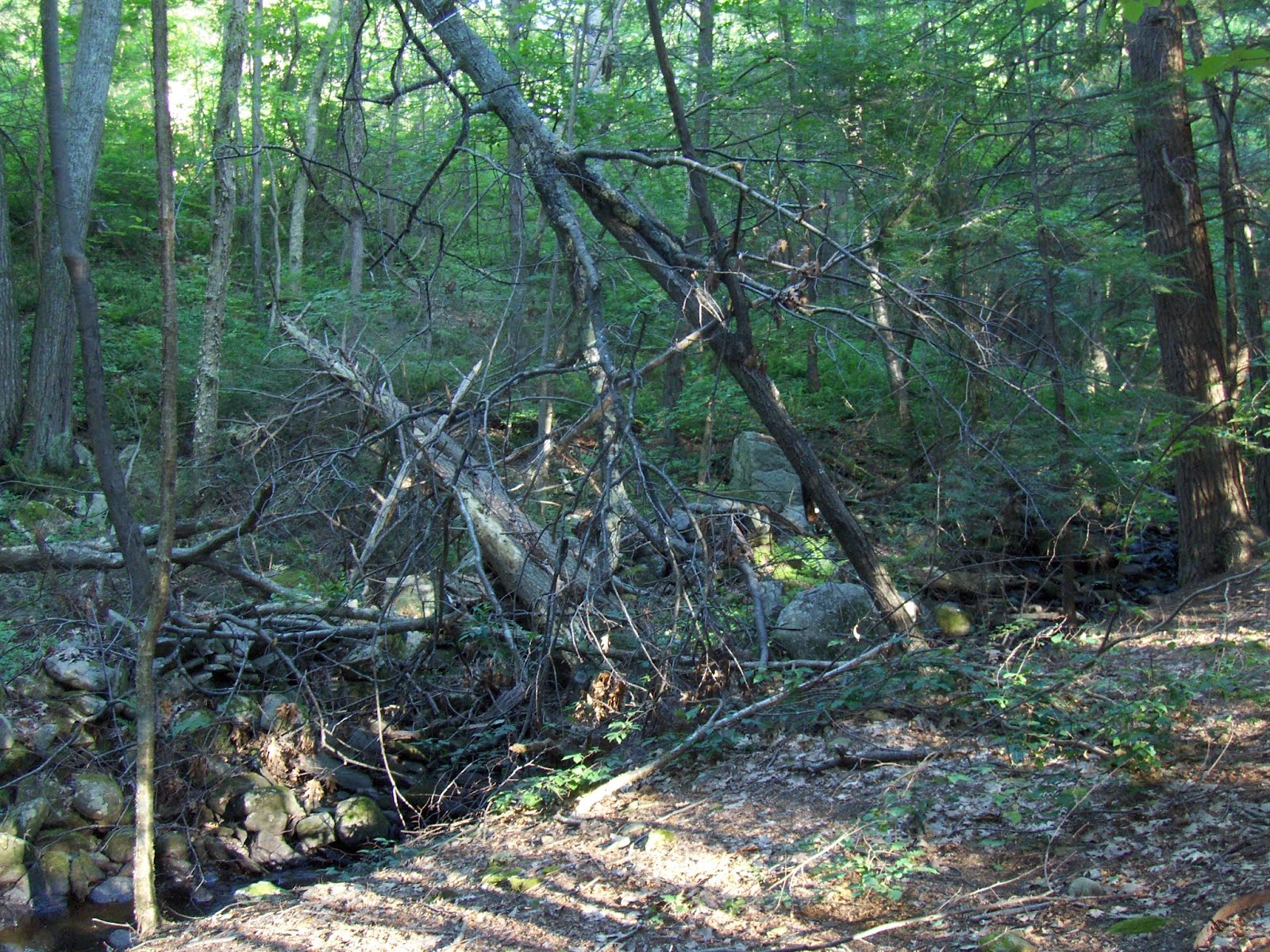
The site after the bobcat work. Note the damage to the tree.
Quartz stones before the damage. This is a crescent shaped pile about 15' long, from bottom to top.Pile of large quartz stones, each of which would probably require two people to carry or drag on a litter.A pile scattered, over time, or possibly by pot hunters.
Stones in the configuration of a wall about 25' long, left to right.

Sunday, July 15, 2012

Swan shaped rock from MO

Reader Shane I. writes:
I found this swan looking rock I believe to be from the paleo indians. I found it down the chariton river in n.e mo. I also found an arrow head nearby. Could use any kind of input.
I've been trying to research this swan looking rock and have heard a lot about it. There just seems to b no pics of anything as detailed and intricate. I believe this is an old paleo Indian artifact and have no reason to believe it to b a fake

Friday, July 13, 2012

Indian Rocks Park

Via Norman Muller:
Seeing your recent post in Rock Piles reminded me to send you these. These are from Indian Rocks Park that is located in the Big Canoe gated subdivision in north Georgia. There are 39 such stone piles that cross the "neck" of a large bowl shaped area where several springs in the bowl proper, gather and exit through the "neck" of the bowl. Typically,these piles are infilled with smaller stones that would be of little or no use for European type construction, therefore I consider their presence to be a marker for prehistoric constructions. Note that one of the piles has been recently damaged.I have nine such sites in north Georgia with this same configuration; the bowl, springs within the bowl, and stone piles crossing the "neck" of the bowl where water from the springs pass through. These sites are always at the headwaters of major streams in the area. Do you see anything like this up your way? If so, have you written anything on them, research, etc. Also, if you think it would help, please forward this to Peter if you think he may have info on this type of site.
Thanks so much, Tommy.

A couple of more photos. One is of the stream that exits the bowl shaped area, locally called a "hollow". The photo is looking north up into the bowl. Tommy

Wednesday, July 11, 2012

Indian Walls

Norman Muller writes:
When I visited Philip Smith, author of that important article on Indian stone walls in Georgia, last November, he loaned me a half dozen black and white 35mm negatives that he took when he researched the stone walls in the mid-1950s. One was taken at an unknown location and showed a large boulder imbedded in a wall and the other was of a couple of propped stones on top of a large and well-constructed wall Both reminded me of peculiar walls we find in New England. The first reminded me of the massive wall in Milford, PA, and the second of the wall in Westerly, RI
(image by Larry Harrop)
among many other examples.

Talk on Stone Chambers - Lyme NH

from the Neara message board and rubyduby:

Adair Mulligan is giving a talk at the Westmoreland Library at 6:30 on Thursday, July 26. She will talk about the work she has been doing with the Town of Lyme, NH cataloging cellar holes and tracking down their history. It should be interesting.

The Library is located at 33 South Village RoadWestmoreland NH. The link for the Westmoreland Public Library site is:http://www.westmore landnh.com/ html/library. html

Tuesday, July 10, 2012

Native Indian Burial Mounds - YouTube

Dennis D writes:
I believe it to be a Native-American ceremonial or perhaps burial site located in the Nipmuck Forest in NE Woodstock, CT.
http://www.youtube.com/watch?v=UFwPycm7xMk&feature=relmfu

Also, there is a map of the area I have included.

Stone Spiral on Martha's Vineyard

This Google Earth view of a Stone Spiral on Martha's Vineyard was sent to me from my friend Dave C:
Is it Modern? Is it Ancient? I can answer that very quickly: "I don't know."

A Bing View: http://binged.it/NdqDMh

And while I was posting the above, dc sent me this one below:

"Went to the highest point on the Vineyard, Peaked Hill, and found this BFR (big freaking rock), about 30 feet across." - dc. (A Split Boulder???)

Monday, July 09, 2012

Random Photo Posting

I got nothin. Back at work but not back to exploring on the weekends. Looking through old folders, I found a shot from Alpine Hill Fitchburg comparing the sizes of a mound and my windbreaker:Here is another from there:Or what about this, from Concord:

Friday, July 06, 2012

Flume Pond - another small Falmouth site

Part of the great Beebe Woods continuum, this new piece of "Falmouth 300 Committee" conservation land is over on the water side of Sippewisset Rd. I followed a path next to a stone wall. The wall looked particularly "Indian": forming acute angles, ending at boulders, bending and dipping into a wet place, low and single course.
After a moment there were rock piles next to the trail:And going off trail, there were about 10 or so. Some were damaged - cobbles scattered around a support boulder. Others were still in decent shape.
This was a pretty little white oak woods, next to a salt marsh and a fresh (?) water pond.
I suspect the reason for rock piles in these woods, is that the presence of fresh water ponds made this the best place to cross land between Buzzards Bay and Martha's Vineyard Sound. I would not want to take a canoe through the dangerous currents of Woods Hole.
What kind of site is this? It has a little bit of the feel of a marker pile site. I did not see quartz in use. There was one large boulder at the edge of the site. Very similar to the sites on the inland side of the road.
Nice of the "committee" to set aside this land and carve a path to the rock piles, directly though the bull briar.

Catacoonamug

I really just wanted to type the word "Catacoonamug". Located in a conservation land in western Lunenburg, this did not seem like a particularly auspicious place to hunt for rock piles. But a due respect for the opinions of man got me out to check. And it is a beautiful brook ravine.
But with not much in the way of rock piles. Somebody had an interesting meal down by the brook:

Tuesday, July 03, 2012

Last finds in June

Last week on Thursday I had some spare time after work and decided to go out searching for Indian artifacts. I went back to a sandy place I had searched earlier in the week, I had carefully scoured most of the place but there were a few small areas that I had not explored, and we had had some rain since my previous visit. The places I had not thoroughly searched were mostly low spots where I had not noticed a lot of chips and flakes from tool maintenance and manufacture, but given enough time I will search absolutely anywhere near where Indians might have lived, there is always the chance of a find. The first low spot I checked was really sandy, I saw this peeking out of the grassy earth.
Finds like this, as I have said, are so exciting. I feared that it would be broken but this time I was lucky again, it was amazing watching the triangular blade and tip emerge from the soil.
I think this might be what is called a Snook Kill projectile point, dating from the late Archaic. It appears to have been made mostly with percussion flaking. I think the material is hornfels. This is among my best finds ever. In a different spot I noticed this:
I was amazed to pick it up and find it to be a "Turkey Tail" point, my first like this. It is very thick and made of rhyolite or felsite. Here are all my finds from the evening, there are a couple of quartz arrowhead fragments, and a nicely made scraper made from a very fine material, also a few clay pipe pieces, from Colonial times.


Plants and Stones Blog

Saturday, June 30, 2012

Light Blogging for a while

I am taking a vacation from work and maybe from blogging.

Friday, June 29, 2012

Mysterious Structures Found in Syrian Desert

[click here] We find similar things here except it is never newsworthy.

Thursday, June 28, 2012

A short walk in Groton MA

Groton remains in the category of "always disappoints" towns but I did see something interesting as I was walking in their conservation land. I saw a slight pit in the earth next to a stone wall.There was one rock in the pit that did not look like it fell off the wall. I did not think too much of this until I turned to walk away, took a couple steps and saw another pit with a rock (left foreground):I have read in detective stories that when you dig a hole and refill it, it compactifies over time, to leave a depression in the soil. These pits are very good candidates for actual burials.

I continued my walk and was reminded that Groton was a place of recent quarrying. This may explain why it is hard to find ceremonial structures there. Here is some debris:
And at the foot of the slope, a cleat of some sort:And then I got lucky and saw those orchises:So, OK I am not disappointed with Groton's flowers.

Serpent Thoughts by Brad Lepper

Wednesday, June 27, 2012

Lots of time staring at the ground

     Friday evening there were heavy rains as summer thunderstorms passed through the area. When dawn came on Saturday there were no clouds in the sky and there was no doubt it was going to be a hot day but I got out in the morning anyway and spent some hours in the glaring sun, searching in a place where I knew the storm would have exposed something new. In many of the places where I look for arrowheads I see footprints of others who have been out there doing the same thing. It is impossible to find absolutely everything and the ground surface is always changing, things are always being exposed and obscured so I will look even in the footprints of others, but after a good storm I always try to be the first person in a likely spot, so I have the best chances of finding something.
     After a few minutes I saw this sticking out of the sand.
     Moments like these are the most exciting times when searching for arrowheads. This is definitely an artifact, probably the base of a stemmed arrowhead. The real thrill is in wondering what you will find when you pull this out of the dirt. It could be a whole arrowhead, it could be a drill, it could be 6 inches long and the find of a lifetime, or it could be just a broken fragment with hardly anything more than what you can see exposed. It could even be just a flake that happens to look just like a stemmed arrowhead base. As I bent down and picked it up I hoped and hoped that it would be a whole arrowhead, and this time I was lucky and it was. Here it is along with some other items I found on Sunday evening in the same place.

     This whole arrowhead in the middle is made of slate. I would call it "Neville-like." The stemmed base on the left is something really unusual, the stem is very square but it has broad and asymmetrical shoulders, this would have been a very unique-looking point. The material is hornfels. The arrowhead on the right is a Stark point made of red felsite, unfortunately it is broken and the tip is missing. I really like this one, it has nice flaking and it was fun to find late in the evening. In the cool air when the sun is going down and animals are active and the earth is covered with long shadows it seems somehow easier to imagine how things might have looked long ago when the Indians still lived on this spot, it is almost like time travel to find something like this in such a setting, and it seems for a moment like this tool was discarded just recently. The people who made these Stark points lived here for centuries but they have been gone for five thousand years.
     Here's another picture from Saturday morning. It was so hot out there in the sun I was afraid I was going to get heat stroke.
     This is a triangular quartz arrowhead. It looks like it might have been resharpened in ancient times. It's the one second from the right in this picture, these are the quartz arrowheads I have found in the last few days.
     The point on the left is interesting, it is very small and is what some collectors would call a "bird point." I am hesitant to assign this to any particular projectile point type because it is so small. Next to it is a Squibnocket Triangle, you can see that it gets narrow towards the tip and I suspect this example was used as a drill. In the middle is the base of a stemmed arrowhead, the tip is missing. This was the only thing I found worth showing in hours of searching last night. The stem has heavy grinding, I don't have any others like this. The point at far right was found early Sunday morning on the Rhode Island coast, the tip is missing. Some people speculate that narrow points like this may haver been used to spear fish.