Friday, March 22, 2013

Rocks-on-rock climbing out of a gully

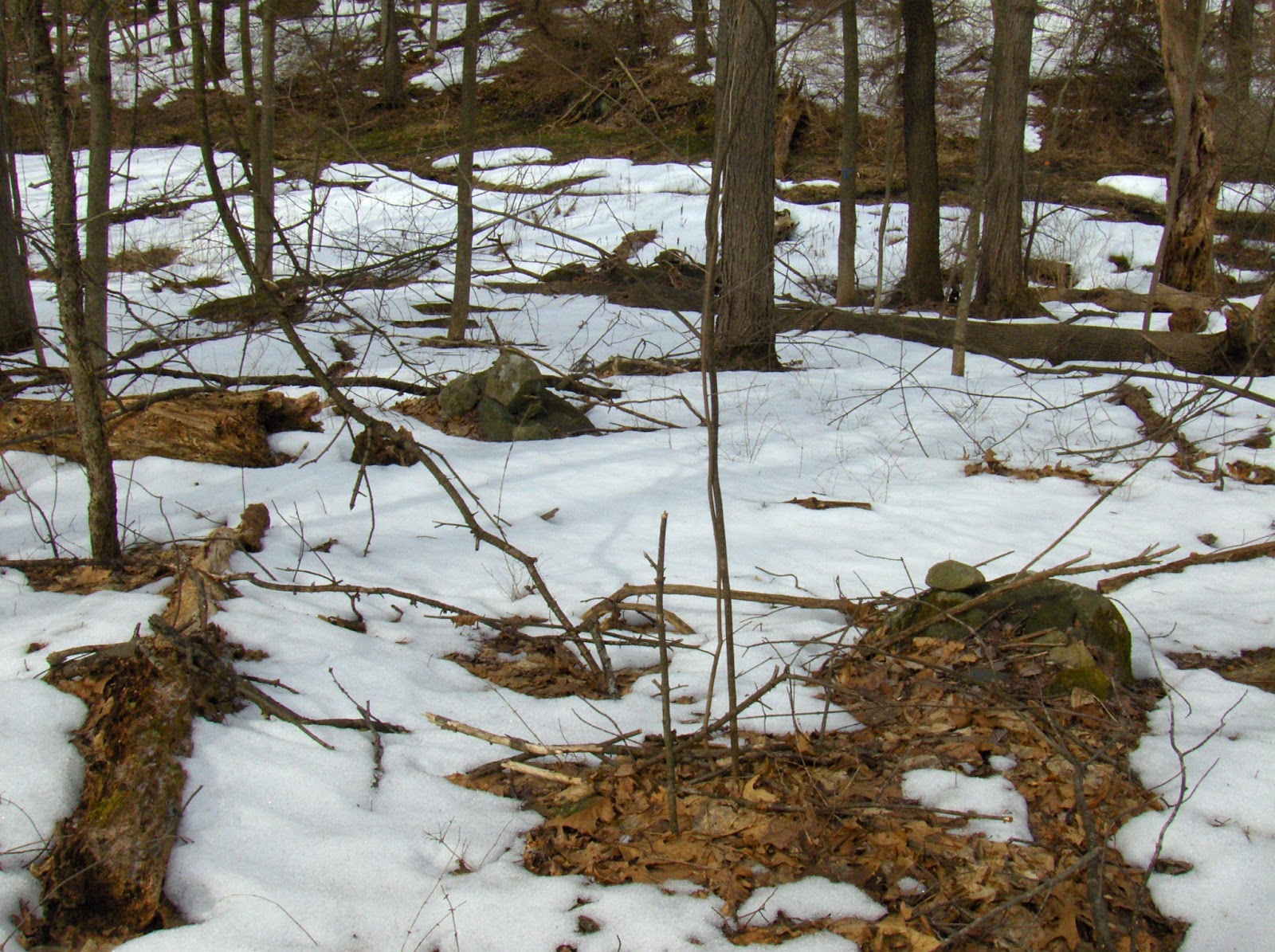
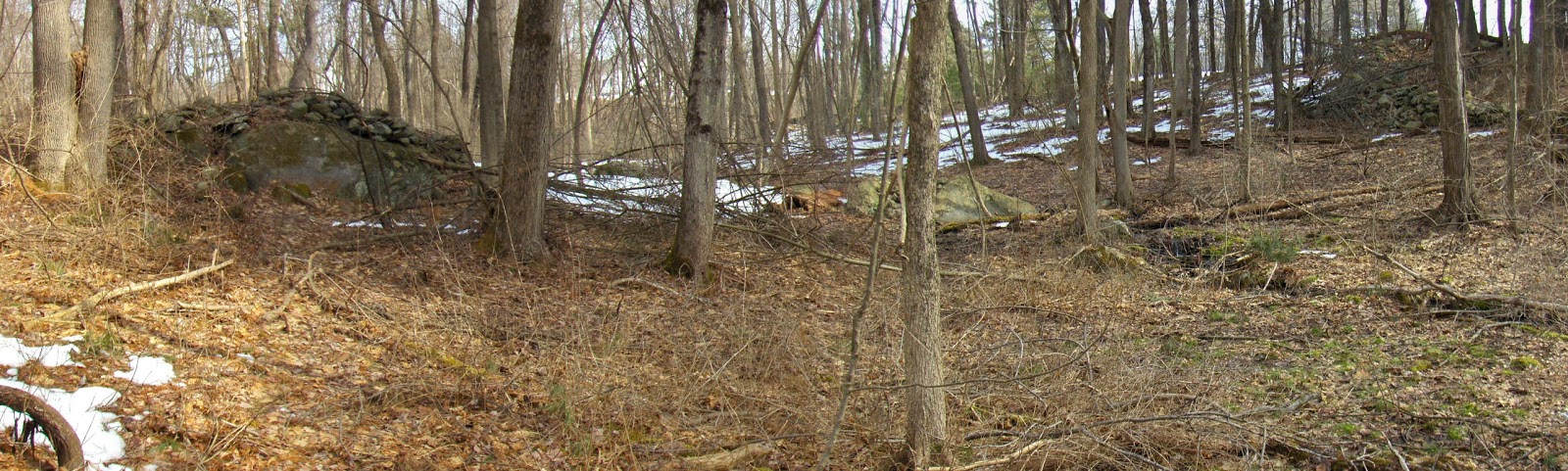
At the southern edge of Rocky Hill, north of Hycrest pond, the gully heading east has a bit of wall and a few seemingly random rock-on-rock structures a few feet higher on the slope. Not really a pattern but we've seen similar things recently.
Sorry for the bad picture. A closeup of one:

A small natural bowl with brook and mound - part 2

We climb up out of the bowl (see here) and find new rock piles above, even as we look back to the mound below:
Looking up the valley from here, there are more rock piles, across the wall and scattered across the slope.
When we walk over there, there seems to be an semi-organized arrangement trailing off downhill back towards the brook:
Take a closer look:
 This one is carefully shimmed.
(It mattered that this remained upright. Maybe because it is shaped like and animal?)
There was another old rock pile in a bush next to the brook, and the piles continued in the same sort of loose trail up the other side of the brook. 
 I commented that we remained within view of the large central mound the whole time and were, actually remaining a reasonably consistent distance from that mound. 
There were a few more rock piles along in this direction back on the side of the brook where we started. We were getting a bit tired and took quick pictures on the way out. 
A pile with quartz:
Most of the larger rocks and almost all of the boulders had piles built on them. Here is a last one:
On top was this interesting black rock:
A gray composite material, with a white feldspar tip:

Stone tool from Livingston County NY

Reader William Catlin sends this:

Thursday, March 21, 2013

A small natural bowl with brook and mound - part 1

I was invited to look at a site nearby and was shown a small valley, with a brook and a few features that are somewhat familiar: a lovely spot, a central mound with a hint of internal collapse, quartz, a split-wedged rock, and small outlier piles - somewhat evenly spaced, somewhat in lines. It was a very nice place and the question becomes: what should be done with this site? It was in a location which, I admit, is highly likely to be vandalized. So making it public is problematic.

We stepped from the suburbs into a hidden place:
The central feature was a large mound. The dog liked it and, at one point, seemed to be sniffing the pile. The dog spent most of the time standing on top:
I poked around, and noticed a small piece of quartz on top:
I was looking for a hollow, but only saw a faint hint of collapse:
My host, Sydney Blackwell, pointed out the "pointer" rock and how it was shimmed up:
A neighboring pile, next to the brook, was more of a split-filled rock but with the same kind of overhanging "pointer":
There were a few more damaged piles along the brook and, later, we found a few other small piles upstream.
The dog really liked that mound.
My sister in law Helen Jones is in the foreground. 
There was also a slab of rock propped up by a number of smaller rocks and dirt:
There was a nearby outcrop with a hint of outline/enclosure:
 
Lets take one more look before we climb up out of the valley:
The brook gurgled as it dropped a few inches over a little step, filling the valley with a quiet sound. Can you believe such a beautiful spot, right here in the suburbs?

I'll continue in another post [HERE]. If you have a moment, compare this site with another from Billerica I saw with FFC and he called "Beech Trees". Or this one from Boxborough - also described here. Or this one from Groton.

Wednesday, March 20, 2013

Return to the "Vee" (and other things around it)


Archaeological dig aims to save [destroy] Native American burial mounds

Does this from the Tennesseean make any sense?

These mounds have "long been known to historians". What is strange is that they are digging up a mound in order to "show that the grave is undisturbed", as part of getting National Historic listing. Some of the cognitive dissonance appears in this part:

To be eligible for the National Register, he said, an archaeological site has to have “research potential,” meaning scientists could dig into the mound and answer questions about how and why they were created.
It is illegal, however, to disturb a grave. Scientists also understand that once they’ve rooted through a historically significant site, they’ve destroyed it, Deter-Wolf said.
“For the same reason, you don’t go out and dig up Gettysburg,” he said. “It’s enough to know that it’s there.”

Got that? First destroy the grave, in order to determine its scientific potential, all the while doing something illegal. 
I don't have an answer to all of this but clearly there is a lack of logic to the topic. Also we darn well better show the research potential of rock pile sites without digging any up, to get into people's minds the idea that the artifact is the site, not the hidden "treasure" which, to be honest, they seem to be digging for in Tennessee.

Monday, March 18, 2013

Feedback from Fenn Fieldtrip


Appetizer

One is Good, Two is Better

I shared a location (or at least thought I did) using Google Earth just a little while ago, pin pointing the location of a "Vee" shaped stone row that I thought might be a Game Run that I imagine could have been used like this:
(But the one in the GE capture is "linear," as I've come to describe non-zigzag stone rows)
Then I took a second look as I "backed up" to get the big picture and then, as plain as the face on my nose, I realize that there is a second "Vee" right by the "bordered on both sides by a stone row Indian Trail that has become (a still unpaved) modern road," there are remnants of another trail right by yet another "Vee:"
So I modify the old drawing:
(a modifcation of a Kieth Wilbur modification...:)
(...of a DeVry interpertation of Champlain's drawing:)

Sunday, March 17, 2013

Quartz knife

     Yesterday I wanted to find a new place to look for Indian relics. A lot of open land isn't being used for much of anything this time of year, it can be a good time to knock on doors and ask permission to search private property that may be off limits at other times. My friend Dave identified a couple of likely places. On our way to the first spot we took a little detour to drive by a lake in an area where many stone tools were found long ago. Imagine our surprise to see a large area of exposed ground surface running right along a stream near where it flows into the lake! Such places are ideal for finding arrowheads. We searched it carefully but found not so much as a flake; perhaps development and the construction of a nearby road changed the appearance of this place since prehistoric times, or perhaps the people long ago simply preferred another area nearby, for whatever reason. We got back into the car and in the first place we wanted to search, there was no ground visible. The same was true in the next place as well, but a local guy we talked to told us of another place that he owned nearby, right on the river, that sounded just perfect. I raced there only to find that the swollen river has covered the area completely, it is under deep running water right now and I will come back to this place but there was no hope of finding anything there yesterday, certainly. With all my prospects exhausted I drove to a couple of favorite places but I have searched them so many times, there was just nothing left for me to find. It is disheartening to spend so much time looking, a whole day, and not find anything. The sky was pretty, though.
     Today I wanted to get out into the woods and look for stone vestiges of a different kind but a friend called and ask if we couldn't maybe go and look for arrowheads just for a little while, I reluctantly agreed and drove us to a favorite spot. It was cold and the wind was blowing right through my heavy jacket. We looked hard in an area where I have had some luck, but found only chips and flakes. We had just about given up when I decided to check one other spot where the conditions were not very good and where I haven't found very much in the past. I saw this:
    Usually when I see something like this it is just a flake but it could also be a fragment of a tool or even a nice arrowhead, there is no way to know until you pull it out of the ground. It's crude, it is very thick and chunky but it is a neat artifact and I am happy to have found it. It is about twice as thick as a typical projectile point in this size, and certainly does not look aerodynamic. I considered that maybe it could be a preform or an unfinished point that was discarded during manufacture. But the base, the hafting part with the weak shoulders, seems finished to me so I am calling it a knife.
     Here is the other side, cleaned up a bit.
     I didn't realize until I got home and put this with my other finds from this year but this material is much more gray and dark-colored than any other quartz point I have found. Smoky quartz, I would call it. Here it is compared to one I found earlier in the year, the common milky quartz material.
     There is no grinding on the stem on this one and I would call the shape Wading River, maybe 2,000-4,000 years old.

Cherokee Indian Grave

Saturday, March 16, 2013

Roger Williams' Indian Hothouses

via Syndey Blackwell:

Roger Williams excerpt:
“Pesuponck: An hothouse…This hothouse is a kind of little cell or cave, six or eight foot over, round, made on the side of a hill (commonly by some rivulet or brook.) Into this frequently the men enter after they have exceedingly heated it with store of wood, laid upon an heap of stones in the middle. When they have taken out the fire, the stones keep still a great heat. Ten, twelve, twenty, more or less, enter at once, stark naked, leaving their coats, small breeches (or aprons) at the door, with one to one to keep all. Here do they sit round these hot stones an hour or more, taking tobacco, discoursing, sweating together. Which sweating they use for two ends: to cleanse their skin; secondly, to purge their bodies, which doubtless is  a great means of preserving them and recovering them from diseases, especially from the French disease, which by sweating and some potions they perfectly and speedily cure. When they come forth (which is mater of admiration) I have seen them run,  summer and winter, into the brooks to cool them, without the least hurt.”
Roger Williams, Narragansett Bay, 1641 from
Indian New England, 1524-1674 A compendium of Eyewitness Accounts of Native American Life
Editor: Ronald Dale Karr, 1999

Rock Piles in New Brunswick

Reader Patricia Sullivan writes:

"...the rock piles out side. It is only two of them there is a lot more but could you look at it and maybe tell me what is it"