[Not rock pile related] This is new evidence that confirms humans in America before 20K years ago. Go early man!
Friday, October 06, 2023


Wednesday, October 04, 2023
Rock Pile Cave (CT)

“Then came the marvelous rock pile caves. As we don’t have
many real caves here in Connecticut, most of them are large rock formations
overhanging, though some have a few smaller spaces connected. Since I didn’t
get to see the cave two sections back, this would suffice. We had fun exploring
and taking pictures. Someone had made a little wall of rocks along the edge,
and built a fire ring. This spot would definitely protect you from bad weather
in a pinch and I said to the group that I was sure that native Americans met or
lived here like the nearby caves. Or at least sought shelter. I wouldn’t be
surprised if this wasn’t one of the legendary leatherman’s spots on his route.
I’ll have to look that up…”


https://happyonthetrails.wordpress.com/tag/rock-pile-cave/

Labelled as "The Rock Pile Cave" here:
Which also mentions a "found" piece of quahog shell:

“Laying on the trail maybe ten or twenty feet from the old
well was an old piece of wampum shell, perfectly round and obviously formed by
humans. I don't know what to make of it. Wampum has been used in jewelry for
hundreds of years, and continues to be used to this day. It was also used as an
alternate form of currency by colonists for a time, but since anyone could just
make their own wampum beads from shells (often poorly), they lost their value.
Normally there would be a hole drilled in the enter of a wampum bead so it
could be strung up. So what is this? Did it just fall off some hiker's jewelry
a few years ago? Or is it a relic? The location along the banks of the
Connecticut River adjacent to a hand-dug well gives me pause. Any thoughts?
There were no other shells around, just this one on the trail. It's quite
eroded, but was most definitely a round disc, about 3/4" diameter…”
(Apparently, I had seen something about Rock Pile Cave before:)
http://rockpiles.blogspot.com/2013/10/boulders-and-ledge-at-rock-pile-cave.html

Wednesday, September 27, 2023
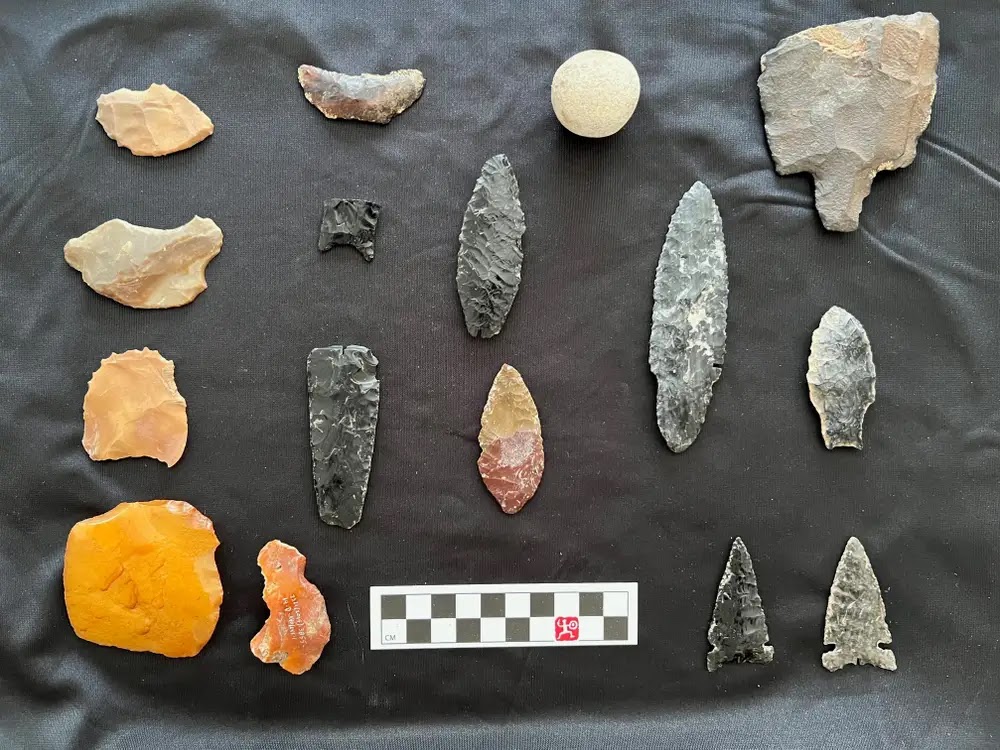
Stone tools older than 18000 years
More people are beginning to believe:
18,000-Year-Old Stone Tools Are Among the Oldest Found in the US (businessinsider.com)
Tuesday, September 26, 2023
Rock piles are not walls…
A recent email communication, addressed to me and possibly to the "Rock Piles" blog as well, although the "Wake up!" seems aimed at my blog "Waking Up On Turtle Island:"

I find that: “The
Mudfossil hypothesis is an observational science, 1st proposed by Roger Spurr
and now by many others. This theory holds that rocks and mountains resemble
petrified creatures and such resemblances are due to the fact they were living
at one time.
This constitutes
some evidence for us that many rock forms are composed of the fossilized
petrified remains of dead life forms and in the case of larger rock formations
and mountain faces, some of these life forms were enormous,” according to the
Amazon blurb for several related publications.“
I find that there’s
an Acedemia.edu page for this “Mudfossil Business,” but there’s not too much to
read but plenty to see on the YouTube, if one has an enormous amount time to waste
listening to the rather bizarre delusions put forth regarding the “Discovery of
ancient giant body parts (stones which) were tested and shown to be human. They
were DNA tested, CAT scanned and anatomist verified:”

Accused of being delusional myself, I find that "The distinction
between a delusion and a strongly held idea is sometimes difficult to make and
depends in part on the degree of conviction with which the belief is held
despite clear or reasonable contradictory evidence regarding its
veracity." Bortolotti, L. (7 June 2013). "Delusions in the DSM 5".
Imperfect Cognitions.


“A bizarre delusion, by contrast, is something that could
never happen in real life, such as being cloned by aliens or having your
thoughts broadcast on TV. A person who has such thoughts might be considered
delusional with bizarre-type delusions.” https://www.webmd.com/schizophrenia/delusional-disorder
Monday, September 25, 2023
The Wonders (Trodden by Golfers)

Sites in Ohio may be as vital to human history as the pyramids.
Why have they been ignored for so long?
BY DAN KOIS (SEPT 24, 2023):
“Among the most curious submissions was the United States’ proposal: a group of eight sites in southern Ohio featuring earthen mounds and walls, collectively called the Hopewell Ceremonial Earthworks. For nearly two decades, a mostly volunteer group of dedicated archaeologists, historians, and Native American tribal officials has been patiently making the case that these mysterious, not particularly photogenic piles of dirt are as culturally and historically significant as Stonehenge or the Colosseum. They’ve battled local opposition and national obscurity, and in some ways, the sites themselves, which are sprawling, sometimes heavily forested, and at several locations, plowed over by centuries of farmers. One is across the street from a federal prison. Another has been turned into a golf course…"


More: https://wakinguponturtleisland.blogspot.com/2023/09/the-wonders.html
Tuesday, September 19, 2023
Ancient Stone Mysteries of New England
A (virtual) library talk by Mike Luoma about his new book.
Ancient Stone Mysteries of New England (Virtual) | Southwick MA
Registration for Zoom, email to: southwicklibrary@comcast.net
Monday, September 04, 2023
Pikia'vish (and Paugussett)
“The first beginning of the rite (i.e., of the formulaic part) is at Imnanava'ram,
a rock pile just below the mouth of Clear creek where there is a riffle."

A KARUK WORLD RENEWAL CEREMONY AT PANAMINIK BY PHILIP
DRUCKER
“The entire ceremony, called ira'hip, or pikia'vish,
"to make again" (both names were used), was performed annually for
the purpose of ensuring plenty of food and freedom from sickness for the
ensuing year. The esoteric part was a sort-of perambulatory ritual, in which
the priest recited formulas and visited a number of sacred spots in the near-by
hills, one each day in a fixed sequence. The exoteric feature was the
performance of a white deerskin dance on the last two days and nights of the
ceremony by the people from Panaminik and adjacent towns. This dance was
actually given only every other year; on the alternate years there was a feast
given by the rich men of Panaminik. The dramatis personae of the ira'hip were: ikha'riara,
or fatawe'na, "first-spirit person," the priest who knew and
performed the esoteric rites; pishi'shikiya'- wun, the woman who cooked the
priest's single daily meal of dried salmon and acorn mush during the ritual;
several assistants to the priest, including two girls (kiya'wun) and a youth,
whose functions seem to have been omitted in the last few performances; and
last but by no means least, the rich men, who provided the objects of value for
display in the dance and food for the feasting. The role of priest could be
taken by any man belonging to Panaminik who knew the ritual. In the ceremonies
in which the informants took part it was customary for several men to relieve
one another as priest, each serving for two or three days, because the slim diet,
hill-climbing, and loss of sleep made the priest's role an arduous one…”
“On reaching the sacred spot, a small circular clearing in
the brush, the priest first had to clear away the year's accumulation of leaves
and twigs, after which he gathered a pile of wood. He laid some tinder on a
small flat stone, lighted it with his fire drill, then set stone and all under
the wood laid on the fireplace. While the fire burned, the priest sat on a flat
rock to one side, smoking his pipe. He did not pray at this time. After the
fire had died down (and he tried to time it so that he might return to the
sweat house by dusk), he removed from the embers the small stone on which the
tinder had been placed, throwing it on a pile of other stones which had been
used thus in previous years…”
“The first beginning of the rite (i.e., of the formulaic
part) is at Imnanava'ram, a rock pile just below the mouth of Clear creek where
there is a riffle. Here a beginning is made in July; the climax as described
seems to fall in August. The ceremony as a whole clearly centers about Inam, on
a flat on the s side of Clear creek, and it is to be assumed that in this town
stood the sweat house specially connected with the formulist's activities.”
January 10, 1936

Connecticut:

Sunday, August 27, 2023
Mike Luoma's book on Ancient Stone Mysteries
Congratulations to another author, writing about ceremonial stone landscapes:

Saturday, August 26, 2023
Indian Barns
I'm reasonably sure this is the foundation and not the "Indian Barns mentioned in the text:

“The Stephen Talkhouse Pharoah house was used by Pharoah later in his life. The house featured two “Indian barns” as food storage, and a footpath toward Bridgehampton on it’s edge.

The foundation remains today, but the house may have been a wood cabin during its use…The shallow pits to the north of the foundation, known locally as, “Indian barns,” were most likely covered with woven thatch and used for food storage…”
https://nativelongisland.com/listing/stephen-talkhouse-pharoah-house/
From the "Bulletin of the Massachusetts Archaeological Society," Vol. 23, Nos. 3 and 4 Massachusetts Archaeological Society (July 1962):
“These underground
barns have been opened or reported in modern times in such widely scattered
places as the Connecticut Valley of Massachusetts and Vermont, Ware River
Valley, Sudbury Valley, Plymouth County, South Woodstock, Connecticut, and
Kennebec Valley in Maine. Occasionally, the character of the contents is still
identifiable. Storage pits have been frequently referred to by early writers,
as may be seen by William Bradford's account: In November, 1620, just before
the Pilgrims landed at Plymouth, they ran into storages on Cape Cod, under
"heap's'of sand newly padled with their hands which they, digging up,
found in them diverce faire Indean baskets filled with corne, and in some
eares, faire and good, of diverce collours . . . a very goodly sight," for
which, at a later date the newcomers gave them "full satisfaction . . . to
their good contente."
Other early
commentators record the presence and use of earth storages on Long Island (very
numerous in 1642), in the Massachusetts Bay Colony, and in Southern Maine.
However, none have been recorded in Maine east of the Penobscot, (Burrage).
By what
characteristics would an archaeologist recognize such an Indian storage pit?
A number of early explorers and colonists have described
vividly such storages here in Massachusetts. The record of Champlain, on Cape
Cod, is admirably clear (1604): "They make trenches in the sand on the
slope of the hills, some five or six feet deep, more or less. Putting their
corn and other grains into large grass sacks, they throw them into these
trenches, and cover them with sand three or four feet above the surface of the
earth, taking it out as their needs require. In this way it is preserved as
well as it would be possible to do in our granaries."
Morton, in his New
England Canaan, adds details: "Their barns are holes made in the earth,
that will hold a Hogshead of corne a peece in them. In these, (when their corne
is out of the huske and well dried) they lay their store in greate baskets ...
with mats under, about the sides, and on the top; and putting it into the place
made for it, they cover it with earth."
John Winthrop, Jr.,
Governor of Connecticut (1657), mentions that their underground barns were
"well lined with withered Grass and with Matts" before being covered.
The contents, he observes, "Kept very well." Wood, in his New England
Prospect (1634) reports a slightly different practice: "Their corne being
ripe, they gather it and drying it harde in the sun conveigh it to their
barnes, which be great holes digged in the ground in the form of a brasse pot
seeled with the rinds" (bark) "of trees."

https://vc.bridgew.edu/cgi/viewcontent.cgi?article=1088&context=bmas
“Pre-contact basketry was intimately related to women's
subsistence and economic activities which centered on the production and
distribution of food, and it is this cultural feature that enabled women to
accumulate wealth and positions of cultural authority. The household/clan/com economy of the
pre-contact Algonquin coincided with the "Old Birch-bark Hunting
Culture" in which women were skilled experts in birch-bark technology.
Using birch bark, women erected quick and efficient shelters, made light-weight
waterproof utensils and covers for canoe frames (Butler and Hadlock 7). Few
original birch-bark articles have survived; however, colonial records describe
several uses of birch-bark construction that played significant economic roles
within women' s com and household economy. Because birch-bark is durable,
waterproof, odorless, tasteless and resistant to decay, it protects stored
items, such as food, from spoiling. "Equally important was the fact that
enough birch-bark for the Indian's needs was almost always just outside their
wigwams" (Butler and Hadlock 6-7). Birch-bark was symbiotic with Algonquin
women's com economy; for example, women used sheets of birch-bark to sun-dry
their com, they stored dried com in bushel size birch-bark baskets, and they
lined the underground walls of their "Indian
barns" (underground granary) with birch-bark…”
From Fishing Weirs to Fancy Baskets: How Changes in Native American Basketry Forms Reflect Changes in the Economic Independence of Native American Women during Colonization - Heidi J. Pickering (2010)
https://creativematter.skidmore.edu/cgi/viewcontent.cgi?article=1074&context=mals_stu_schol
From "Native Tech:"


Wednesday, August 23, 2023
Monday, August 21, 2023
A little rhyolite blade from Dennis MA
A pretty material. This is smoothed out from being in the water.


Wednesday, August 09, 2023
Perhaps my prettiest find - Raynham MA Arrowhead
Very lucky, I was inspecting every square inch and it payed off. It comes as a great surprise when you are actually looking at an arrowhead, after so many hours inspecting every square inch and not seeing anything. The shape is usually a surprise too. 

This is a bit like a stemmed Squibnocket point, a bit like a Stark Point. Here is a bit of video:
It is hard to put my finger on a feeling that I don't deserve to find such a beautiful thing. Where does the guilt come from - the feeling that someone will suddenly appear and take it back? As I drove home, crossing over the Bourne Bridge, thinking: well at least I got it back to Cape Cod.
Friday, August 04, 2023
Thursday, August 03, 2023
Blade from Sandwich MA
A bit crude but I am happy to find something there - at Scornton Creek and Rt 6A.


Sunday, July 30, 2023

Friday, July 14, 2023
Monday, July 10, 2023
A visit to the Robbins Museum - Home of the Massachusetts Archaeological Society.
Went to visit what is surely one of the great displays of arrowheads to be seen anywhere. I have complex thoughts about how most of museum's pieces rival my own best finds. And about mortality: The folks who collected those arrowheads are as gone as the people who made them. At the same time those beautiful points mean much less to me than my own finds. I am already forgetting the stories of how I found my own and, when they end up in the museum my sense of their beauty will be gone. Meanwhile, look at this!
.JPG)


Gregg Lott, VP of the MAS

Jake ...(could not catch the last name). President of MAS.

Knowledgeable guys, and friendly. Continuing:
These are said to be atlatl counterweights
.JPG) And here are a lot more:
And here are a lot more:.JPG)
.JPG)
.JPG)
.JPG)

.JPG) I think these displays are in very good taste.
I think these displays are in very good taste.
.JPG)
.JPG)
.JPG)
.JPG)
.JPG)
.JPG)
.JPG)
.JPG)
.JPG)
.JPG)
.JPG)
.JPG)

.JPG)
.JPG)
.JPG)
.JPG)
.JPG)
.JPG)
.JPG)
.JPG)
Wow.
Subscribe to:
Posts
(
Atom
)
