Sunday, February 03, 2019

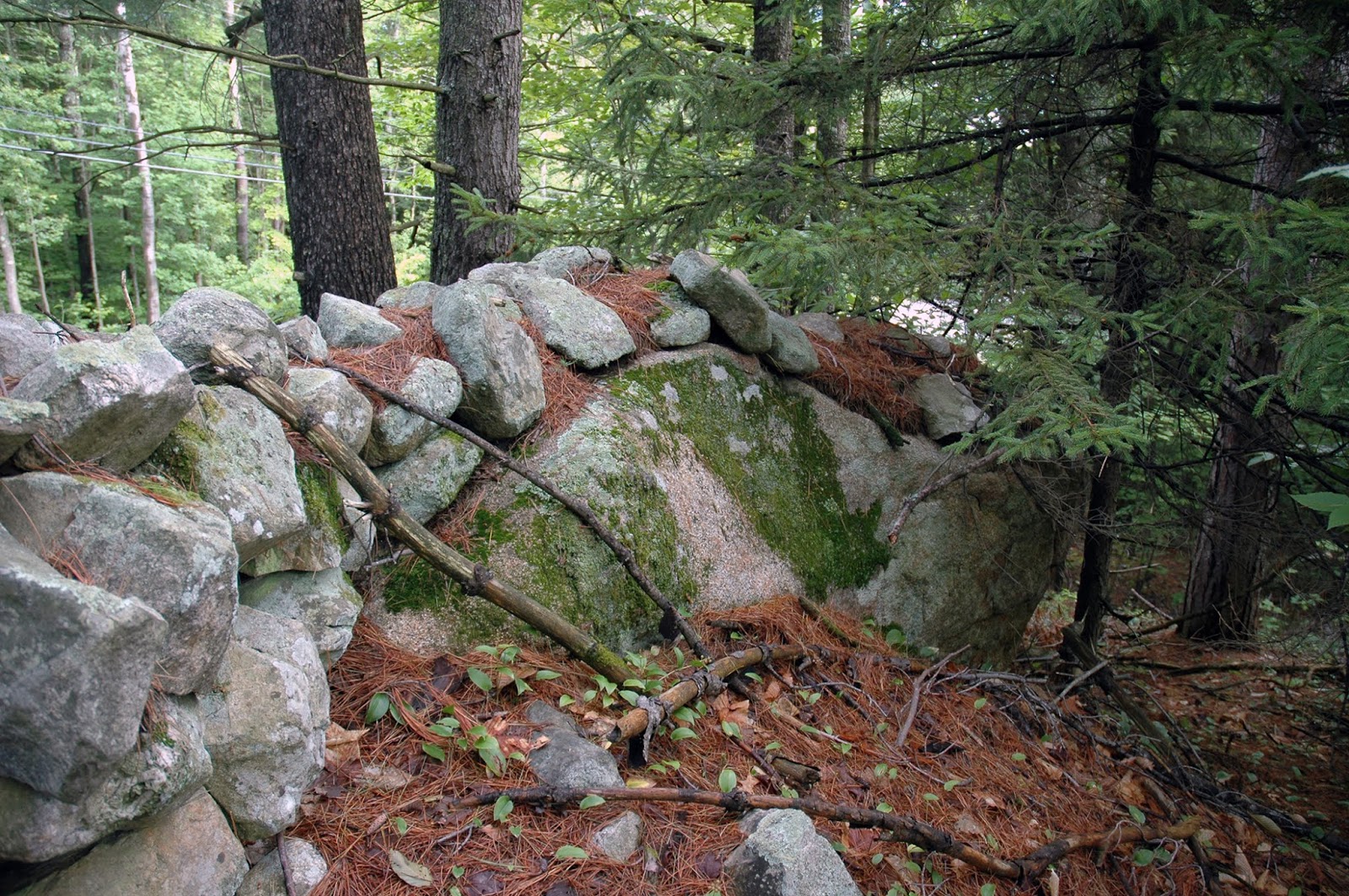
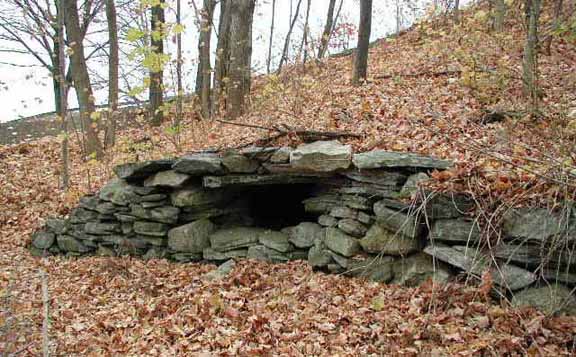
Vision Quest Structures (Saskatchewan)

 "Conceptually, the vision quest structure is a bed. (Joseph) Medicine Crow tells us that: The rows of stones or slabs of rocks, usually oblong-shaped, used by those “Going Without Water” were made not for comfort but as symbolic beds. The names for these structures, therefore, suggest this concept: “fasting bed,” “where someone has lain,” “where to dream,” and “where to have visions” are common examples (1992:81)."
      Quote from the Heart of the Crow Country: the Crow  Indians’ Own Stories
Used as a reference here:
https://www.academia.edu/38265432/Vision_Quest_Structures_in_the_Ethnographic_and_Archaeological_Record_With_Examples_from_Saskatchewan?email_work_card=view-paper

"Not all stone features associated with vision quests are related to fasting beds. In some cases, monuments, in the form of cairns, appear to have been constructed to commemorate vision quest events. Kroeber (1907:419) indicates that the creation of these monuments is “thecommon practice”. Similarly, Curtis (1909a:46) records an instance where the vision quest of a chief “was later marked by the people with a low mound, which is still rebuilt from time to time as it becomes worn away by wind and rain”. Despite these observations, additional references to monuments connected with vision quests do not appear to be common..."

Thursday, January 31, 2019

Harry Holstein Video

From Norman Muller:

I just received this video clip from Harry Holstein.  

Some CT Turtle LiDar

With Great Thanks to 

  Well now, this is a place we all have heard a little bit about, Buell Hill in Killingworth CT, that Turtle made of stacked stones, that one of these people in the photograph once confessed to me that he didn't know "how anybody could look at and not think it was intended to be a Turtle:"
Here it is again:
Tom Paul once drew a map of "stone walls" and a "Turtle Cairn"
and I once matched up a little bit of it, as best as I could,
 to an aerial photo superimposed over a topographic map that I lifted at caltopo.com :

The Lidar and Tom Paul's map,
matching up the features:

  So what else is on Buell Hill? Some interesting things perhaps:

Exactly where this is on Buell Hill, I'm unsure, but it is sort of interesting:

(Not the same "Stone Prayer" but a photo of another by Marjorie Theroux Tietjen:)
Undulating (vertically), an interesting row of stones:
Closer:
Closer still (and drawing in the eye isn't necessary):


Up on the outcrop:
Video Link:

Tuesday, January 29, 2019

Rock Piles in Holden

From Reader Conor B:

I came across a group of around a dozen small stone piles on a hill slope facing north. It is right next to a reservoir that would have been wet meadow in the past. In the 8th photo of the link you can see the top stone of one pile is quartz. https://photos.google.com/album/AF1QipN7g-4hLLNIYANmGMZaU7iwOuZX5RwQXFGQF140
[since link not working:]


Sunday, January 27, 2019

LiDAR survey of NH Walls

From Norman Muller:

I just posted a comment about a short wall segment in NH that is unrecorded by LiDAR.  Below are two photos: one of the split boulder and another of a portion of the wall.  Both features are immediately next to Route 16 in Ossipee, NH.

Saturday, January 26, 2019

A landscape unseen in over 40,000 years

[Not rock pile related]

Canadian arctic revealed by receding glaciers:
https://phys.org/news/2019-01-landscape-unseen-years.html

I hope archeologists are in a rush to get up there and confirm human presence [or not]. It is a great opportunity.

Wednesday, January 23, 2019

State Officials Turn to Crowdsourcing for Stone Wall Mapping Effort (NH)

  JAN 21, 2019
"The New Hampshire Department of Environmental Services has launched a new online crowdsourcing project with the goal of mapping every stone wall in the state...LiDAR reveals hills, rivers, ravines, and, as it turns out, stone walls. But there are more stone walls revealed in the LiDAR scans of New Hampshire than any one researcher or historian could hope to map. So DES is inviting you to help record the locations of the state's stone walls by looking through the online map for the telltale straight lines that cut across the otherwise curvy landscape..."
The LiDar for New Hampshire is available online
with the NH Stone Wall Mapper:


 I had to update this post from last year:

"Two houses being built there, but most of the stone works seem to be surviving!" Anna tells me...

NH Stone Wall Mapping Group 


Tuesday, January 22, 2019

"The Kite"

Qussukquanush (?)

   "Desert kites are constructions aimed at trapping game animals, found in the Middle East. The constructions are generally believed to have been used "to catch herds of wild ungulates." They appear in deserts and are most common in eastern Jordan; some also appear in the Negev Desert of Israel and Sinai Desert of Egypt."  Wikipedia

Thursday, January 17, 2019

genetics nonsense

[Not rock pile related]

I am going to quote a paragraph here, from
https://phys.org/news/2019-01-long-term-neandertal-dna-europeans.html

Over the past several years, multiple teams of researchers have conducted studies with the goal of learning more about what has happened with the Neandertal DNA that became mixed with human DNA approximately 45,000 years ago. Most have agreed that introduction of DNA from Neandertals underwent negative selection and thus has slowly diminished—at least in modern Europeans. In this new effort, the researchers have found evidence that suggests these earlier results were wrong, and that there is no evidence of negative selection. They further contend that the reason the other researchers got it wrong was because they made incorrect assumptions about between non-Africans (Europeans) and Africans.


Note that "most" researchers got it wrong because of "incorrect assumptions about gene flow...". You wonder, what kind of journals published this research that was largely confused about basic assumptions? Also how can the "evidence" of the earlier papers become the "no evidence" of the later paper? Suppose, for example, they were papers about the color of a flower; and rewrite the phrases. You have "most have agreed the flower was pink" and now there is "no evidence the flower is pink". Given these contradictions you have to ask: what kind of a standard for "evidence" exists in a subject that can do such a reversal?

The conclusion is that there is no such thing as "evidence" for DNA comparisons. Consequently [I will take this to the extreme], one should assume all genetic evidence related to Native Americans and peopling of the New World is suspect of being just an expression of "incorrect assumptions about gene flow" by researchers.

Don't get me wrong. There is certainly worthwhile science to do with genetic comparisons. The problem is that it is so easy to introduce bias. You would think the journals might have a clue about this.

Saturday, January 05, 2019

Different Mound Shapes and "Apalachia"

For those not put off by the "People of One Fire" point of view, you may find this interesting. It describes differences in origin for three different groups called "Apalachian". Each had different styles of mound.

https://peopleofonefire.com/footnote-there-were-three-distinct-ethnic-groups-called-apalache.html

Thursday, January 03, 2019

Rattlesnake Eye and Scales (PA)

"Hey, what's up with that one?" I asked John Martin a while back:
A day or two or three ago, he went back up to the "stone wall" to capture more images:
Of course I'm reminded of this:
Either some kind of great cosmic coincidence is going on or this is intentionally realistic and anatomically correct for the species:
He was thinking of that too because I'd sent him that - and this as well:
"Anyone can say it's a Big Snake," it's true,
 But now and again a Stone Structure says it too:
Added 01/04/2018
Same "Squamation" in a MA Chamber:

A few more examples:


Wednesday, January 02, 2019

Could this be a turtle?

Reader RC asks.

He writes:
I found your site when searching for information on prehistoric rock Cairns after reading a local history book that my wife gave me for Christmas.  I remembered having this stack of stones on my property.  I cut away some willows today and this is what I found. Interesting in that there are other stones on the ground around it and remnants of a stone wall about 25 feet away.  I would be curious what you think.  I am located in Otsego County, New York State. 

Monday, December 31, 2018

Year in Review - 2018

The year 2018 was slow, with fewer new sites than in the past. I am exploring less, the drives are getting longer, and I moved my base from Concord to the Cape. These days, I only explore on weekends when I make the drive back and forth.

New sites were reported from Georgia and South Carolina and, generally, public awareness has continued to expand, both at the state level and the town level. The Native Americans and Doug Harris have been rolling out aggressive outreach campaigns.


-- SITES --
Feb-March:
(near) Nod Brook Groton
Howard Brook in Northboro - some fine sites along the brooks of the "Fish and Wildlife" area, south of Mt Pisgah.

"Debunking Stone Wall Myths"
Excellent argument on "crazy" stone walls not being post-colonial
https://www.youtube.com/watch?v=55jQq9M0iiw

April:
South Justice Hill - the best and only large site I found this year.

There were several smaller sites in the valley between the hill and S. Princeton center:

June:
I start exploring to the south, in place like Foxboro and Stoughton:
July:
I explore southern Franklin State Forest:

Still further south at the edge of Wrentham: - mounds (still) have hollows:
September, more Wrentham [no more hollows]:
October:
I get a little miffed about the spread of fake history:

I start calling damaged mounds "Wrentham Pavements":
and
and (in November)
They seem to all be like this, from Wrentham on south. However, fresher mounds were still to be seen in that area.

December:
Finally, a major site is seen, shown to me by reader "bd" in Wrentham State Forest. It has many varieties of "mound-with-hollow", mostly of the mid-sized sort. From classic:
To multi-chambered:

Also, the kind of "pavement" I am have come to expect in this part of the state:
[or perhaps not? The typical "Wrentham" style is a pile spilling over the edge of a bluff, above a wetland.]

-- SITES OUSIDE NEW ENGLAND --

Cairns and Copper Mines: Drummond Wisconsin. http://rockpiles.blogspot.com/2018/04/outlook-cairn-drummond-wisconsin.html

Chatahoochee National Forest:
Pickens County, SC:

http://rockpiles.blogspot.com/2018/12/from-reader-dg-i-thought-you-might-find.html

Some links:
Finger Lakes area of NY 
A Wall Site in Bartow Co., GA
Poconos Rock Piles 
Another Stone Complex (GA) 
Rock Piles on a Farm in Saskatchewan 
Ontario "Megaliths" 
Mounds with hollows - headwaters of the Susquehan... 
ALEC MOUNTAIN STONE CIRCLE – NACOOCHEE VALLEY 
Negwegon Stone Piles - Michigan 

-- PUBLIC AWARENESS --

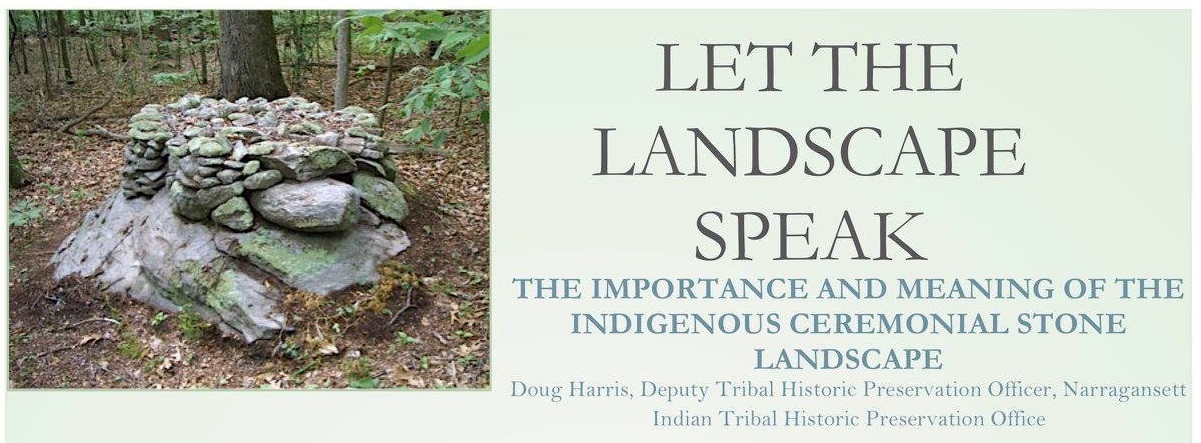
"Let the Landscape Speak:"

Doug Harris's schedule gets filled: