
Thursday, May 24, 2007


More BHill piles
Here are some interesting shaped piles. This first one is a familiar shape. I think there was something similar at the pig skull site. 
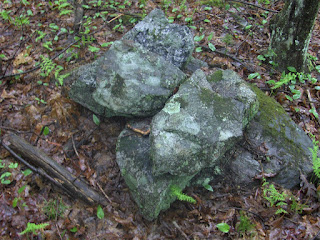 Tim M. asked about the second pile in the video and I do have other pictures of it but there must have been moisture on the lense:
  Here is a detail of the end of the pile:
  It is worth mentioning that this pile is at the same location as the small line of rocks that turned out to be more like an outline, the other day. This one:
 And this:


 Tim M. asked about the second pile in the video and I do have other pictures of it but there must have been moisture on the lense:
  Here is a detail of the end of the pile:
  It is worth mentioning that this pile is at the same location as the small line of rocks that turned out to be more like an outline, the other day. This one:
 And this:
Wednesday, May 23, 2007
Tuesday, May 22, 2007
All the springs on the hill
 I swear, every place where a brook was starting with water coming out of the ground on this hill, there were rock piles. Here are some from the location marked "A":
 This last example is something I think has a very particular meaning. I notice the special shape which is common to both rocks. Note also that the smaller one is in reversed position relative to the larger one. Read a more extended discussion here of this type of pile, which I call "Twins". This is a pretty nice example. I walked up the valley above "A" and kept finding more piles, then I circled around the east side, filmed a porcupine, climbed the hill and explored the hilltop. Everywhere there was water, there were rock piles. I have videos and other pics.
As I climbed up the valley above "A" I continued coming across isolated piles here and there along the water course. The piles became more distinct and more massive. I think these two are about the best examples; they were in a "final" upper valley above which I saw no further rock piles.

 I started the day making little videos - too numerous and time consuming to post - about how I was venturing out into the unknown, not knowing what I would find. Starting with the drive north, continuing with the brook outflow into the pond west of "A". I then continued uphill and around to "B" and "C" shooting little videos of each discovery as it came up. Perhaps we have time for the first brook video?
Higher on the hill, at one of the other springs, were a couple of structures, a split wedged rock, a little line of rocks:

 I am lucky to live in a place where I can see new sites like this every weekend. But then I really wonder if there are not things like this everywhere, so it is not luck so much as simply going out to look. For what it is worth, we have a once in history opportunity right now to go out and find these places. This walk was very pleasant. It was sopping wet but it did not matter. There was a Great Horned Owl at this first site ("A") and a Porcupine on the east side of the hill. And then I kept coming across tumbled rocks and wondering if they used to be a rock piles before seeing other piles in better condition.

Rock piles and Indian Graves
Try "search this blog" with the word 'cemetery' and you get a number of results worth reviewing in the context of the N.Smithfield discussion.
For example this [Click here] from West Virginia (seems relevant)
And this [Click here] from Westford Mass (definately relevant).
I remember something also from Michigan (Keweena) but cannot locate it.
For example this [Click here] from West Virginia (seems relevant)
And this [Click here] from Westford Mass (definately relevant).
I remember something also from Michigan (Keweena) but cannot locate it.
Lots more articles about North Smithfield and Wilfred Greene
[Click here]
The Nipsachuck story grows.
And James Gage writes in:
FYI - New article from today Tuesday May 22 -
[Click here]
James Gage
P.S. Lauren Cook - It is my understanding it is "Mr." Cook [My apologies for the gender confusion - pwax]
The Nipsachuck story grows.
And James Gage writes in:
FYI - New article from today Tuesday May 22 -
[Click here]
James Gage
P.S. Lauren Cook - It is my understanding it is "Mr." Cook [My apologies for the gender confusion - pwax]
Monday, May 21, 2007
Stone seat
This is somewhat damaged but still a magnificent construction. It was on a little ridge overlooking the beginning of water flow from a hill. But the opening of the seat was uphill. Here is a view of the opening:
 And here is a view from the other side:
 I would like to get some of the archeologists to explain what this could possibly have to do with field clearing. The study of rock piles begins with the observation that there are other types of piles besides field clearing ones. For example ones like this with structure and made of lburnt ledgerock.
 And here is a view from the other side:
 I would like to get some of the archeologists to explain what this could possibly have to do with field clearing. The study of rock piles begins with the observation that there are other types of piles besides field clearing ones. For example ones like this with structure and made of lburnt ledgerock.
The pagans got here first
 Note the red bows and straw decorations in the pine tree. This pile has been "found" by someone with some whimsey. It is along a conservation land trail in Carlisle.
A little structure in the wall - from FFC in Carlisle, MA
Friend from Carlisle (FFC) pointed out this little symmetric structure in the stone wall at a conservation land in Carlisle:


Academic Thinking re North Smithfield - from the ASNJ bulletin board
Norman Muller forwarded this comment. Unlike some comments by people who know nothing about archeology and nothing about rock piles, this opinion at least has the benefit of being informed with real information At the bottom, I added some personal comments.
I looked at a similar site in Freetown, Mass., about 20 years ago, and about 30 miles from North Smithfield. My feeling was that someone started clearing a field or pasture and then changed their mind. All of the piles were about a convenient wagon-load in size, and were on soil that was naturally very stony. At that one, there were some folks who claimed that the whole thing represented Bronze-Age astronomical alignments, and a Sioux who thought they were burials.
Piles of stones don't characterize archaeologically recovered Native American burial sites in Rhode Island. Period. Not at West Ferry in Jamestown (dug by William Simmons), not at RI 1000 in North Kingstown (dug by Paul Robinson, among others), and not at Burr's Hill in Warren, salvaged by on-the-ball amateurs in the early 20th century. When I did a statewide survey of Rhode Island's 75 known native cemeteries and burial finds in the early 1980s, stone piles did not characterize any of them, from any period. Historic cemeteries, even those dating to the 17th and early 18th centuries, had small, unmarked stones, with carved stones appearing on some sites in the 19th century. Some recent graves had decorative stone borders, but that was it.
There is some ethnographic evidence that cairns could build up over time at culturally significant sites along trails, as travellers added stones, but as I recall, nothing specifically linking them to burials, never mind fields of burials.
North Smithfield was historically between the Narraganset to the south and the Nipmuck to the north, while the Wampanoag (or Pokanoket, as many prefer to be called) were further east, east of Narragansett Bay. As documented consultation with native groups is a required part of the review process up there, at least the Narragansett will have the opportunity to comment.
Lauren Cook
PWAX Comment:
I tend to agree with Ms. Cook that cairns are not burials however she is incorrect that they could not be memorials. On the one hand, the idea of a donation pile is well documented, for example at Monument Mountain in Mass. On the other hand, there is a growing body of evidence and personal communications with the Native American community indicating that cairns or some other similar marker (eg rock-on-rock and cedar) would have been placed where a person died in battle. Further substantiation of that idea can be examined physically by anyone who explores "King Philips Woods" in Sudbury, MA. While we are waiting for academic archeologists to catch up with the facts, on the ground we can discuss why they have been so systematically confused about these topics in the past.
PWAX Comment #2:
To try to put my finger on what is wrong with Ms. Cook's statements, here is one problem: the burials that she excavated are very probably from the mid-Archaic, namely 3-5K years ago. Rock piles are a modern, possibly historic period only, phenonemon. There is no connection with what was happening 4K years ago. Ms. Cook should not be so sloppy as to dismiss a modern phenomenon because of its lack of connection with burials from such a distant past. Taking some of her other points: the cartload sized piles may be true in some cases but so what? This is pretty un-systematic information. Also we all know there are field clearing piles. The point is that there are also some others that are not (no field, non-glacial ledge-rock, well built, structured sites, etc...). There are thousands of pictures on this blog [I think there are probably that many] with small piles and with very large ones. For sure, some are intermediate sized. Finally, I keep seeing people referring disdainfully to Bronze-Age visitors from Europe. Academics like to tar people with one simple-minded brush but they are not real scientists when they consider such topics as relevant. If they want to be scientists, they need to go look at all of the data, not a selective sub-set of it, and give up the idea that attacking a person is a valid form of scientific discourse.
I looked at a similar site in Freetown, Mass., about 20 years ago, and about 30 miles from North Smithfield. My feeling was that someone started clearing a field or pasture and then changed their mind. All of the piles were about a convenient wagon-load in size, and were on soil that was naturally very stony. At that one, there were some folks who claimed that the whole thing represented Bronze-Age astronomical alignments, and a Sioux who thought they were burials.
Piles of stones don't characterize archaeologically recovered Native American burial sites in Rhode Island. Period. Not at West Ferry in Jamestown (dug by William Simmons), not at RI 1000 in North Kingstown (dug by Paul Robinson, among others), and not at Burr's Hill in Warren, salvaged by on-the-ball amateurs in the early 20th century. When I did a statewide survey of Rhode Island's 75 known native cemeteries and burial finds in the early 1980s, stone piles did not characterize any of them, from any period. Historic cemeteries, even those dating to the 17th and early 18th centuries, had small, unmarked stones, with carved stones appearing on some sites in the 19th century. Some recent graves had decorative stone borders, but that was it.
There is some ethnographic evidence that cairns could build up over time at culturally significant sites along trails, as travellers added stones, but as I recall, nothing specifically linking them to burials, never mind fields of burials.
North Smithfield was historically between the Narraganset to the south and the Nipmuck to the north, while the Wampanoag (or Pokanoket, as many prefer to be called) were further east, east of Narragansett Bay. As documented consultation with native groups is a required part of the review process up there, at least the Narragansett will have the opportunity to comment.
Lauren Cook
PWAX Comment:
I tend to agree with Ms. Cook that cairns are not burials however she is incorrect that they could not be memorials. On the one hand, the idea of a donation pile is well documented, for example at Monument Mountain in Mass. On the other hand, there is a growing body of evidence and personal communications with the Native American community indicating that cairns or some other similar marker (eg rock-on-rock and cedar) would have been placed where a person died in battle. Further substantiation of that idea can be examined physically by anyone who explores "King Philips Woods" in Sudbury, MA. While we are waiting for academic archeologists to catch up with the facts, on the ground we can discuss why they have been so systematically confused about these topics in the past.
PWAX Comment #2:
To try to put my finger on what is wrong with Ms. Cook's statements, here is one problem: the burials that she excavated are very probably from the mid-Archaic, namely 3-5K years ago. Rock piles are a modern, possibly historic period only, phenonemon. There is no connection with what was happening 4K years ago. Ms. Cook should not be so sloppy as to dismiss a modern phenomenon because of its lack of connection with burials from such a distant past. Taking some of her other points: the cartload sized piles may be true in some cases but so what? This is pretty un-systematic information. Also we all know there are field clearing piles. The point is that there are also some others that are not (no field, non-glacial ledge-rock, well built, structured sites, etc...). There are thousands of pictures on this blog [I think there are probably that many] with small piles and with very large ones. For sure, some are intermediate sized. Finally, I keep seeing people referring disdainfully to Bronze-Age visitors from Europe. Academics like to tar people with one simple-minded brush but they are not real scientists when they consider such topics as relevant. If they want to be scientists, they need to go look at all of the data, not a selective sub-set of it, and give up the idea that attacking a person is a valid form of scientific discourse.
Sunday, May 20, 2007


Saturday, May 19, 2007
Short stretches of stone wall
Spaulding Hill in northern Westford has a number of interesting features, for example these short stretches of stone wall:


More Nipsachuck - letter to the editor
I must respond to the April 25 letter by Pete Carlson "Just piles of rocks" and the May 4 letter by Mike Martel "Not very much science in this archaeological fishing expedition."
PAUL H. SOARES
The writer is the vice chairman of the North Smithfield Conservation Commission.
ANCIENT RHODE ISLAND BURIAL SITE THREATENED Seaconke Wampanoag Tribe moves to World Stage
( North Smithfield , Rhode Island , USA ) Reuters News Service reported today that development threatens the future of Rock Piles estimated by archaeologist and URI Professor Frederick Meli as spanning at least 230 acres (93 hectares) and has both North Smithfield officials and that state's longest recognized Indian tribe concerned.
The Seaconke Wampanoag tribe claims the piles are a war memorial and sacred burial place kept hidden for centuries. The tribe claims it is as important to them as Arlington National Cemetery is to the United States .
Historians, state officials, private developers and tribal leaders in Rhode Island agree that Nipsachuck woods in North Smithfield is culturally and historically significant. Despite this historic significance, Narragansett Improvement Co. has said they will press on with plans to build a 122-lot housing project over 200 acres (80-hectares) in the area near the Massachusetts border.
The company claims their hired archaeologist studied the stones and concluded they were likely left in piles by early European settlers who built a network of stone walls in the area. "I don't believe any of these Indian artifacts are on my land," Reuters reports company president John Everson as saying. "The whole area is very stony."
The Seaconke Wampanoag historian has advised since the story broke that the deed for that land contained specific covenants limiting its use to grazing cattle and is specific that houses not be built on it. It also stated that any Indians remaining on that land were required by that deed of sale to wall up their fields from the English cattle. “Those covenants regarding development were in place for a reason, and now you know why,” the historian said citing the deed recorded at RI Colony Records 1, 33. "Any title researcher can verify this restriction," he said.
The Reuters Story by Jason Szep is at:
[Click here]
Reuters Photos by Brian Snyder are at:
[Click here]
The Seaconke Wampanoag tribe claims the piles are a war memorial and sacred burial place kept hidden for centuries. The tribe claims it is as important to them as Arlington National Cemetery is to the United States .
Historians, state officials, private developers and tribal leaders in Rhode Island agree that Nipsachuck woods in North Smithfield is culturally and historically significant. Despite this historic significance, Narragansett Improvement Co. has said they will press on with plans to build a 122-lot housing project over 200 acres (80-hectares) in the area near the Massachusetts border.
The company claims their hired archaeologist studied the stones and concluded they were likely left in piles by early European settlers who built a network of stone walls in the area. "I don't believe any of these Indian artifacts are on my land," Reuters reports company president John Everson as saying. "The whole area is very stony."
The Seaconke Wampanoag historian has advised since the story broke that the deed for that land contained specific covenants limiting its use to grazing cattle and is specific that houses not be built on it. It also stated that any Indians remaining on that land were required by that deed of sale to wall up their fields from the English cattle. “Those covenants regarding development were in place for a reason, and now you know why,” the historian said citing the deed recorded at RI Colony Records 1, 33. "Any title researcher can verify this restriction," he said.
The Reuters Story by Jason Szep is at:
[Click here]
Reuters Photos by Brian Snyder are at:
[Click here]
Reuters Picks Up Nipsachuk Story
by JimP "Piles of rocks spark an American Indian mystery" by Jason Szep for Reuters.
[CLICK HERE] to read the article on Yahoo! News.
If the quotes in that article are accurate, I'm surprised by Paul Robinson's non-committal and I take back anything good I ever said about William S. Simmons. Dr. Fred Meli is in a class by himself and I applaud him.

Seaconke Wampanoag Chief Wilfred Greene stands next to a mound of rocks that local tribal leaders and historians say mark a historic Indian burial ground in the woods in North Smithfield, Rhode Island May 16, 2007.
(PHOTO: Brian Snyder/Reuters)
[CLICK HERE] to read the article on Yahoo! News.
If the quotes in that article are accurate, I'm surprised by Paul Robinson's non-committal and I take back anything good I ever said about William S. Simmons. Dr. Fred Meli is in a class by himself and I applaud him.
Thursday, May 17, 2007
More on the grammar of black and white pairs
Except that the last time I discussed this I was talking about red and white pairs [Click here], I came across a similar phenomenon at a site in Carlisle, walking with FFC. There are about fify rock piles along a slight slope facing south over a wetland. Besides piles there were some other impressive features:
 There were piles with deliberate vertical "fins":
 And piles with what looked like deliberate white rocks:
 And piles with deliberate black rocks:
 Maybe it is a stretch but these features are similar to what I was seeing at that site with the "grammar of brown and white stones" [Click here] and I am inclined to start keeping an eye out for other sites with this kind of deliberate white rocks, black (or brown) rocks , and vertical fins.
Besides piles like that there were also some effigy-like piles.
 There were piles with deliberate vertical "fins":
 And piles with what looked like deliberate white rocks:
 And piles with deliberate black rocks:
 Maybe it is a stretch but these features are similar to what I was seeing at that site with the "grammar of brown and white stones" [Click here] and I am inclined to start keeping an eye out for other sites with this kind of deliberate white rocks, black (or brown) rocks , and vertical fins.
 Besides piles like that there were also some effigy-like piles.
Subscribe to:
Posts
(
Atom
)