Sunday, October 29, 2023

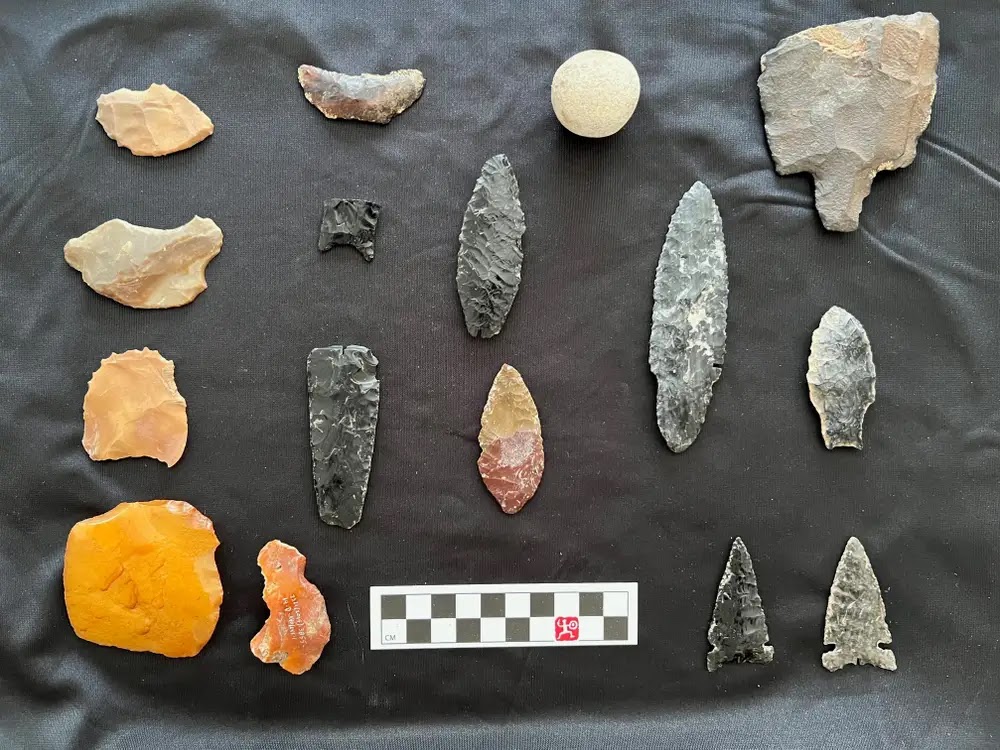
Rhode Island Arrowheads - "Cumberland/Barnes phase"

Josh in Rhode Island sends this:

Over the last four years I have found some really rare and unique treasures at the beach including points from the cumberland/barnes phase and earlier (el joboid).  The site is on private property (where I have permission to be looking) with multiple occupations and also produces many side notched hardaway daltons.  I have found many artifacts made from shells as well including the photo I sent of a 1 inch paleo type point that slightly twists and has a notch on one side only.


[This is a quahog shell- a wampum arrowheaad]


Thursday, October 19, 2023

Heard there were arrowheads at Waquoit

I can believe it. But I think the nice ones must be all gone.
This material is argillite.

Saturday, October 14, 2023

Decoding the Stones: Mike Luoma on New England's Hidden History


  “In this episode, Mike Luoma shares his journey of discovery, visiting possible sacred stone sites and trying to unravel their meanings and histories. Whether you've stumbled upon mysterious stonework yourself or are just curious about the hidden history of New England, this book and our conversation with Mike offer eye-opening insights…”

https://youtu.be/j6kiO_HopqQ?si=hMg653IVo2Q5SRyB

Tuesday, October 10, 2023

News from the Friends of the Nashoba Praying Indians

 Friends of the Nashobah Praying Indians: Bulkeley Farm Native structures update


Dear Friends of the Nashobah Praying Indians,


Friends of the Nashobah member Lyle Webster is offering 36 acres of his family land to Littleton for purchase as open space conservation land.  The acquisition will come up for vote on the 11-1-23 Littleton town meeting. 


The land is part of the Bulkeley Farm which was founded circa 1700 and is one of the oldest farms in Littleton.  And just as significantly the property has a number of stone structures that have been assessed as Native ceremonial stone constructions by myself, Strong Bear, and experts James & Mary Gage, and Kimberley Conners. 


A town purchase of the land for conservation use would among other things preserve these Native structures.  If you are a resident of Littleton, please support this acquisition with your vote at town meeting November 1st


Lyle is giving tours of the property, including some of the structures.  These will be held on Saturdays and Sundays at 1:00 – 3:00pm, through October.  The tours are 45 minutes long. 


If you would like a tour of this promising conservation property, please contact Lyle at lylewebster@verizon.net.


I have walked the Bulkeley Farm many times with Lyle and it is always a pleasure.  I hope the town acquires it. 


Lyle – if there is anything I missed, or needs to be added to this email, please ‘reply all’ with your additions / corrections. 


On a historical note, during King Philip’s War in 1675-76, Concord was only lightly defended.  However, Metacomet’s warriors never attacked it.  It was learned afterwards that this was because Peter Bulkeley lived there, and Metacomet – who thought highly of Peter as a highly spiritual person – would not attack a town where Peter lived. 


Quick update – the next FoNPI event is a book signing at Orchard House, tentatively scheduled for November.  Updates to follow as details become available.


Best wishes,


Dan

Monday, October 09, 2023

Our Hidden Landscapes: Indigenous Stone Ceremonial Sites in Southern New England


Our Hidden Landscapes: Indigenous Stone Ceremonial Sites in Southern New England

by Dr. Lucianne Lavin

Thursday, October 26, 2023

Harwinton Town Hall

100 Bentley Dr.

Harwinton, CT

Doors open at 6:30 pm

Presentation begins at 7:00 pm

Pre registration requested at this link.

Directions at this link.

Sponsored by the Harwinton and Burlington Land Trusts

​“A hike in the woods often reveals a variety of built stone cultural features. Many of these are the remains of abandoned farmsteads and industrial mill sites. Others, however, represent Native American ceremonial sites. The idea of Native Americans designing stone structures that represent sacred landscapes is fairly new to some Northeastern researchers, as it was historically – and erroneously -- thought that local Indigenous peoples did not build in stone and all such structures were the result of European-American farming activities. Some of it is, but some of it is not. 

​This PowerPoint presentation (and the recently published book on which it is based) introduces people to Southern New England’s Indigenous Ceremonial Stone Landscapes (CSLs) – sacred spaces whose principal identifying characteristics are stacked stone structures that cluster within specific physical landscapes. They are often unrecognized as the significant cultural landscapes they are, in dire need of protection and preservation.

​State regulations (in Connecticut, at least) support preservation of sacred Native American sites (that is, those sites of ritual significance), and so it is important for members of land trusts and conservation organizations, as well as private property owners, to be able to recognize these sites within their properties and work to preserve them.”


A visit to the Aptuxet Trading Post - Bourne MA

A messy and poor display. Still....

First shelf:


2nd shelf, lots of shadowy points:


Such a hard to see collections, you might almost miss it:

I did not see it (the paleo blade in the above) until I got home and was looking at pictures.

I wish they would arrange these, straighten them out, light them properly, and provided some sign-age.


Slightly better:


Low tide along the Pocasset River this morning around noon. 

That museum could use a consultant.

Friday, October 06, 2023

Wednesday, October 04, 2023

Rock Pile Cave (CT)


“Then came the marvelous rock pile caves. As we don’t have many real caves here in Connecticut, most of them are large rock formations overhanging, though some have a few smaller spaces connected. Since I didn’t get to see the cave two sections back, this would suffice. We had fun exploring and taking pictures. Someone had made a little wall of rocks along the edge, and built a fire ring. This spot would definitely protect you from bad weather in a pinch and I said to the group that I was sure that native Americans met or lived here like the nearby caves. Or at least sought shelter. I wouldn’t be surprised if this wasn’t one of the legendary leatherman’s spots on his route. I’ll have to look that up…”


https://happyonthetrails.wordpress.com/tag/rock-pile-cave/

Labelled as "The Rock Pile Cave" here:

Which also mentions a "found" piece of quahog shell:


“Laying on the trail maybe ten or twenty feet from the old well was an old piece of wampum shell, perfectly round and obviously formed by humans. I don't know what to make of it. Wampum has been used in jewelry for hundreds of years, and continues to be used to this day. It was also used as an alternate form of currency by colonists for a time, but since anyone could just make their own wampum beads from shells (often poorly), they lost their value. Normally there would be a hole drilled in the enter of a wampum bead so it could be strung up. So what is this? Did it just fall off some hiker's jewelry a few years ago? Or is it a relic? The location along the banks of the Connecticut River adjacent to a hand-dug well gives me pause. Any thoughts? There were no other shells around, just this one on the trail. It's quite eroded, but was most definitely a round disc, about 3/4" diameter…”

(Apparently, I had seen something about Rock Pile Cave before:)

http://rockpiles.blogspot.com/2013/10/boulders-and-ledge-at-rock-pile-cave.html


Wednesday, September 27, 2023

Stone tools older than 18000 years

More people are beginning to believe:

18,000-Year-Old Stone Tools Are Among the Oldest Found in the US (businessinsider.com)

The lower left orange scraper is from below a layer of volcanic ash - well dated.

Tuesday, September 26, 2023

Rock piles are not walls…

 A recent email communication, addressed to me and possibly to the "Rock Piles" blog as well, although the "Wake up!" seems aimed at my blog "Waking Up On Turtle Island:"


  I find that: “The Mudfossil hypothesis is an observational science, 1st proposed by Roger Spurr and now by many others. This theory holds that rocks and mountains resemble petrified creatures and such resemblances are due to the fact they were living at one time.

  This constitutes some evidence for us that many rock forms are composed of the fossilized petrified remains of dead life forms and in the case of larger rock formations and mountain faces, some of these life forms were enormous,” according to the Amazon blurb for several related publications.“

  I find that there’s an Acedemia.edu page for this “Mudfossil Business,” but there’s not too much to read but plenty to see on the YouTube, if one has an enormous amount time to waste listening to the rather bizarre delusions put forth regarding the “Discovery of ancient giant body parts (stones which) were tested and shown to be human. They were DNA tested, CAT scanned and anatomist verified:”

  Accused of being delusional myself, I find that "The distinction between a delusion and a strongly held idea is sometimes difficult to make and depends in part on the degree of conviction with which the belief is held despite clear or reasonable contradictory evidence regarding its veracity."  Bortolotti, L. (7 June 2013). "Delusions in the DSM 5". Imperfect Cognitions.


 “A bizarre delusion, by contrast, is something that could never happen in real life, such as being cloned by aliens or having your thoughts broadcast on TV. A person who has such thoughts might be considered delusional with bizarre-type delusions.” https://www.webmd.com/schizophrenia/delusional-disorder

Monday, September 25, 2023

The Wonders (Trodden by Golfers)


 Sites in Ohio may be as vital to human history as the pyramids.
 Why have they been ignored for so long?

BY DAN KOIS (SEPT 24, 2023):

“Among the most curious submissions was the United States’ proposal: a group of eight sites in southern Ohio featuring earthen mounds and walls, collectively called the Hopewell Ceremonial Earthworks. For nearly two decades, a mostly volunteer group of dedicated archaeologists, historians, and Native American tribal officials has been patiently making the case that these mysterious, not particularly photogenic piles of dirt are as culturally and historically significant as Stonehenge or the Colosseum. They’ve battled local opposition and national obscurity, and in some ways, the sites themselves, which are sprawling, sometimes heavily forested, and at several locations, plowed over by centuries of farmers. One is across the street from a federal prison. Another has been turned into a golf course…" 


More: https://wakinguponturtleisland.blogspot.com/2023/09/the-wonders.html

Tuesday, September 19, 2023

Monday, September 04, 2023

Pikia'vish (and Paugussett)

 “The first beginning of the rite (i.e., of the formulaic part) is at Imnanava'ram,

 a rock pile just below the mouth of Clear creek where there is a riffle."


A KARUK WORLD RENEWAL CEREMONY AT PANAMINIK BY PHILIP DRUCKER

“The entire ceremony, called ira'hip, or pikia'vish, "to make again" (both names were used), was performed annually for the purpose of ensuring plenty of food and freedom from sickness for the ensuing year. The esoteric part was a sort-of perambulatory ritual, in which the priest recited formulas and visited a number of sacred spots in the near-by hills, one each day in a fixed sequence. The exoteric feature was the performance of a white deerskin dance on the last two days and nights of the ceremony by the people from Panaminik and adjacent towns. This dance was actually given only every other year; on the alternate years there was a feast given by the rich men of Panaminik. The dramatis personae of the ira'hip were: ikha'riara, or fatawe'na, "first-spirit person," the priest who knew and performed the esoteric rites; pishi'shikiya'- wun, the woman who cooked the priest's single daily meal of dried salmon and acorn mush during the ritual; several assistants to the priest, including two girls (kiya'wun) and a youth, whose functions seem to have been omitted in the last few performances; and last but by no means least, the rich men, who provided the objects of value for display in the dance and food for the feasting. The role of priest could be taken by any man belonging to Panaminik who knew the ritual. In the ceremonies in which the informants took part it was customary for several men to relieve one another as priest, each serving for two or three days, because the slim diet, hill-climbing, and loss of sleep made the priest's role an arduous one…”

“On reaching the sacred spot, a small circular clearing in the brush, the priest first had to clear away the year's accumulation of leaves and twigs, after which he gathered a pile of wood. He laid some tinder on a small flat stone, lighted it with his fire drill, then set stone and all under the wood laid on the fireplace. While the fire burned, the priest sat on a flat rock to one side, smoking his pipe. He did not pray at this time. After the fire had died down (and he tried to time it so that he might return to the sweat house by dusk), he removed from the embers the small stone on which the tinder had been placed, throwing it on a pile of other stones which had been used thus in previous years…”

“The first beginning of the rite (i.e., of the formulaic part) is at Imnanava'ram, a rock pile just below the mouth of Clear creek where there is a riffle. Here a beginning is made in July; the climax as described seems to fall in August. The ceremony as a whole clearly centers about Inam, on a flat on the s side of Clear creek, and it is to be assumed that in this town stood the sweat house specially connected with the formulist's activities.”

January 10, 1936

https://culturalburning.org.au/download/154/academic-research/4104/a-world-renewal-ceremony-at-panaminik.pdf


Connecticut: