Showing posts sorted by relevance for query Hopkinton State Forest. Sort by date Show all posts

Thursday, February 18, 2010

The Wachusett Tradition and Marker Piles

Since I coined the two phrases of "Marker Piles" and the "Wachusett Tradition", some discussion is needed about whether they are inter-related and, if so, what is that relation. I think there is some relation but the ideas are not identical. Let me explain.

A few weeks ago at the Hopkinton State Forest I noticed and described how the piles had a vertical face as well as a slanted or horizontal face that blended in to the hillside.
I have always described this vertical face as a basic characteristic of what I called "marker piles". [It was Linda McElroy of Acton who first pointed out the vertical face on a pile at the "Acton Grid" but I stole the idea and gave it a name.] This type of pile has been discussed a lot on this blog [click here for some of the discussions]. So I won't spend time now talking about even spacing of rock piles or rock piles in a line.

But then, at Hopkinton State Forest, I noticed this other pile characteristic of blending in with the slope of the hillside. So a week after that, at Millers Hill in Holliston, seeing something like that I called it a "ski jump" profile [click here and scroll down]. This is frequently a characteristic of marker piles but not always. However Millers Hill and Hopkinton State Forest are slightly different - Millers Hill has a big platform and Hopkinton State Forest has smaller more numerous piles.Both have ski jump shaped piles. So these sites are similar but neither exactly fits the definition of "Wachusett Tradition": both sites have nice views - "outlooks"- but the chambered rectangular cairns are absent. Also neither of these sites is a typical marker pile site in the sense of numerous lined up piles.

Now, with a site I found last weekend in Upton at the Warren Brook Watershed Conservation Land, some kind of connection was seen: ski jump piles in intimate connection with a chambered rectangular cairn at a place with a good view. I will report that site separately but here are "ski jumps" from there:
And here is a chambered (vandalized) and rectangular cairn from there:
[Sorry the snow makes it hard to see but there is a rectangular hole at the center of the pile].

I think this is a significant overlap between one form of marker pile (the "ski jump") and the Wachusett Tradition of chambered cairns.

Let's return to the thought that these are not typical marker pile sites. The latter have, in the past, been places with many small piles, lined up and evenly spaced. But with these recent sites (Millers Hill, Hopkinton State Forest, and Warren Brook) the lines and the even spacing are not so evident, all that is left is the vertical face and the characteristic of blending in to the uphill slope. To be accurate, the Hopkinton State Forest site is almost halfway between a standard marker pile site and a Wachusett Tradition site - the piles are somewhat smaller and somewhat evenly spaced. Is it reasonable to think that Hopkinton State Forest is some kind of transitional site from a culture and thought process somewhere between the (older) Wachusett Tradition and the (newer) Marker Pile site? I say "older and newer" because the Wachusett Tradition sites are much more beaten down than some of the very fresh looking marker pile sites I have seen.

Is it reasonable to go even further and imagine a crude chronology that extends from Wachusett Tradition to Marker Piles with Hopkinton State Forest as somewhere between the two? It is too late for me to ask if this is truly reasonable because I have gone over into thinking this way. I don't know where Miller's Hill fits in and do not know if the absence of chambered cairns is more significant or the presence of ski jump shaped large piles there.

So, for better of worse, I have adopted a sense of chronology, a sense of a spectrum of types of site with older, larger, and especially chambered, rock piles more in the Wachusett Tradition and younger, smaller, more numerous, more lined up rock piles more in the Marker Pile style of site. Vertical faced piles remain present throughout. This spectrum is a result of my observation - classifications that arise from a long term examination of many sites rather than the immature "Rock Pile Types" I was seeing and describing a few years ago (see here) based on superficial characteristics of the piles. That is not to say I repudiate that earlier classification but rather that it is evolving and becoming more real and more observable place to place.

So, since I am provincial and locked into a Middlesex County MA study area, it begs the question: what is going on in other places outside of this small world? Most of the piles I see photos of, from further south in New England, seem like marker piles to me. Do chambered cairns at an outlook show up somewhere else? What about huge platforms like at Millers Hill? Where do they fit in and how common are they elswhere? Please let me know.

Saturday, January 30, 2010

Rock Piles in Hopkinton State Forest

Reader Nick H emailed a couple of years ago about a rock pile site in Hopkinton State Forest

"Spent most of the day at Hopkinton. There are 70 large piles running from the top of the hill to the bottom, with crude stone lines on either side. Many of the rock piles have niches built in. Have photos and GPS points of all.
Note that there was a "Praying Indian" village only 3 miles away in the late 1600s. "

So last weekend we drove down to Hopkinton to have a look. I hope it is OK to mention that the hill is the one north of the reservoir, mostly inside of the loop road. The site is in plain view from the road and people are aware of it. It consists of numerous shallow ridges of bedrock running across and down the hill and forming sort of scalloped topography; with rock pile placed along and down these the outcrops. The piles mostly had well defined vertical faces but they were not so much laid out in rows as they were evenly spaced down along the outcrops. Have a look:
A closer look:Other "flat faced" examples:andThese piles look pretty undisturbed to me. I guess they have always been out in the open and not subject to falling trees.

Here are views from either end of a group of structures that are almost in a line. But I don't know if what might be more important is the angle they face on the hillside.
The site is on the southern and southwestern side of the hill with a bit spilling onto the top. The seventy piles seem clustered into groups of from five to ten. The site looks out over the Hopkinton Reservoir to the south. Whatever is going on at these sites, is hovering at the edge of consciousness. Again, notice that the uphill side of this pile runs smoothly into the slope. The largest rock in the pile, placed where it is, results in exactly that effect: both a vertical face and a continuation of the uphill slope. I think this should be related to its function. This site will make a nice study example someday.

On the other side of the street, downhill:

Tuesday, October 09, 2007

Short stretch of stone wall - Hopkinton State Forest

Last Saturday I went back to Hopkinton State Forest to explore beyond the hill where I found a fair sized rock pile site - the one I have been reporting about for the last week. Saturday, I saw this stretch of wall down the western side and then a small rock pile site in the wetland back there behind houses. Then I went on to the true summit, another small site on one shoulder of the larger hill, a couple of minor piles here and there and then that nice rocking stone. It is a pretty nice walk in there. Anyway, I am going to be posting random pictures and site descriptions for then next couple of days. Then we can look at some pictures from a minor site off Elm Rd in Leominster.
I have decided to count short enough stretches of stone wall as a kind of rock pile. This one was isolated from other walls in the area.

Here is another little feature from nearby.
Note the wedge of rock in the crack and the hint of structure in the rocks to the rear.

Tuesday, January 03, 2017

2016 Year In Review

I leave it to other authors to summarize their year. For me it was a year of mounds. So I am going to post them, month by month. I sincerely hope this makes the point that mounds, especially rectangular ones with 'hollows' are to be found everywhere expressing variations on the same theme.

January:
Hammonasset Hassanamessit:
This was the best of the year. Tall without hollow or rectangle. Maybe cuz it was on the Bllackstone not the Merrimac? I note how trails are visible from mound to mound (there were two others, not shown).

Callahan State Forest Framingham:
Long "eyebrows" - also not rectangular and without hollows. These simply appear to be features on a horizon. Not sure, it was behind an electrified fence. Similar ones across the road on "Gibbs Mountain".

Also from Callahan State Park, an old favorite:
This one is rectangular and has two hollows. A couple's grave.

February:
George's Hill, Upton:
A degenerate rectangle. Only visible because of the snow.

Warren Brook, Upton:
Another rectangle with a hollow. Lots of stuff in this area.

March:
I was pursuing this search strategy: go as close to the sky as you can get where the water still flows.  I used this for most of the year.
One of several large messy mounds from the high brook valleys of Harvard, MA
This is the conservation land between Bolton Rd and East Bare Hill Rd.

Davis Rd, Acton:
This was a "good spot" sixty feet from the road. The viewing conditions were good. This one was rectangular with a hollow.

Parker Hill, Fitchburg:
Rectangular with two hollows. Sometimes these guys get pretty decrepit. But you can see it clearly enough. Another couple, lost in time.

 April: No "mounds" this month.

May:
Gates Ln, Stow: [threatened by development]
A two part mound. Considered as one, it would be rectangular with a missing portion in the middle.

Blodgett Hill, Merrrimac NH:
Kinda rectangular, kinda with hollows. A mess. Pretty subjective.

Hopping Brook, Hopkinton [threatened by development]. A big one:
And many other wonders:
A classic mound with hollow.

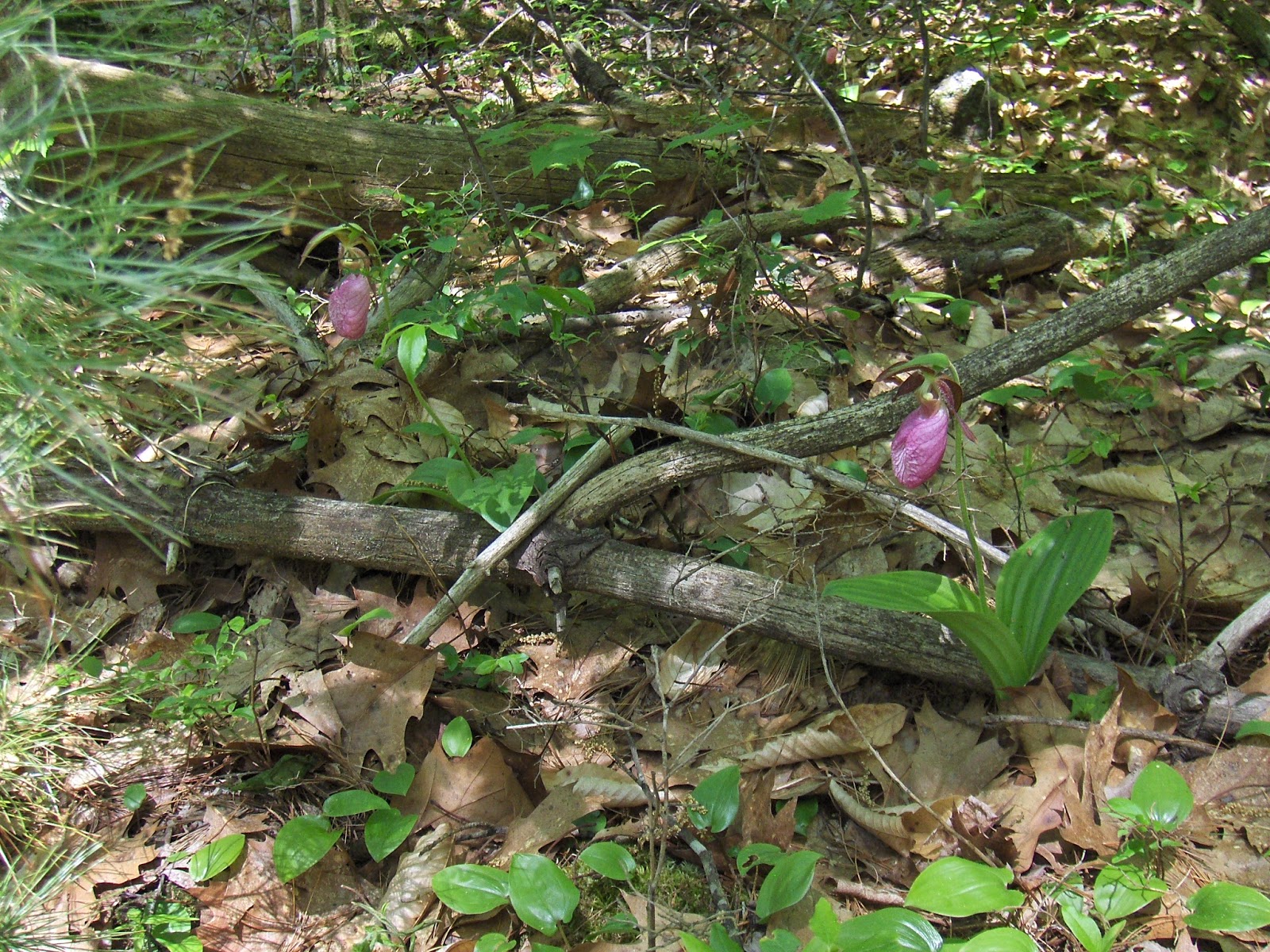
Aww! Lady Slippers:
 

June:
Out by Little Wachusset, on Brown Hill, Princeton:

Kinda wanted it to be rectangular with a hollow. But it was not.
  
Sudbury State Forest, visiting old friends:
 But now I see these as not only built into an outcrop, but also holding several hollows.

July:
Mathew Howes is also concerned about Hopping Brook:
 
 That is the main "burial" behind him.

August was barren [I was on vacation too.] 

September:
Warren Brook Cons. Land, Upton [highly recommended site]:
Another messy rectangle.

October:
Concord, MA [Boaz Brown cellar hole]
A lovely triangular mound. No hollows. Across from cellar holes, this is suspicious.

North Brook, Berlin:
Rectangular with hollow.

November:
Classic Leominster State Forest:
 
And a glimpse of the old favorites on "middle" Manoosnoc:
Rectangular, with hollow(s).

Codman Hill, Harvard:
Another of the large smeared rectangles from upper brook valleys of Harvard.

Brown Rd, Harvard:
Maybe a bit of a rectangle and a bit of a double hollow. This is also from a high brook valley of Harvard, but not the same large rectangular smear that we have seen before.

Northern Gardner, Wilder Brook:
A big smear, with a hollow.

December:
Mound in high valley in Carlisle MA:
  
Same idea but from Wolf Brook, Townsend (and more overgrown):
 
  
Last field trip of the year, by invitation of Sydney Blackwell and Gail Coolidge to Harvard, MA
A large messy pile downhill west of Bolton Rd [I think I found this before.]
This is located in the same way as the one from Carlisle, just above. This is a classic small rectangle with hollow (and possibly a tail):
There were three like this (but worse off), here at the very highest point of the brooks that run down to Corn Rd, past "Above the Falls".

Then how about this outstanding, long mound, much like the Blood Hill "J" but smaller. This was behind private houses and I never could have gotten there without help.
[Gail C. in the foreground].

A great end to the year.

Thursday, January 01, 2015

2014 - Review

Here are my most memorable places and things from 2014  [I may have missed things because it is difficult to navigate the history of this blog]

January:
Finally got to Codman Hill in Harvard without fear of tresspassing, as it has become public land. Lots of different sizes and types of piles. I liked this one at the hilltop.

Found nice features on Green Hill in Shrewsbury on Fortune Drive:
also this classic miniature pyramid across the street from the Hill:

February:
There was too much snow on the ground for exploring.

Looking at the articles, what stands out in my mind is the claim of "Mayans in Georgia". It was not too well received here but I continue to think it an interesting and, actually, pretty non-controversial suggestion.

There were posts from new contributors: Curtis Hoffman and Sydney Blackwell.  Later in the year Matthew Howe began contributing lots of pictures and information from the Holliston area. Welcome and thanks!

Also some stone tools. Might as well appreciate these little snapshots of ancient times. My river rocks from Waltham commercial building flower beds:

clay beads from Sturbridge:

arrowheads from Narragansett Bay:

March:
Readers sent in more pictures and sites, alleviating the snow imprisonment for me. 
Equinunk PA (John P):
Sinking Creek Mountain (Tim MacSweeney got this one):

Still a lot of snow on the ground. Things starting to peek through. Chris Pittman starts finding arrowheads.

I finally put together a coherent theory of how marker pile sites function to track moving shadow positions during the year.

Cairns threatened by development at Lawton-Foster Rd in Hopkinton RI.

Major finds south of Peppercorn Hill along Camp Str. Milford. Not surprising, this is a very busy area full of sites; or one big continuous site - depending on how you count them.

A site from Gamble Lake, Michigan with "stone donut" piles - proving that the rectangular pile with hollow is a universal phenomenon in the eastern US (we saw near identical features from New Brunswick, Canada):

Also, sites were reported from southeastern CT, from Mt Shasta in CA, and there was ongoing discussion of Track Rock Gap in Georgia.

April:
I found new rock piles in my home town, Concord, which is always a surprise and slightly embarrassing. I am supposed to know this place. Just goes to show that a site can be hiding in any 50 foot square piece of woods. These new piles were just uphill from Minot Pratt's spring. Also my eyes were opened to features I probably ignored in the past:
The number "9" shape was mentioned recently.

Headwaters of Fall Brook in Sterling:

Fine cairns from Worcester NY (thanks Tim):
 

Notable stories evolved with the perjury charge of "A URI professor". A sad story in several ways.

West side of South Manoosnoc finally revealed a new mound site. It is fair to say I have been looking for such a place for a while. Glad to find it in the snow:
 
and a structure against a boulder:

More amazing cairns sent in from, this time, from West Virginia (thanks again Tim):
[This reminds me that this was a year after I noticed how dogs obsessively hang out around rock piles. I am sure there is a residual smell they can detect. Maybe dogs are better than sonar for certain determinations (yeah...you know what I am talking about).] 
Also some interesting rock art at this Facebook page from the owner of the above site.

I had forgotten this. Apparently I was a good boy and found several sites on South Manoosnoc. Including some effigies near a western sub-summit.

Tim M. is finding new sites and Chris P. new arrowheads.

More incredible cairns, this time from Eastern PA:

[It is interesting, how similar these "cairns" are from PA, NY, and WV. Maybe people only notice the big things but the smaller things are there too, unnoticed.]

Still snowy, still reporting on river rocks from Waltham. I love these things:


May:
Continued exploring northwestern Willard Brook State Forest. A "chamber":

Also several hilltop sites in Leominster and Westminster.

The town of Acton finished clearing a grid site as part of their "Trail Through Time". This included signs showing the grid:
And newly visible piles - meaningful to me (cuz the shape is a variant of a "9"):

June:
Chris P is having some luck:

(My luck consisted in finding a pair of nesting goshawks.)

A new stone "Beehive" from Medway found by Matt Howe:

July:
Not much exploring going on.

August:
Franklin State Forest. They have piles with hollows too:
(If this was a hole someone dug into the pile, the removed rocks should be scattered around. Note, they are not.)

I am spending weekends at the beach; not in the woods. Matt Howe sends in many photos from Holliston, Milford, Hopkinton.

September/October:
Rocky Pond Brook in Hollis NH, some large piles integrated with adjacent homesteads:

Found new rock piles at Weatherbee Ave in Acton, on a Sunday stroll with my wife:

Top of Juniper Hill, Ashby:

Aside from NEARA, I notice the advent of many smaller regional organizations promoting the idea of Native American Stonework. It is fair to say this idea has taken pretty firm hold in several of the towns in this area: around Concord, around Deerfield, and in many other places I am not tracking closely.

November/December:
Grand mound sites in Ashburnham:

And northern Townsend:
 
and
 

Some nice sites in Westminster here, and at High Ridge:
(compare to what I was just looking at on Noon Hill - it is the same as the structure at 'C')

Other smeared rectangles at Lovewell Pond in Nashua NH:

Various strangeness on the flat sub-summit in Franklin State Forest:

The incredible furry mounds at the top of Falulah Brook - how could I forget these?


I am spending lots of time exploring in Walpole and Medfield. There are lots of interesting sites at Noon Hill and I am well pleased with the old things I spot there:

Not too dramatic a year. Mostly filling in gaps and extending previous explorations.