Showing posts sorted by relevance for query 500 cairns. Sort by date Show all posts

Monday, February 13, 2006

Fieldtrip continued - the eastern slope of the Hill of 500 Cairns

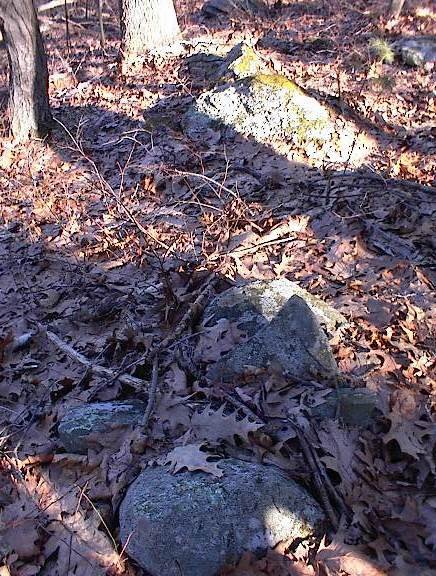
The eastern slope of the Hill of 500 Cairns, also has rock piles on it. They are much more sparsely located than on the western slope and they are more built up. I am not sure they are marker piles but there were clear examples of four-in-a-row diagonalling up the hill from this side. Also, these piles are well outside of what George Krusen called the "enclosure" of stone rows which surrounded the famous limestone "cairn field" at the western foot of the hill. Perhaps these eastern slope piles are more recent additions to the site.
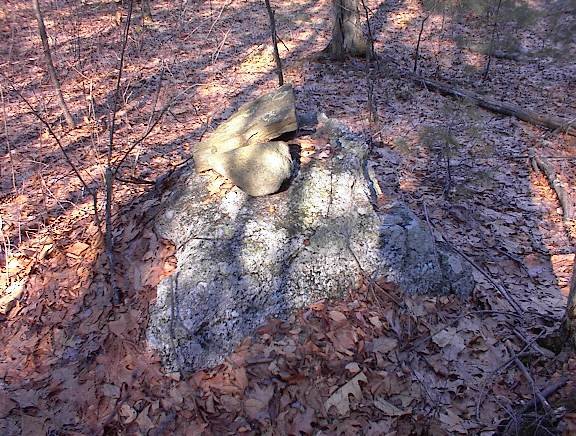
The first thing I saw on the eastern side was a nice light feldsparstructure.

There were some nice piles over here.
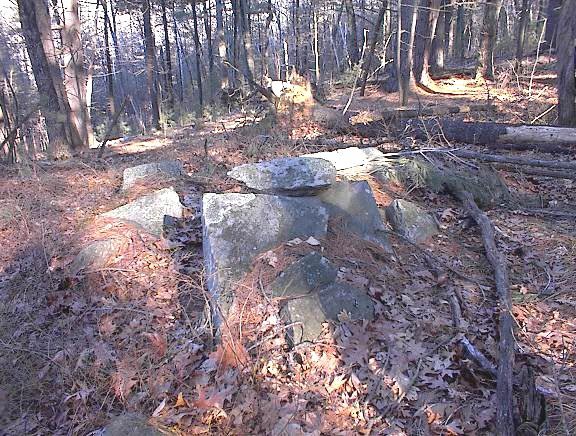
If they are marker piles they are more like the type where the pointer rock is flat like a "fin" sticking out of the pile. By this time in our fieldtrip I was starting to get hungry and becoming less interested in yet another rock pile. But there are some different interesting things on the eastern slope. Let me tell you about (1) an aperture pile, (2) a strange short stone row with a large aperature through it, and an isolated piece of quartz perched on a ledge at the edge of the hill. [Click here] for information about the aperture pile and the quartz. Here is the curious stone row:

The row ends to the right of the picture. At the top on the left is a larger rock - a bit like the head of a snake. What I found most interesting was the hole in the middle of the wall. See that? Yet one more thing suggesting looking at/ through/ past a construction. That seems to be the theme of the Hill of 500 Cairns.
****************
After exploring the eastern side of the hill, we headed back over the top, where there were a few more things suggesting viewing. For example look at the graduated sizes of the blocks of rocks in the foreground. See the way shadows behave up here?
After this we headed down the southeastern side of the hill, passed that ledge with quartz and scrambled back out to the road. I am ashamed to say I missed this site entirely when I came to explore this hill sometime last year. So now we have a little bit of a sense of this Hill of 500 Cairns. My conclusion: this is a hill which is steep on all side and has elevated horizons in all directions. So it is a natural location for marker piles and, in my experience, is more thoroughly covered with piles than other hilltop sites nearby.

Fieldtrip to the Hill of 500 Cairns

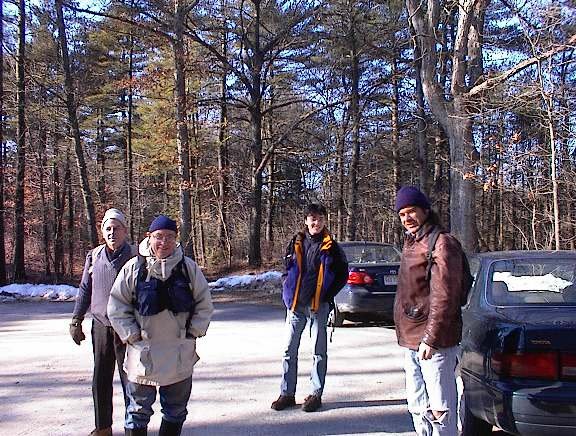
I organized a field trip with George Krusen because I wanted to see the piles Tim Fohl found on the Hill of 500 Cairns.Here is the group, from left to right: George Krusen, Tim Fohl, Phillipe (a friend of Bruce), and Bruce McAleer. We parked at the end of Whitcomb Rd, off of Sugar Rd in Bolton. From there we walked north along an access road parallel to Rt 495 with the noise of cars only a few feet to the left. As we continued we diagonalled slightly to the right and uphill, passing over a small subsidiary hill and then continuing on to the main hill.
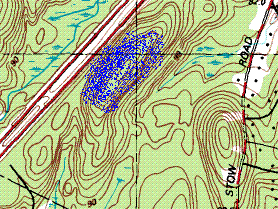
This map fragment shows the end of Whitcomb Rd at the lower left, shows the two lanes of Rt 495, and shows a haze of blue dots representing the parts of the hill where we found rock piles. I am publishing the location of this hill because (a) it was public knowledge in the past; and (b) the site has already been largely destroyed.

But for all of its publicity the un-answered questions about this hill grow rather than contract. The original mystery, which previous investigators did nothing to resolve, included the question of who made the piles and when. The principal investigator in the past, Cheney, (see George Krusen's notes below) rejected all possible builders of these piles in favor of the "Red Paint people" - the maritime archaic group who used lots of red ochre (hematite) in their burials. It seems absurd today that he didn't consider more recent Indians as possible builders. Apparently he "knew" that Algonquians "never built in stone" and hence his absurd conclusions. He claimed to have studied these unique piles for many years yet came to no apparent conclusion about their function; his excavations did not lead anywhere: he found no bodies and no artifacts [compare for example with Mavor's excavation of a rock pile in Freetown]. Also, if he had visited any of the neighboring hill and looked around carefully he would have seen his site is not as unique as he thought. He should have known that five or so hills within 3 miles of this place have very similar sites - or at least they are very similar to what is left at the Hill of 500 Cairns. He also should have known and mentioned that there is a significant limestone quarry about one mile from the hill. Now, rather than resolving these older mysteries, we have new ones to add:
  • Was there an ego conflict between the Harvard professor group and the DWP Italians?
  • Who carted off the limestone? Was it really limestone?
  • Where are all the pictures and the reports?
  • Why didn't anyone comment on the extensive "cairns" further uphill
  • Where did the number 500 come from?
So it continues to be a good story and it remains relevant today. Somebody (mostly in Stow, hint hint) should really make sure that destruction does not occur at the other sites nearby.

Meanwhile, back to my story: we proceeded uphill and as we got near the top with a steep slope to the west we started seeing low ground piles. Look closely at these examples:
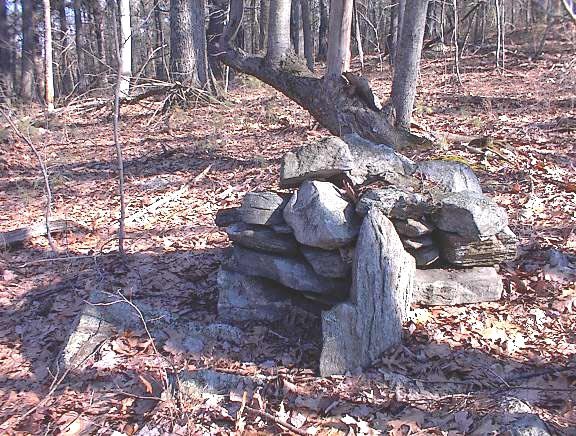
This first one has an elongated rock lying flat next to a pointer rock sticking up. My approach to rock piles is to look at these details and assume they are deliberate. In this case it is a patten I have seen before. That type of a pile fits the definition of "marker pile". So also does this next one.
Note the pointer rock on top. Note also that this style of pile might be supported on a boulder or could be directly on the ground. I do not know if these pointers were to look past or if, rather, they create an interesting shadow somewhere. You can see from all the pictures I took that there is a strong interplay between light and shadow on this hill. So, after seeing a few marker-type piles, I started looking from pile to pile to see if any lined up to form three-in-a-row. There were plenty of vestiges of this but no good photograph-able examples. In anycase I concluded that this was a typical marker pile site. Bruce, who has been with me at many of the nearby marker pile sites, agreed. Nearer the top of the hill the marker piles were stacked higher - I presume this is so they remain visible from lower down looking uphill.
Here is another nice example. It has a lot of structure and I believe that rock in front leaning up against the pile is important. But what role did it play? Was it occasionally moved into a slot in the pile? It is certainly not visible at any distance from the pile.
Here is one more from up there. It reminds me of the "crossed pair" examples discussed earlier. So finally we left the western slope and moved around to the eastern slope where there were more piles.
For now, here is a panorama of the western slope. This is the way it looks up there. I'll continue with the western side in a subsequent post.

Sunday, February 12, 2006

George Krusen's notes

Here is a picture of George Krusen, of Boxborough, sitting one one of the hundred or so features that remain near the top of the hill called the "Hill of 500 Cairns". George gave me a copy of the following notes and said I could publicize them:


SOME NOTES ON THE HILL OF 500 CAIRNS
HARVARD, MASSACHUSETTS
BY GEORGE C. KRUSEN II
11/11/03 DRAFT

Preservation of the Boxborough Esker started in the 60's and today it is an 80 acres preserve owned by the Nature Conservancy; this preserve is in the western part of Boxborough and bounded by Rt 495 on the East and by Beaver Brook on the West.

Byron Dix discovered native American stonework on the Preserve, the most interesting of which is a stone row up the eastern side of the easker in line with the summer solstice sunset.

Prior discovery of Indian sites had been made on the Towermarc land west of Beaver Brook and to the South on a hill now east of Rt 495. The latter site was written up in the Boston Sunday Herald on September 18, 1960. That location has been kept secret by a Dr. David Cheney who only shared it with his friends.

This writeup is concerned with Dr. Cheney's site.

Morse Payne and I went in search of what might remain of this hill which was probably destroyed by the building of Rt 495. To our surprise we found some remnants of rock piles and also learned that the land was now owned by the Harvard Conservation Commission. A talk by Cheney to the Harvard Historical Society on October 3, 1960 had some important ommissions:


1. The original cairn field has been completely surrounded by a stone row. The parallel ends still exist on either side of the highway.

2. No evidence existed of any of the limestone that was said to be the material of contruction of the cairns.

3. Over the summit of the cairn field on the eastern side of the highway is a large boulder about 15 feet high.

4. Cheney made the point that a tributary (Elizabeth Brook as it is known today) flows by the site to the Nashua River via the Assabet River. This would have made the site accessible by canoe. What wasn't mentioned was the possibility of paddling north about 1.8 miles and portaging a short distance into Beaver Brook which flows north along the esker to the Nashua via Stoney Brook thru Westford.

Unfortunatley, the site had been stripped of much of the stone work before the DPW Commissioner, Jack P. Ricciardi, ordered a survey locating what was left of the mounds. About 80 pages of survey notes are available. About 14 of the mounds were assigned Peabody Numbers (P. B.) and presumably examined by an archeologist, Fred Johnson, of the Andover Museum. We have been unable to find this report altho we know the conclusion from notes at the Harvard Historical Society; they were the work of farmers. Neither do the Peabody Museum at Harvard University, the Massachusetts Historical Commission nor the Andover Museum seem to have the report.

Three people (other than the Herald photographer) were known to have taken pictures at the undisturbed site. They were Norman Schmidt, George Fuller and Dr. Paul Dudley White. All are deceased but Mr. Schmidt. Cheney said in his paper that:

"My friend of the decades, classmate (Harvard 1908) Dr. Paul Dudley White; the late George S. Fuller of Newton; my friend Norman B. Schmidt of Harvard; Dr. Byers of Andover; Frank Croty, the State Editor and Columnist of the Worcester Telegram-Gazette, Globe reporters, Herald reporters, Vernon Kilgour of West Boylston, Dr. Bok of Harvard, - these are a few of the questers who have trodden this old way with me."

Mr. Schmidt has looked in vain for his pictures, no photos were known to the two childern of Mr. Fuller and Dr. White's daughter, Penny, knows of pictures taken by a stereo camera but now lost. However, the latter has vivid memories of riding her horse thru the cairn field. "they looked ancient covered with moss and pineneedles and made with stone foreign to the area."

Dr. Cheney advances four possible builders of the cairns and eliminates all but one. "My sole desire has been to learn the truth. At present the Red Paint Indian origin is the only tenable theory". I give a lot of credence to this man since he had some formal training in Archeology(Dartmouth College).

There have been two other living witnesses to the original cairn field. Russell Lawrence of Stow helped a logging crew work in the area before Route 495 was built. He saw the cairns and was so inspired by them that he was careful not to disturb them while cutting and dragging logs. The second witness was a lad of about 13 who saw one cairn remaining on the southbound lane of Rout 495 after all the trees had been removed but before earth moving. This Edward Tatten took the cairn apart hoping to find bones: He removed rock after rock of this five foot high cairn and found rocks still there at ground. He removed them to a knee high depth before stopping. Stone still remained in the foundation. This corroborates Dr. Cheney's account that the cairns had well planned foundations, probably not the work of colonial farmers.

"I have carefully removed, with the aid of my friends, three cairns, to study their structure and to excavate under them. All three were built with great care. A pit was first dug, rectangular, and perhaps a foot in depth. A large, flat limestone slab was laid in the pit; a smaller rectangular slab lain on top of that; and the cairn then built up with care, to last. The blocks of stone, many of a large size, were of calcium rocks we call "limestone". The chemistry of resultant weathering cemented the stones together and so helped to preserve the cairns. Originally the majority of these structures were roughly conical. One, with its back to the prevailing wind, is rudely shield shaped, and still stands. Another of mighty stones, was what my friend, George Fuller, called "the altar cairn". They have carted those stones away."

Could the one "still standing" be the one that Ed Tatten took apart? Two inconsistencies appear. Only Cheney mentioned the weathering together. Ed Tatten thinks "his cairn" was just made from local rock, not limestone or material brought in from elsewhere.

Further work will include:

1. Tracing the deed trail back at the Worcester Registry of Deeds.

2. Go back to the Peabody Museum and ask that they look for Fred Johnson's report in the file of Professor Phillips. The latter was the Curator there. a good firend of Fred Johnson and lived on Sugar Road, Bolton close to the Hill of Cairns.

3. Continue the search for the report at the Andover Museum where D. Johnson worked.

Monday, December 17, 2007

Re-visiting the edges of "The Hill of 500 Cairns"

I wrote about this hill previously [Click here and more generally here]. A couple of weekends ago I was going to go on a long drive to explore in Southborough and passed this Hill of 400 cairns (or 500 cairns) on Rt 495 and thought: "I should really go explore more around the northern edge of the hill". Then I realized that that was a better prospect than the one I was headed towards, so I changed plans. Last time at this hill with a group of people, we walked up to the top from the southwest, starting at the end of Whitcomb Rd in Bolton. This time, instead of climbing the hill, I stayed as far west as possible, following the deer fence along the highway and stayed at the foot of the hill. This should have taken me right down to the edges of the part of the site that was destroyed by the highway. In fact there were rock piles right up to the deer fence: And some really pretty little things under the thin crust of snow: Although we are told that the destroyed site contained wondrous things (large cairns of limestone, with blocks cemented together from age) there is no reason today to suspect that that part of the hill was much different from here, 50 yards away. I cannot find a single piece of limestone, nor any very substantial cairns.

I can't escape the feeling that this hill consists of a large collection of different "grids". The notion of a site extended at many different times seems to fit this place well. And I cannot help but get a sense of lined up piles here. But it is hard to show. Here is the basic westward facing slope, with one line of rock piles after another running down the slope in parallel; but you cannot really see them: In another part of the hill, the line is un-mistakable, here are four or five in a row:Wondrous enough.

Wednesday, May 27, 2015

A few other sights on the way to the Hill of 500 Cairns

 By the time we get to this one, we are on the hill itself.
It still surprises me that this hill that was partially removed when they built Rt 495, was considered so special at the time. I look at a map of the valley of Beaver Brook and Elizabeth Brook - where the Nashua and Assabet Rivers almost meet (just to the north of here), and every single hill has rock piles on it. Some, like Codman Hill, are quite spectacular. This hill (and here) west of Cisco was written about by Mavor and Dix. Then there is that lovely little hill near the Boxborough cross roads, un-named and un-blogged [well not entirely]. Marble Hill in Stow also.

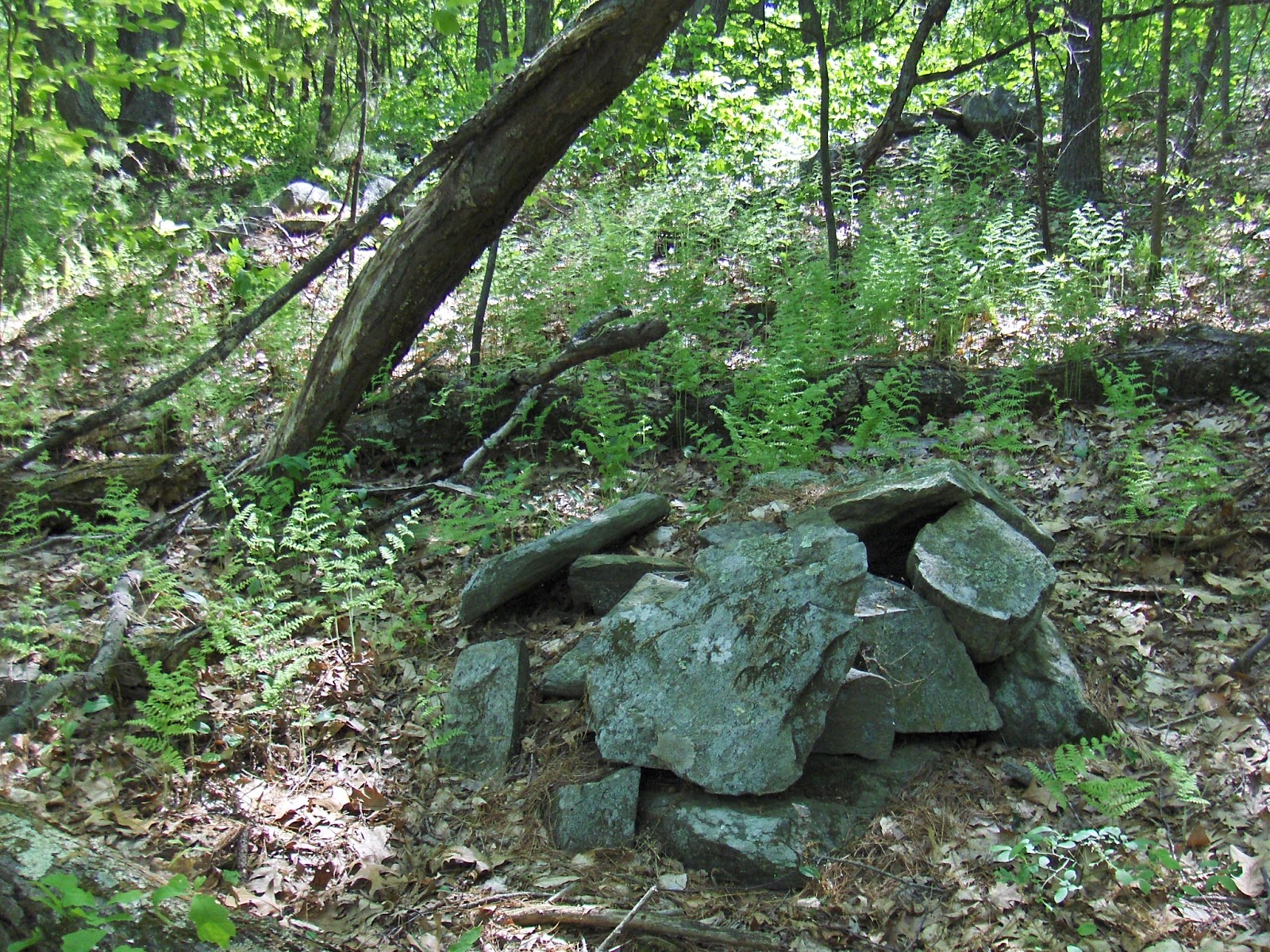
The western slope of this hill "of 500 cairns" is where the action is. Today one sees a typical marker pile site.
 
For my money, Spindle Hill  a couple hills over in Stow, at the end of Gates Ln, is more interesting.

Sunday, February 12, 2006

Marker Pile sites

I introduced the word marker pile below [Click here].
Here is an idealized sketch of a marker pile site: the piles are almost evenly space and lie along lines which lead uphill to a high elevation horizon. At an actual site there may be dozens of the these lines of sight. Some other features which occur at marker pile sites are
  • aperture piles
  • lines which lead to a ledge with a quartz rock on the ledge
  • prayer seats
The sketch suggests these lines of sight might be designed to point at a sunrise even or a star event. I do not think it is a fantasy that the hills in the Rt 495 corridor often have lines of piles which slant up down and across their slopes. There are more than half a dozen site like this along there and within three or four miles. But whether these sites were built to watch events at a high elevation horizon is just a guess. If you like, it is a fantasy which helps to organize the information. So I hope this at least explains the idea of a marker pile site. And why mention this now? Because I want to say that the Hill of 500 Cairns is a typical marker pile site and I need to establish the vocabulary.

Here is an example from Stow.

And here is a view uphill to the east at The Hill of 500 Cairns.

Friday, January 01, 2016

2015 - Review

The year started out with heavy snow that kept me indoors for several months. It ended with some new theories and exploration strategies that succeeded, so the year ended well. More details are available in the archive of links to the right.

January:
Just before the snow there were some minor sites and a field trip with Curt H. and Matt H. I found a fine marker pile site at Rocky Pond and Birch Hill in NH:
Later, after the snow melted, I found some fine 'rectangle with hollow' examples there, near the road.

Sitting snowbound at home, in January we saw:
 - new sites reported from CT 
 - strange rocks from Brazil
 - stone walls from CA

February:
As Tim MacSweeney says: "Up to our necks in snow". Sitting at home we saw:
 - rock piles in Alaska
 - other people's photos
 - strange rocks from CT
 - Hopkinton Land Trust buys 13 acres, notable for having "cairns" 
 - Tim sends picture of Nuclear Lake, NY
 - We watch "America Unearthed" - marveling at the degradation of content into drivel, including archaeologists stepping on rock piles while looking for traces of archaeology.

March:
Finally enough snow melted, I started getting in some hikes. Mostly to the south of Concord, as there was less snow in that direction.
 - Finally some "red rock" rock piles in Randolph, on south side of Ponkapoag Pond.
For several years, I had hoped to find piles made of the "Wamsutta Formation" rock.
 - March 28th was the first visible rock pile of the winter.
 - New pictures began to emerge from CT (thanks Tim)
 - Before that we are still looking at old photos ("Petroforms") and foreign photos (rock piles of northern Sweden)
 - strange rocks from NH
 - multiple news items from the Nolumbeka Project
 - more CA stone walls

April:
SNOW IS FINALLY GONE AND OUTDOOR ACTIVITY RESUMES
 - sites along North Str, Upton and along Warren Brook
with old decripit mounds:

  - re-exploring at Holden Rd Shirley, found a new 'mound' by the inland wetland:
  - a lovely mound group by Miscoe Brook in northwestern Upton:

May:
 - a couple of very minor sites at Wolf Swamp, Boxboro. But then, sites are hard to come by in there.
 - Chris Pittman startles all of us with his magnificent arrowhead finds:
 - I revisit George Krusen's "Hill of 500 Cairns", and located a few more on the east side:
 - Petromorphs from Montana
 - At the end of the month I locate a (for me) second (after Miscoe) significant site of the year, at Lovell Reservoir Fitchburg. With a great mound group:
Looking back, I think this may have been the "best" find of the year. But what was most significant was, in fact, the messy berms in the ravine there, which I payed little attention to.

June:
 - minor sites on Merrill Hill NH
 - strange rocks from Hollis NH
 - new finds by the Gumpass in Pelham NH, and A TICK BITE.

July:
Mostly I am going to the beach on weekends and not exploring....this is the dead zone of summer.
 - I found a little rock outline-connected-to-wall about 20 feet from the road at Minuteman State Park. No, the park is not aware of it.
 - The genetic nonsense about Native American DNA rears its ugly head.
 - A big load of nothing at Bordeland State Park (some messy stuff at the southern edge along a brook).

August:
 - more nothing at Bordeland State Park
 - more nothing at Red Brush Hill
 - Norman M. sends this photo of a stone chamber:
 - more nothing at Moose Hill, Sharon MA
 - an interesting boulder with auxiliary piles north of Silver Lake in Hollis NH
 - Mamjohn Pond in Gardner MA. Fine rectangular mounds:

September:
 - Egg Rock in Concord, is a famous spot but no one ever noticed the rock piles in the woods behind there.
 - Tim M. visits the "Judges Woods" behind the house where I lived as a teenager:
(looks like marker piles mixed with [in the rear] mounds).
 - found a rectangular mound buried in the bushes next to the Concord River - a few hundred yards from my house. Never took pictures.

October, November
 - a walk in Mason NH with Carol Montgomery - turns up lots of minor features that "click" together as similar to other sites in this "northern" MA/NH area. For example, little piles with hollows:
 
Also, carefully build rock piles against outcrops. This is a feature that resonates with others places:
 - Various threats occur:
       Algonquin Pipeline expansion
       The Stow Grid (ongoing)
       A (thankfully) false rumor of Parker Woodland destruction.
 - Much exploration at the north end of Horse Hill Groton/Dunstable:
 - The post about Horse Hill captures, or begins to capture, a couple of important theoretical ideas:
  •  that burial mounds will be found at the high point of the path of least resistance from the water up the hill
  • that a mixture of marker piles with larger, lower, mounds is to be expected at the high point.
  • that (at least in the Nashua watershed) the top of the ravine will have long berms with hollows, in place of or in addition to rectangles with hollows.
December:
This theory, results in my beginning a refined hunting strategy: find a major waterway, and a small tributary brook. Follow the brook to its high point and look around. In the northern (Nashua River) areas, look for elongated berms with hollows, otherwise expect rectangular mounds. This burials at headwaters becomes a highly successful strategy for me, for the rest of the year. Would any of my readers care to give it a try? I am able to "squeeze juice from a rock" (or is it "milk from a bull") and find rock piles in Groton near the Throne:
 
 - Amazingly I extract a rock pile from Ballard Hill in Lancaster MA. After all, the Nashua River passes nearby:
 - I re-explore Rattlesnake Hill in Bolton. A couple of brooks lead up from a larger waterway and the same hunting strategy turns up a couple new sites on the hill.
 
 - At Blood Hill I finally become aware of elongated mounds with hollows, found in ravines. They have a characteristic shape, location, distribution in the Nashua and Souhegan watersheds [which is only as far as I have explored]. So let me end this review with the grandest "ravine culture" mound I know - the grand "J" at Blood Hill which captures the essence of this special aspect of stone mound culture in these parts (right click and open in new tab to see magnified):
And finally, this is echoed by a pile along E. Wachusett Brook in Princeton

The sites and ideas that stand out from the rest, over the year, were:
 - Ravine Culture at Blood Hill
 - The pathway up the hill at Horse Hill
 - The Lovell Reservoir Mound Group 
 - A forlorn site near the head of Miscoe Brook