Wednesday, August 05, 2020

Mendon Town Forest

Reader Keith told me about a site in Mendon and it was great going back in the woods. Thinking about seeing rock piles in the woods, after months of doing other things, the whole idea that there would be Native American ceremonial stone structures out there begins to seem like a dream. The idea that I could take a few steps up a hill and see a collection of structures facing west, spread out down the side of the hill, seemed unreal. Not because I didn't trust the information but because the whole idea is so alien to this modern, currently coronavirus-focused, culture. But you step into the woods and there the rock piles are - still and peaceful. And you think: these may still be around, even if America passes away.

So it was with these thoughts that I followed Keith's directions [enter from Asylum Street, take the northernmost trail] and within 10 minutes found myself in a wonderful collection of rectangular mounds with hollows. 
There were also satellite "marker" piles, near each of the larger mounds. Generally the site was undisturbed and the piles were in excellent shape. If you head downhill and upstream to a little valley northeast of the summit, there are other mounds down in there and, at the headwater, a different sort of mound, larger and [seemingly] older.

At first, a glimpse of a few piles near the summit lets me know I am getting into it. Then, this rock on rock seems to signal a "final approach", as we get to larger piles.
And here we are at the top.
(from another side)
This was perhaps the largest of the mounds that are scattered across the northern slope near the summit. The site "faces" northwest. Just downhill from this first mound, was a small boulder in line with a marker pile:
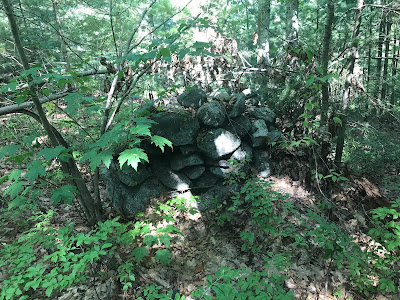
And here are several other mounds:


Beautifully made, and in excellent shape. So much so that you begin to think the hollow in the pile never had a covering of stones. Perhaps the pile was covered with brush?

Added Later: This photo shows a good example of a right-angled (90 degree) corner in a mound. This is why I call the mounds "rectangular". Not all corners need to be present. It was significant to me that Doug Harris instructed people in Carlisle who were building a viewing platform near a rock pile site to avoid making corners in the platform. That idea was not part of the culture of the people who made this site in Mendon, nor generally in inland Middlesex.

Here is another, with a larger, longer pile in the background:

Here is a boulder connected to a rectangle with hollows:

The slope continues:

And you follow it down and to the right (east) and find other rectangular mounds next to the "crease" of water flow:

Is there anything more marvelous than an ancient ruin, poking up through the hay-scented ferns? 

Following the gully up hill, one finds:

Seen from above, this is a different style of mound: larger, not so rectangular, and more broken down. 
To me this seems older than the fresh piles on the summit. Which fits into a theory, that "water loving" burials are older than "sky loving" ones. This site, sitting at one of the highpoints feeding into the Blackstone River, began in the valley and, over time, went higher on the hill. That is how I imagin it developed. Generally in various places, the higher on the hill, the better the condition of the rock piles.

Heading back, a few other things, seen in passing:

This one looks like an effigy:

Thanks Keith!

Wednesday, July 29, 2020

Thursday, July 23, 2020

Finding Meaning in Stone


July 22, 2020 by Hannah Harvey - “Nothing excites the imagination like an unanswered question, and since spring I’ve been exploring a little-recognized mystery here in Pennsylvania…”

Clovis First dies again = Chiquihuite Cave

[About first Americans, not rock pile related]

Solid research about people in Mexico around 30K years ago. If accepted this will become another version of "Clovis First".  Archeologists cannot get enough of assuming a diminutive role for America in world pre-history.

https://www.inverse.com/science/chiquihuite-cave

Monday, July 13, 2020

Rhode Island Arrowheads

More finds from reader Joshua:

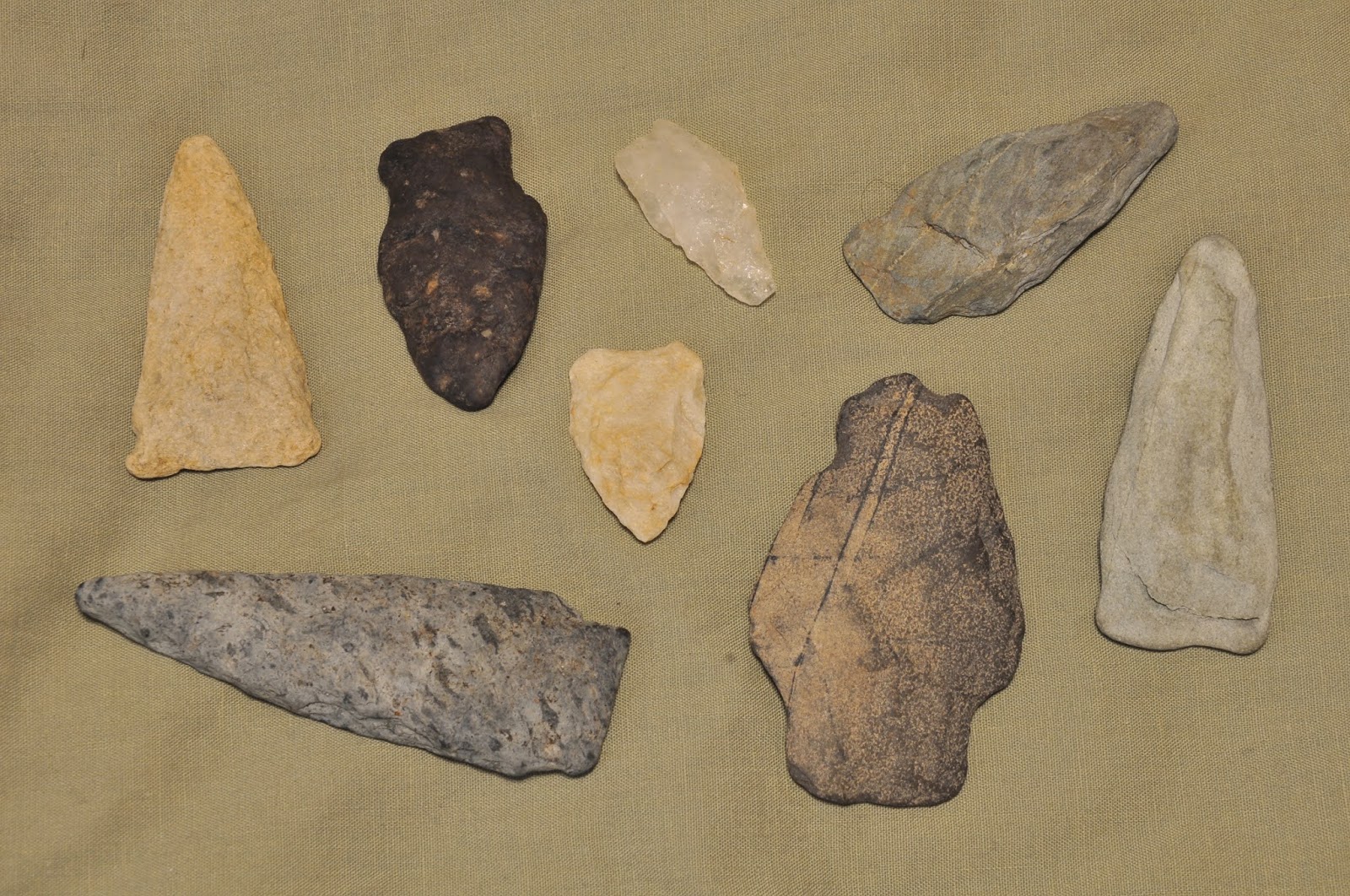
I have found quite a lot of artifacts in the past month or so including a brewerton eared triangle, possible resharpened clovis point made from quartzite that measures just over an inch in length, a frost island point made from black rhyolite with porphyritic quartz specks, a large point made from felsite or some other material that has been ground down in two places to be used as a spokeshave.  Also is an argillite piedmont I think and another old argillite spearpoint as well as a small quartz lamoka point and a really old spearpoint made from blue gray serpentine stone. It has a knick or spur on one of the basal edges so I think it might be a stringtown lanceolate.  It's heavily beveled to the point where it seems to twist slightly and the only tools I see at this site made from serpentine are paleo tools and paleo artifacts such as birdstones.  I included a photo of the spearpoint with other paleo artifacts to show that they are all made from serpentine. Also included is a photo of some recent broken points including a neville point made from very unique material, a rhyolite palmer I think and a quartz point that I keyed out to jim thorpe but am not sure. All of these artifacts were collected at the same site that I believe is very old site dating back to the clovis era and possibly pre-clovis times facing narragansett bay.   Thank you for any and all help.  


[from a second email]
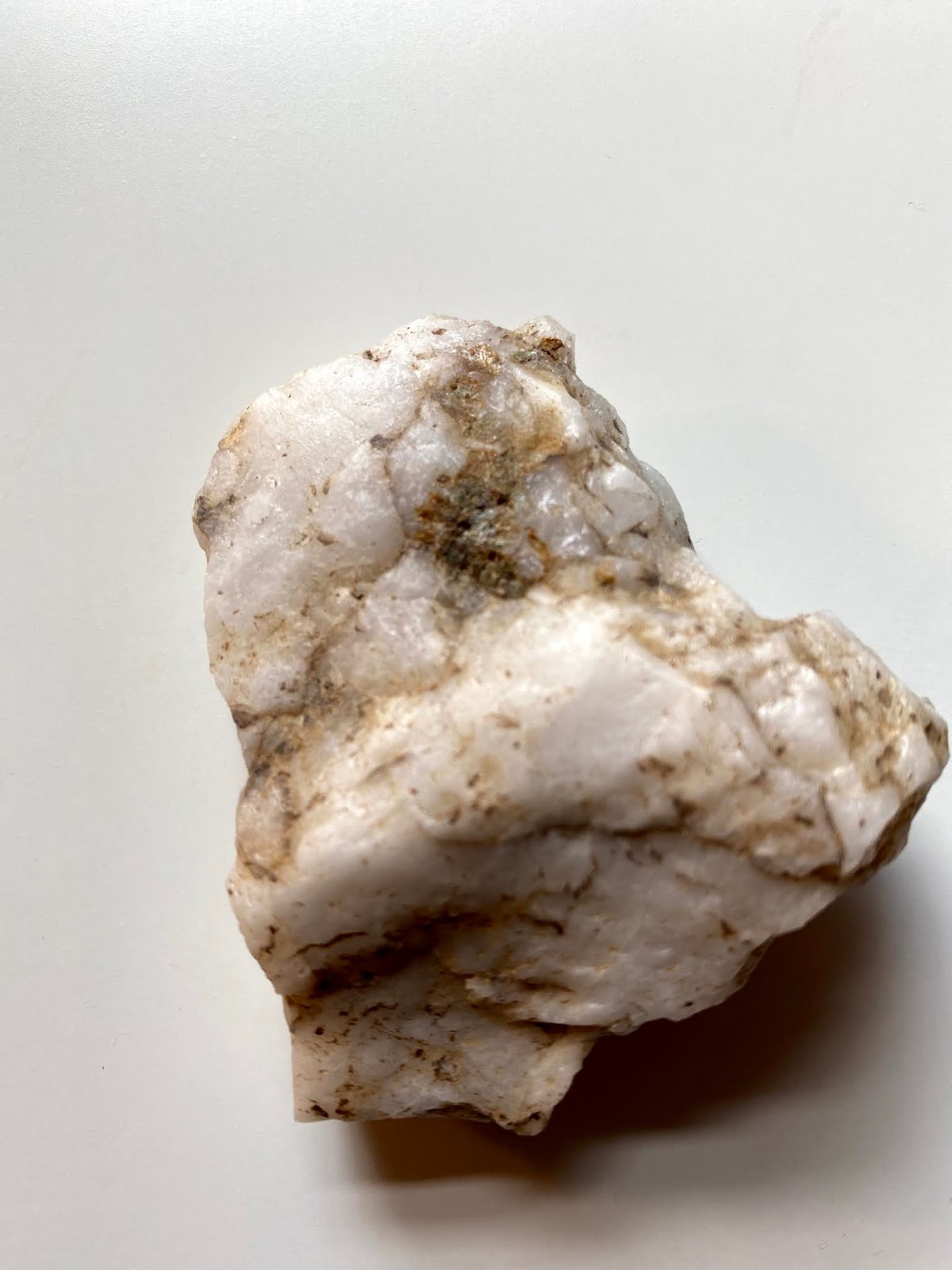
. . . plus an interesting piece of what i think is art made from orthoquartzite (sandstone).  It's ground down in certain areas to make certain planes and shapes.

Tuesday, July 07, 2020

Aundré Bumgardner Photos (Glastonbury, CT)


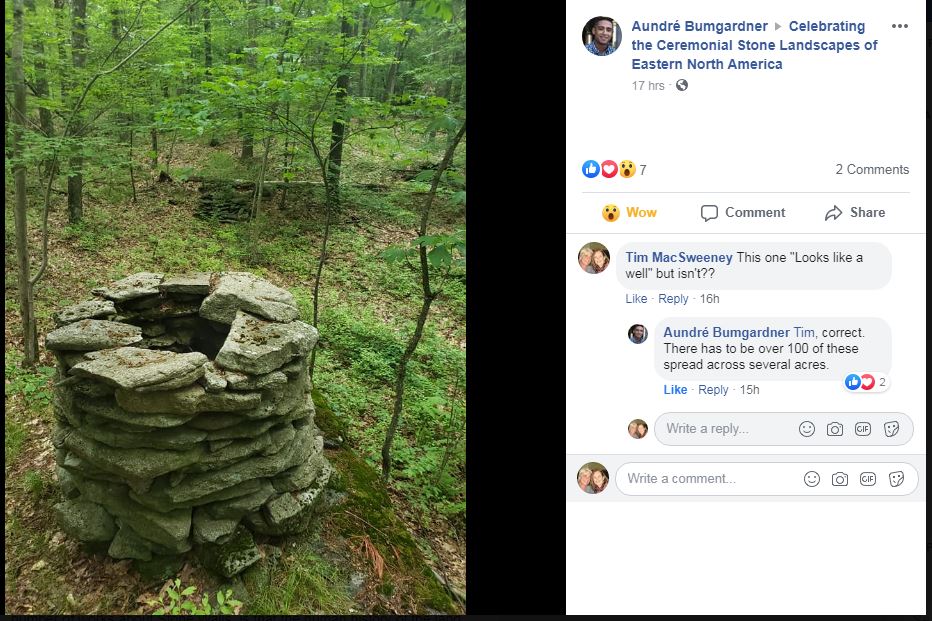
   Some photos of some beautiful “Stone Prayers” taken by AundrĂ© Bumgardner  in Glastonbury, CT.


Dogs can detect burials up to 5K years old

I have written several times that dogs seem to like to sit on top of stone mounds. There is lots of photo evidence. They don't seek out boulders to stand on - so the preference is not about getting a view out over the landscape.

So I always wondered if dogs smelled something (you know...like human remains) and how long after burial would something still have a detectable smell for a dog. Well, apparently the burial age can be up to 5 thousand years - more than enough to encompass the large stone mounds of our last 2 thousand years

Anyway:
(from the Atlantic)
https://www.theatlantic.com/science/archive/2020/07/dogs-archaeology-bones/613828/

(past references to dogs on rock piles)
https://rockpiles.blogspot.com/search?q=dogs

Monday, July 06, 2020

Mayans in Georgia

Thought I would browse this YouTube, to recall the controversy.

https://www.youtube.com/watch?v=C2w-WSl3NN8

I don't remember if readers are ok with the idea of Mayans in Georgia, or want to make fun of it. The videographer Scott Wolter is easy to make fun of. But the rock piles and stone walls are real. So permit me to take a position on the idea that there were "Mayans" in North America.

I believe that mound building cultures dominated America for most of the last 2 thousand years. We are told that the earliest mound sites (eg "Poverty Point") are in southern US and predate Adena Mounds in the Mississippi as well as Olmec pyramids in Mexico. (I just looked it up, the Olmec were 1200 BC and Poverty Point is 1100 BC, so actually US sites are contemporaneous with oldest central American ones). They were building monuments all around the Caribbean at that time - for example the Caddo mounds in Texas.

In addition to the timing and architecture being connected between cultures of central and north America, it is clear [to me] that the basic cultures were a bit homogenous all over the Americas, in general. You look at a Mayan arrowhead [hard to find pictures of them] and it is the same as an arrowhead from the Mississippian mound building cultures of later years.

Pre-classic Mayan:

 Cahokian:

I have one of these arrowhead. I found it in Arizona at a "Sinagua" site - a pre-Anasazi, Puebloan people. What this tells me is that there was a culture that was pan-American with many local variations of the common theme. And they built mounds in the north and in the south. In the river valleys and alluvial deltas, they built in dirt. In the rocky highlands they built from stone. 

Everyone was building mounds and everyone was building terraces and everyone was making the same sort of arrowhead. It would not be surprising if an Indian from the north east could have been intelligible to one from Mississippi using a shared "trade language". I propose that mound building cultures were all similar and all shared some common behaviors and beliefs. These include not only mounds and arrowheads but also foods. The "three sisters" of corn, beans, and squash did not get to New England by coincidence but through trade and a continuity of cultures. Another example is the "4 color" division of: black, white, yellow, and red -corresponding with compass directions.

So why are we creating a false sense of separation between the Mayans and the Indians of Georgia? Of course the Mayan culture was present in Georgia. But those Indians should be called "Georgians". To make fun of this idea is to ignore the obvious cultural continuity that, I believe, stretched from Canada to Peru. You can make fun of it. You can argue about timing and the difference between when the Adena were in the Mississippi valley versus the Mayans in central America. But you have to make arbitrary distinctions to do it. Every place from Mexico to Massachusetts had examples of the same cultures.

Tuesday, June 23, 2020

Mysterious Stone Structures of the Eastern Forest

"Thousands of mysterious stone cairns are scattered throughout the Eastern United States. The stone monuments have been documented since the 1600s both by Native Americans and European settlers, but no one has any idea who built them." Words, music, and photography by Sequoyah Kennedy

https://youtu.be/T3ieQOVjzf0

Crude stone tools?

From reader Kevin, in Walpole MA. Please give opinions in the comments:


Thursday, June 11, 2020

Washed Up Artifacts (Westbrook & Madison CT)


"Evan Honeyman of Farmington found a verified Native American arrowhead or spear point on Quotonset Beach in Westbrook recently...experts placed the artifact at between 2,000 and 3,000 years old, and possibly composed of basalt, rhyolite or mudstone..."

https://www.nhregister.com/middletown/article/1-000-year-old-artifact-washes-up-on-Connecticut-15309055.php#item-85307-tbla-4

Also: Madison man finds ancient 'mysterious' stone at Hammonasset:

(State Archaeologist Sarah) Sportman  confirmed, via email, that this was indeed “a very cool find.”
“Several ground stone or pecked stone spheres have been found in Connecticut, but they are a mysterious artifact type that is found all over the world and from different time periods,” she wrote..."  

Thursday, May 28, 2020

Encountering familiar local Middlesex County names West of Chicago

Following the idea that rivers west of Chicago flowing into the Mississippi were busy travel corridors, I was looking for the obvious places to hike and explore for rock piles. Interestingly I immediately came across some old friends:

Both places look worth visiting. Sure looks like our guys went out there too, so I would expect rock piles there.

Monday, May 25, 2020

Mother Earth

(Peterborough Ontario)

Norman Muller writes:
Being confined mostly inside for the past two months has given my mind freedom to roam, and recently I have been looking at photos I have taken plus those I have not, and have noticed a similarity among them: mainly that splits, cracks, and V- or U-shaped formations have female connotations, since the Earth, after all, gives birth to all kinds of life forms.  

In the Anza Borrego Desert in California, one of the Indian tribes took a formation with a deep crack and carved the stone around it to resemble a female vagina (1st image).  The same occurred at the Empie site in Arizona, where cracks were fashioned to resemble female labia (2nd image).  At a site in Rochester, Vermont, we have a split boulder with a phallus-shaped rock inserted in the crack (3rd image).  Further north, in Peterborough, Ontario, we have the area around a crack in the limestone bedrock pecked to resemble a woman menstruating (4th image: the color of the stone around the vagina is red).  

In the article attached below about the "Terraced Boulder Site" in Pennsylvania, I illustrate some natural "V" and "U" shaped formations in outcrops filled with stones, again emphasizing the female nature of the form.  Was filling the shape with stones to complete the female image a practice reserved for women of the Indian tribes to make them more fertile?  It is impossible to tell.  But there is little doubt in my mind that the enhancement of these shapes was not purient to the Indians who created them, but simply a ritual to enhance Mother Earth.


Anza Borrega:

Empie Petroglyph Site, AZ:
Rochester VT, Site R7-6:

OSL Dating of the Oley Hills Site - Norman Muller

In the current issue of North American Archaeologist (Vol 41(1), 33-50, 2020), is the article “Optically stimulated luminescence dating of a probable Native American cairn and wall site in Eastern Pennsylvania.”  The article was coauthored by James Feathers, director of the Luminescence Dating Laboratory at the University of Washington, and by Norman Muller, retired art conservator at the Princeton University Art Museum.  The site in question is the Oley Hills site in eastern Pennsylvania, which Muller has been studying since 1997.  In 2018, two small cobbles of gneiss were removed in complete darkness from the Terrace, the largest built feature at the site, and sent to Feathers for analysis.  In 2020 he determined that the two cobbles were placed around 2570 ± 330 B.P., which is within the Adena period.  This is the first time that direct dating of stone by OSL has been applied to any of the numerous cairn and wall sites in the northeastern U.S.

Thursday, May 21, 2020

Anyone still up in the Acton area exploring new woods?

If there is, I wonder if you could take a look at the woods west of Flushing Hill in Westford.

Tuesday, May 19, 2020

My little argument with NEARA and the goal of site protection

It has been the policy of my writing and publishing to expose sites to the public under the general rule that knowledge will protect sites better than secrecy. Whether or not to publish site locations is a matter that used to be discussed regularly at NEARA meetings I attended - conferences and board of directors' meetings. But the NEARA default was that sites should be kept secret. Anyone wanting to get access to the site locations might be able to, by attending field trips or by visiting the organization's library. But publications by NEARA, like archeological publications often do, tried to avoid discussing site locations. So, although it was discussed over and over, the default policy was to keep site locations a secret. Deferring the discussion meant continuing the default.

My disagreement with NEARA runs deeper and relates to whether it is alright to discuss Native American burial mounds. I observe that many sites have what appear to be burial mounds. Having that in mind helps one get a sense of what is going on with different features of the site. But aside from the potential to get some understanding of a place, burial sites already have very strong legal protection. So determining that a site is likely to be a burial site is the best way to get a site protected.

It cannot be good to pretend these sites are something else, so I cannot agree with NEARA about keeping locations secret and censoring discussion of burials.

Someday it would be interesting to study some of NEARA's most famous failures. The site at Pratt Hill was bulldozed by a landowner angry about all the trespassing by NEARA members. The site at Burnt Hill was monopolized by a NEARA "director" and taken away from the community. The site never received any legitimate "research" and may have gotten damaged over the years. Who knows?

Sunday, May 17, 2020

Quartz Levanna point with broken tip

Reader Joshua writes:

I found this on the side of the sidewalk on the grass and dirt near a river with dozens of quartz flakes buried next to it.  It was found in South Kingstown, Rhode Island a few days ago while walking near the center of town.

Thursday, April 30, 2020

Jade at the landfill?

[Not rock pile related] Came across this while shoveling topsoil from a big pile at the Falmouth landfill into the back of my car. It pays to be interested in what can be found in dirt:
Is it jade? I think it is glass. These sorts of ring appear on the tassel of Chinese lanterns, and maybe in some Korean headgear.

Anyway, no arrowhead hunting and no rock pile hunting - just gardening and the occasional unexpected discovery in the dirt.

(After a bit of searching) I guess they are called "Disc Pendants":

Update: Looking carefully, there appears to be a capital 'O' etched inside the material.
Update: I have a piece of real jade (an ashtray) and it is about the same hardness.

Friday, April 10, 2020

Thursday, April 09, 2020

The Road to Plymouth/Patuxet (WĂ´panĂ¢ak/Wampanoag Territory)

      “During her journey, Weetamoo walked well-worn paths through forests which her community had long managed with fire. As Roger Williams noted, Native men performed controlled burns of the “underwoods” in the fall, which, combined with selective cutting for firewood, fostered an abundant open forest, which encouraged the growth of tall nut trees. The spacious canopy allowed sunlight to filter through the leaves, encouraging growth of berries and other edible plants. The nuts, grasses, berries, and saplings that flourished in this forest were inviting to game, while the clearing of undergrowth facilitated travel and visibility for hunting as well as gathering..."

Sign the Mashpee Wampanoag Petition

[During the Pandemic when no one was looking, the government tries to revoke the Mashpee Wampanoag tribal stutus.]

Thank you to 235,000 of you who signed our petition.

We continue to support the Mashpee Wampanoag Tribe, and as you can see members of Congress are listening and starting to take some action.


There are legal proceedings in the works, and while we await that frustrating yet important process we can still continue to share the petition, call members of Congress, and stay up to date on what's happening.

Share the petition: MoveOn.org/StandWithMashpee

And stay connected with the Tribe on Facebook and the website.

Thank you,

Judi


Wopanaak Language Reclamation Project started this petition on MoveOn. If there's an issue close to your heart that you'd like to campaign on, you can start your campaign here.