


Friends of the Nashobah Praying Indians: Bulkeley Farm Native structures update
Dear Friends of the Nashobah Praying Indians,
Friends of the Nashobah member Lyle Webster is offering 36 acres of his family land to Littleton for purchase as open space conservation land. The acquisition will come up for vote on the 11-1-23 Littleton town meeting.
The land is part of the Bulkeley Farm which was founded circa 1700 and is one of the oldest farms in Littleton. And just as significantly the property has a number of stone structures that have been assessed as Native ceremonial stone constructions by myself, Strong Bear, and experts James & Mary Gage, and Kimberley Conners.
A town purchase of the land for conservation use would among other things preserve these Native structures. If you are a resident of Littleton, please support this acquisition with your vote at town meeting November 1st.
Lyle is giving tours of the property, including some of the structures. These will be held on Saturdays and Sundays at 1:00 – 3:00pm, through October. The tours are 45 minutes long.
If you would like a tour of this promising conservation property, please contact Lyle at lylewebster@verizon.net.
I have walked the Bulkeley Farm many times with Lyle and it is always a pleasure. I hope the town acquires it.
Lyle – if there is anything I missed, or needs to be added to this email, please ‘reply all’ with your additions / corrections.
On a historical note, during King Philip’s War in 1675-76, Concord was only lightly defended. However, Metacomet’s warriors never attacked it. It was learned afterwards that this was because Peter Bulkeley lived there, and Metacomet – who thought highly of Peter as a highly spiritual person – would not attack a town where Peter lived.
Quick update – the next FoNPI event is a book signing at Orchard House, tentatively scheduled for November. Updates to follow as details become available.
Best wishes,
Dan

Our Hidden
Landscapes: Indigenous Stone Ceremonial Sites in Southern New England
by Dr. Lucianne
Lavin
Thursday, October
26, 2023
Harwinton Town
Hall
100 Bentley Dr.
Harwinton, CT
Doors open at 6:30
pm
Presentation
begins at 7:00 pm
Pre
registration requested at this link.
Directions at
this link.
Sponsored by the
Harwinton and Burlington Land Trusts
“A hike in the woods often reveals a variety of built
stone cultural features. Many of these are the remains of abandoned farmsteads
and industrial mill sites. Others, however, represent Native American
ceremonial sites. The idea of Native Americans designing stone structures that
represent sacred landscapes is fairly new to some Northeastern researchers, as
it was historically – and erroneously -- thought that local Indigenous peoples
did not build in stone and all such structures were the result of European-American
farming activities. Some of it is, but some of it is not.
This PowerPoint presentation (and the recently published
book on which it is based) introduces people to Southern New England’s
Indigenous Ceremonial Stone Landscapes (CSLs) – sacred spaces whose principal
identifying characteristics are stacked stone structures that cluster within
specific physical landscapes. They are often unrecognized as the significant
cultural landscapes they are, in dire need of protection and preservation.
State regulations (in Connecticut, at least) support
preservation of sacred Native American sites (that is, those sites of ritual
significance), and so it is important for members of land trusts and
conservation organizations, as well as private property owners, to be able to
recognize these sites within their properties and work to preserve them.”
A messy and poor display. Still....
First shelf:


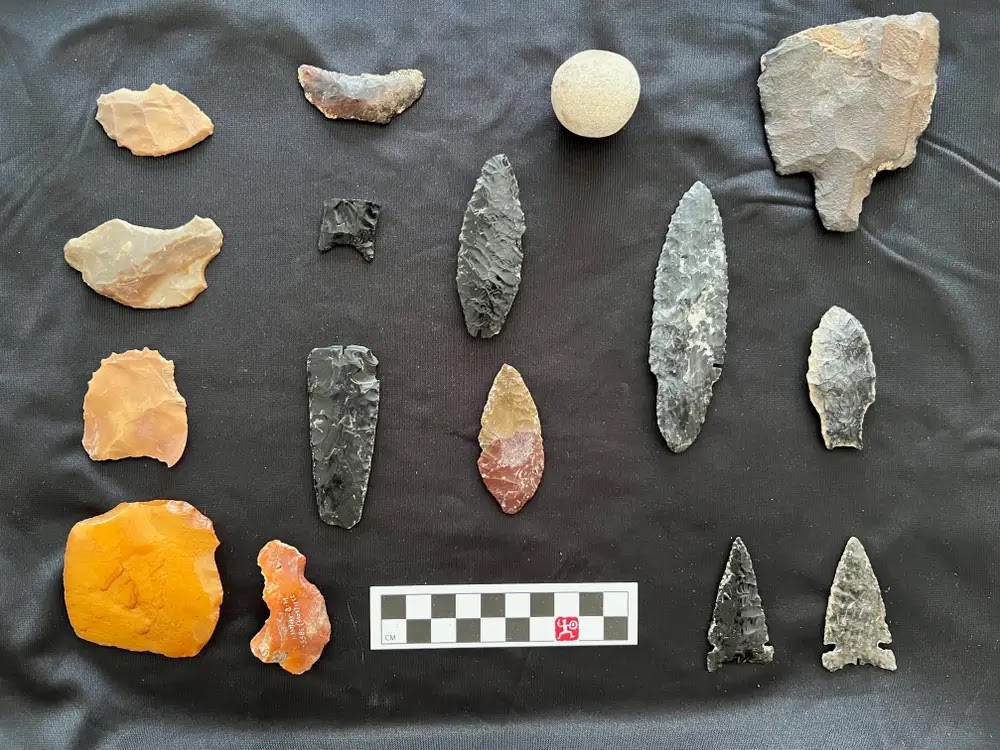
[Not rock pile related] This is new evidence that confirms humans in America before 20K years ago. Go early man!

“Then came the marvelous rock pile caves. As we don’t have
many real caves here in Connecticut, most of them are large rock formations
overhanging, though some have a few smaller spaces connected. Since I didn’t
get to see the cave two sections back, this would suffice. We had fun exploring
and taking pictures. Someone had made a little wall of rocks along the edge,
and built a fire ring. This spot would definitely protect you from bad weather
in a pinch and I said to the group that I was sure that native Americans met or
lived here like the nearby caves. Or at least sought shelter. I wouldn’t be
surprised if this wasn’t one of the legendary leatherman’s spots on his route.
I’ll have to look that up…”


https://happyonthetrails.wordpress.com/tag/rock-pile-cave/


(Apparently, I had seen something about Rock Pile Cave before:)
http://rockpiles.blogspot.com/2013/10/boulders-and-ledge-at-rock-pile-cave.html

More people are beginning to believe:
18,000-Year-Old Stone Tools Are Among the Oldest Found in the US (businessinsider.com)
A recent email communication, addressed to me and possibly to the "Rock Piles" blog as well, although the "Wake up!" seems aimed at my blog "Waking Up On Turtle Island:"

I find that: “The
Mudfossil hypothesis is an observational science, 1st proposed by Roger Spurr
and now by many others. This theory holds that rocks and mountains resemble
petrified creatures and such resemblances are due to the fact they were living
at one time.
This constitutes
some evidence for us that many rock forms are composed of the fossilized
petrified remains of dead life forms and in the case of larger rock formations
and mountain faces, some of these life forms were enormous,” according to the
Amazon blurb for several related publications.“
I find that there’s
an Acedemia.edu page for this “Mudfossil Business,” but there’s not too much to
read but plenty to see on the YouTube, if one has an enormous amount time to waste
listening to the rather bizarre delusions put forth regarding the “Discovery of
ancient giant body parts (stones which) were tested and shown to be human. They
were DNA tested, CAT scanned and anatomist verified:”

Accused of being delusional myself, I find that "The distinction
between a delusion and a strongly held idea is sometimes difficult to make and
depends in part on the degree of conviction with which the belief is held
despite clear or reasonable contradictory evidence regarding its
veracity." Bortolotti, L. (7 June 2013). "Delusions in the DSM 5".
Imperfect Cognitions.


“A bizarre delusion, by contrast, is something that could
never happen in real life, such as being cloned by aliens or having your
thoughts broadcast on TV. A person who has such thoughts might be considered
delusional with bizarre-type delusions.” https://www.webmd.com/schizophrenia/delusional-disorder

BY DAN KOIS (SEPT 24, 2023):
“Among the most curious submissions was the United States’ proposal: a group of eight sites in southern Ohio featuring earthen mounds and walls, collectively called the Hopewell Ceremonial Earthworks. For nearly two decades, a mostly volunteer group of dedicated archaeologists, historians, and Native American tribal officials has been patiently making the case that these mysterious, not particularly photogenic piles of dirt are as culturally and historically significant as Stonehenge or the Colosseum. They’ve battled local opposition and national obscurity, and in some ways, the sites themselves, which are sprawling, sometimes heavily forested, and at several locations, plowed over by centuries of farmers. One is across the street from a federal prison. Another has been turned into a golf course…"


More: https://wakinguponturtleisland.blogspot.com/2023/09/the-wonders.html
A (virtual) library talk by Mike Luoma about his new book.
Ancient Stone Mysteries of New England (Virtual) | Southwick MA
Registration for Zoom, email to: southwicklibrary@comcast.net
“The first beginning of the rite (i.e., of the formulaic part) is at Imnanava'ram,

A KARUK WORLD RENEWAL CEREMONY AT PANAMINIK BY PHILIP
DRUCKER
“The entire ceremony, called ira'hip, or pikia'vish,
"to make again" (both names were used), was performed annually for
the purpose of ensuring plenty of food and freedom from sickness for the
ensuing year. The esoteric part was a sort-of perambulatory ritual, in which
the priest recited formulas and visited a number of sacred spots in the near-by
hills, one each day in a fixed sequence. The exoteric feature was the
performance of a white deerskin dance on the last two days and nights of the
ceremony by the people from Panaminik and adjacent towns. This dance was
actually given only every other year; on the alternate years there was a feast
given by the rich men of Panaminik. The dramatis personae of the ira'hip were: ikha'riara,
or fatawe'na, "first-spirit person," the priest who knew and
performed the esoteric rites; pishi'shikiya'- wun, the woman who cooked the
priest's single daily meal of dried salmon and acorn mush during the ritual;
several assistants to the priest, including two girls (kiya'wun) and a youth,
whose functions seem to have been omitted in the last few performances; and
last but by no means least, the rich men, who provided the objects of value for
display in the dance and food for the feasting. The role of priest could be
taken by any man belonging to Panaminik who knew the ritual. In the ceremonies
in which the informants took part it was customary for several men to relieve
one another as priest, each serving for two or three days, because the slim diet,
hill-climbing, and loss of sleep made the priest's role an arduous one…”
“On reaching the sacred spot, a small circular clearing in
the brush, the priest first had to clear away the year's accumulation of leaves
and twigs, after which he gathered a pile of wood. He laid some tinder on a
small flat stone, lighted it with his fire drill, then set stone and all under
the wood laid on the fireplace. While the fire burned, the priest sat on a flat
rock to one side, smoking his pipe. He did not pray at this time. After the
fire had died down (and he tried to time it so that he might return to the
sweat house by dusk), he removed from the embers the small stone on which the
tinder had been placed, throwing it on a pile of other stones which had been
used thus in previous years…”
“The first beginning of the rite (i.e., of the formulaic
part) is at Imnanava'ram, a rock pile just below the mouth of Clear creek where
there is a riffle. Here a beginning is made in July; the climax as described
seems to fall in August. The ceremony as a whole clearly centers about Inam, on
a flat on the s side of Clear creek, and it is to be assumed that in this town
stood the sweat house specially connected with the formulist's activities.”
January 10, 1936


Congratulations to another author, writing about ceremonial stone landscapes:

I'm reasonably sure this is the foundation and not the "Indian Barns mentioned in the text:

“The Stephen Talkhouse Pharoah house was used by Pharoah later in his life. The house featured two “Indian barns” as food storage, and a footpath toward Bridgehampton on it’s edge.

The foundation remains today, but the house may have been a wood cabin during its use…The shallow pits to the north of the foundation, known locally as, “Indian barns,” were most likely covered with woven thatch and used for food storage…”
https://nativelongisland.com/listing/stephen-talkhouse-pharoah-house/
From the "Bulletin of the Massachusetts Archaeological Society," Vol. 23, Nos. 3 and 4 Massachusetts Archaeological Society (July 1962):
“These underground
barns have been opened or reported in modern times in such widely scattered
places as the Connecticut Valley of Massachusetts and Vermont, Ware River
Valley, Sudbury Valley, Plymouth County, South Woodstock, Connecticut, and
Kennebec Valley in Maine. Occasionally, the character of the contents is still
identifiable. Storage pits have been frequently referred to by early writers,
as may be seen by William Bradford's account: In November, 1620, just before
the Pilgrims landed at Plymouth, they ran into storages on Cape Cod, under
"heap's'of sand newly padled with their hands which they, digging up,
found in them diverce faire Indean baskets filled with corne, and in some
eares, faire and good, of diverce collours . . . a very goodly sight," for
which, at a later date the newcomers gave them "full satisfaction . . . to
their good contente."
Other early
commentators record the presence and use of earth storages on Long Island (very
numerous in 1642), in the Massachusetts Bay Colony, and in Southern Maine.
However, none have been recorded in Maine east of the Penobscot, (Burrage).
By what
characteristics would an archaeologist recognize such an Indian storage pit?
A number of early explorers and colonists have described
vividly such storages here in Massachusetts. The record of Champlain, on Cape
Cod, is admirably clear (1604): "They make trenches in the sand on the
slope of the hills, some five or six feet deep, more or less. Putting their
corn and other grains into large grass sacks, they throw them into these
trenches, and cover them with sand three or four feet above the surface of the
earth, taking it out as their needs require. In this way it is preserved as
well as it would be possible to do in our granaries."
Morton, in his New
England Canaan, adds details: "Their barns are holes made in the earth,
that will hold a Hogshead of corne a peece in them. In these, (when their corne
is out of the huske and well dried) they lay their store in greate baskets ...
with mats under, about the sides, and on the top; and putting it into the place
made for it, they cover it with earth."
John Winthrop, Jr.,
Governor of Connecticut (1657), mentions that their underground barns were
"well lined with withered Grass and with Matts" before being covered.
The contents, he observes, "Kept very well." Wood, in his New England
Prospect (1634) reports a slightly different practice: "Their corne being
ripe, they gather it and drying it harde in the sun conveigh it to their
barnes, which be great holes digged in the ground in the form of a brasse pot
seeled with the rinds" (bark) "of trees."

https://vc.bridgew.edu/cgi/viewcontent.cgi?article=1088&context=bmas
“Pre-contact basketry was intimately related to women's
subsistence and economic activities which centered on the production and
distribution of food, and it is this cultural feature that enabled women to
accumulate wealth and positions of cultural authority. The household/clan/com economy of the
pre-contact Algonquin coincided with the "Old Birch-bark Hunting
Culture" in which women were skilled experts in birch-bark technology.
Using birch bark, women erected quick and efficient shelters, made light-weight
waterproof utensils and covers for canoe frames (Butler and Hadlock 7). Few
original birch-bark articles have survived; however, colonial records describe
several uses of birch-bark construction that played significant economic roles
within women' s com and household economy. Because birch-bark is durable,
waterproof, odorless, tasteless and resistant to decay, it protects stored
items, such as food, from spoiling. "Equally important was the fact that
enough birch-bark for the Indian's needs was almost always just outside their
wigwams" (Butler and Hadlock 6-7). Birch-bark was symbiotic with Algonquin
women's com economy; for example, women used sheets of birch-bark to sun-dry
their com, they stored dried com in bushel size birch-bark baskets, and they
lined the underground walls of their "Indian
barns" (underground granary) with birch-bark…”
From Fishing Weirs to Fancy Baskets: How Changes in Native American Basketry Forms Reflect Changes in the Economic Independence of Native American Women during Colonization - Heidi J. Pickering (2010)
https://creativematter.skidmore.edu/cgi/viewcontent.cgi?article=1074&context=mals_stu_schol
From "Native Tech:"

A pretty material. This is smoothed out from being in the water.


