Thursday, November 05, 2015
Boston-Maine Railtrail, Mason NH Part B
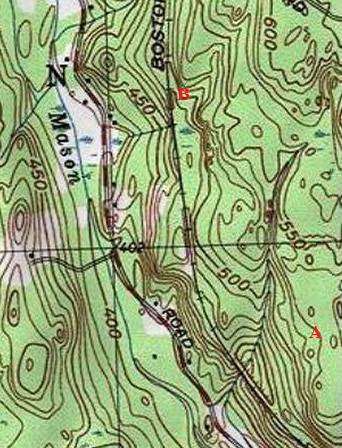
Continuing from here. We walked out of the woods back to the rail trail, went further north and looked at a massive wall next to and below the rail trail. It was at "B" on the map, actually the top of a watershed leading to Mason Brook.
Looking down from above:
Here we are looking at the well made end of the "wall". Looking back towards the railroad bed above:
Some panoramas:
I was commenting that there is a lot of internal structure in this "wall".
Meaning: nooks, crannies and well built faces in the middle of the wall, not at the edges. For example:
closer:
Last look (the railroad bed is the higher ground behind):
I don't believe for a second that that is a colonial wall for any of the usual agrarian reasons.
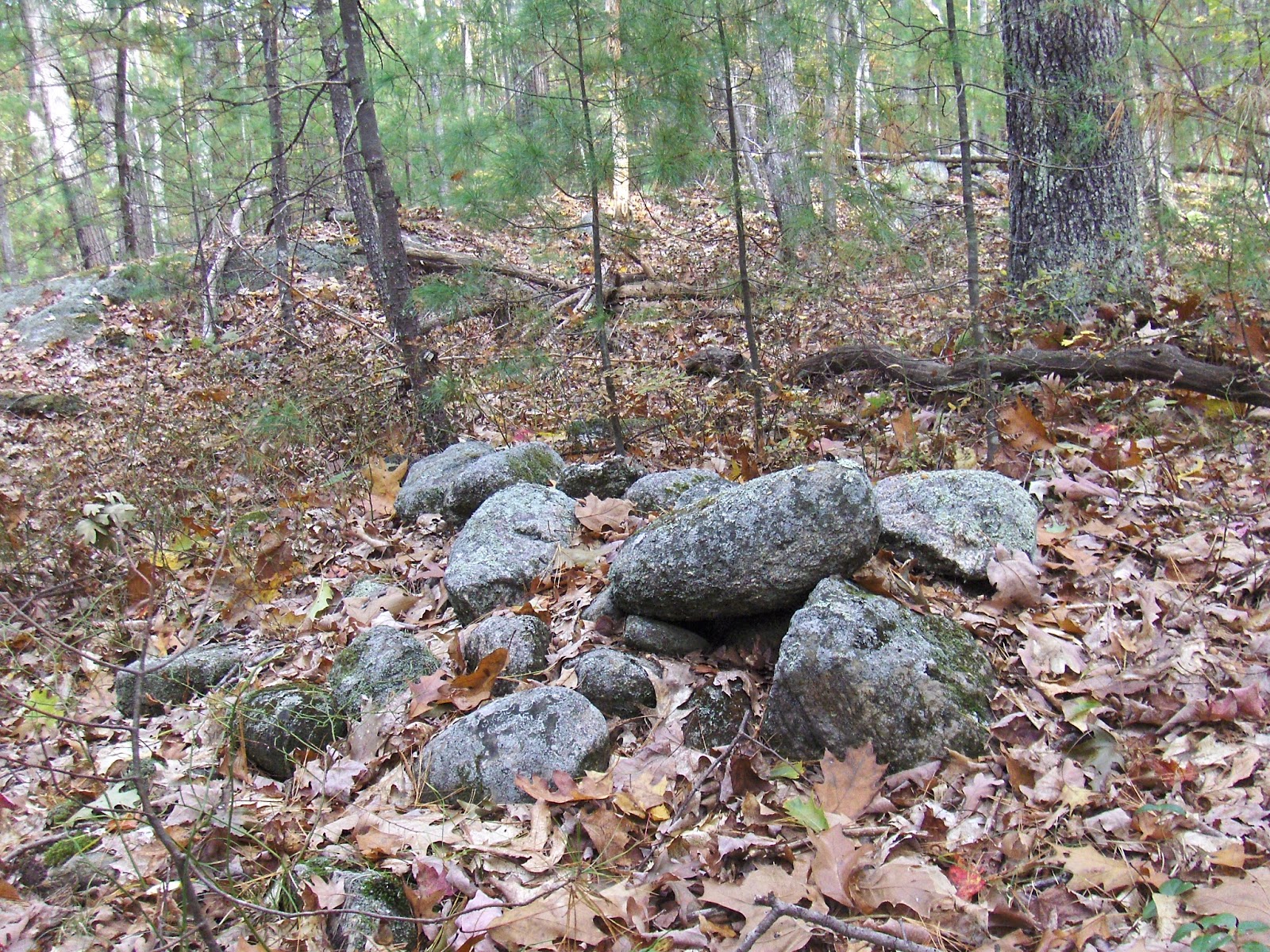
Suspicious, we explored the vicinity carefully....oop! here is a small pile and then something bigger in the distance (about 40 yards from the "wall"):
This is a large trench in a pile, at the end of a regular wall:
I have seen trenches like that before, eg in Estabrook Woods and on Mt Elam. I interpret them as mass burials representing something quite different from the individual piles with hollows, seen up hill to the south (around "A").
Closeup of the trench:
A nearby pile with quartz:
And a low pile connecting the trench to the end of the regular wall:
Looking down from above:
Here we are looking at the well made end of the "wall". Looking back towards the railroad bed above:
Some panoramas:
I was commenting that there is a lot of internal structure in this "wall".
Meaning: nooks, crannies and well built faces in the middle of the wall, not at the edges. For example:
closer:
Last look (the railroad bed is the higher ground behind):
I don't believe for a second that that is a colonial wall for any of the usual agrarian reasons.
Suspicious, we explored the vicinity carefully....oop! here is a small pile and then something bigger in the distance (about 40 yards from the "wall"):
This is a large trench in a pile, at the end of a regular wall:
I have seen trenches like that before, eg in Estabrook Woods and on Mt Elam. I interpret them as mass burials representing something quite different from the individual piles with hollows, seen up hill to the south (around "A").
Closeup of the trench:
A nearby pile with quartz:
And a low pile connecting the trench to the end of the regular wall:
All of which says this is not just a collection of walls.
Wednesday, November 04, 2015
A walk in Mason NH - Boston and Maine Railtrail
A friend from Concord, Carol Montgomery, offered to show me a rock pile site she found in Mason NH; and she took me to a "Rail Trail" heading north from Morse Rd at the southern edge of Mason NH [turned out this was one road west of my furthest west exploration up there].
A few yards in we scrambled up the railroad cut, crossed a wall
and stepped into an extensive area of arranged rocks (at "A"), short stretches of wall, and hollow outlines that are familiar to me from down closer to Fitchburg.
What would this arrangement have been for?
In several places I thought there was a trail passing the structures. For example on the right of the boulders:
Also, there was clearly an old road here:
Since the road went right through here, it suggests the road and piles were "known to each other".
Another bit of old wall [this answers a request by Tim MacSweeney to supplement of the picture ("A picture tells the whole story") from a few days ago. Tim: this is how the wall looked.]
Smaller occasional rock piles grew larger and more frequent as we headed north. Finally we started seeing outcrops with piles built on top of them, and with suggestive "divets" are the edges:
A few yards in we scrambled up the railroad cut, crossed a wall
and stepped into an extensive area of arranged rocks (at "A"), short stretches of wall, and hollow outlines that are familiar to me from down closer to Fitchburg.
What would this arrangement have been for?
In several places I thought there was a trail passing the structures. For example on the right of the boulders:
Also, there was clearly an old road here:
Since the road went right through here, it suggests the road and piles were "known to each other".
Another bit of old wall [this answers a request by Tim MacSweeney to supplement of the picture ("A picture tells the whole story") from a few days ago. Tim: this is how the wall looked.]
Smaller occasional rock piles grew larger and more frequent as we headed north. Finally we started seeing outcrops with piles built on top of them, and with suggestive "divets" are the edges:
There was much use of quartz:
Just next to this pile was a structure that looked too delicate to last long:
But it had a good coating of lichen and was sturdy. It is just possible this has been in place for a while. Still...more than 100 years? I have a hard time believing it. Many other piles looked completely buried and old. After this we saw many smaller piles with quartz, some with visible "hollow" in the middle. Let's follow along the outcrops, looking at quartz and at piles with hints of structure:
Look carefully:
Sometimes I think a site may have been selected because it is in a key location with outcrops angling in a useful direction. For example, here much of the site seemed lined up with outcrops or built into them. Other examples: Codman Hill Harvard, and Behind the Horse Farm just northeast of there.
One last example of this series was particularly nice:
Look how it continues:
And tapers off delicately:
Then we were into a flat area with beautiful little domed piles, each with quartz, possibly in a grid:
Tuesday, November 03, 2015
Jalisco, Mexico 1890-1898
Huichol medicine man,
Stones on a boulder in a grove of
trees.
What kind of trees?
What’s growing below the trees and
around that stone feature?
Is there an enclosing row of stones, stacked to
resemble a surrounding serpent?
Collection: Lumholtz Expedition to Mexico
Citation: Image Number: 43734
“Andres Teodorr, Huichol medicine man, Jalisco, 1890-1898,” Lumholtz, Carl, 1851-1922, AMNH Digital Special Collections, accessed November 3, 2015, http://images.library.amnh.org/digital/items/show/27158
Digital Special Collections of the
American Museum of Natural History’s Research Library
Stones and
more on a boulder,
What else has
been placed there?
Subscribe to:
Posts
(
Atom
)