Tuesday, August 16, 2022

Tiverton #2

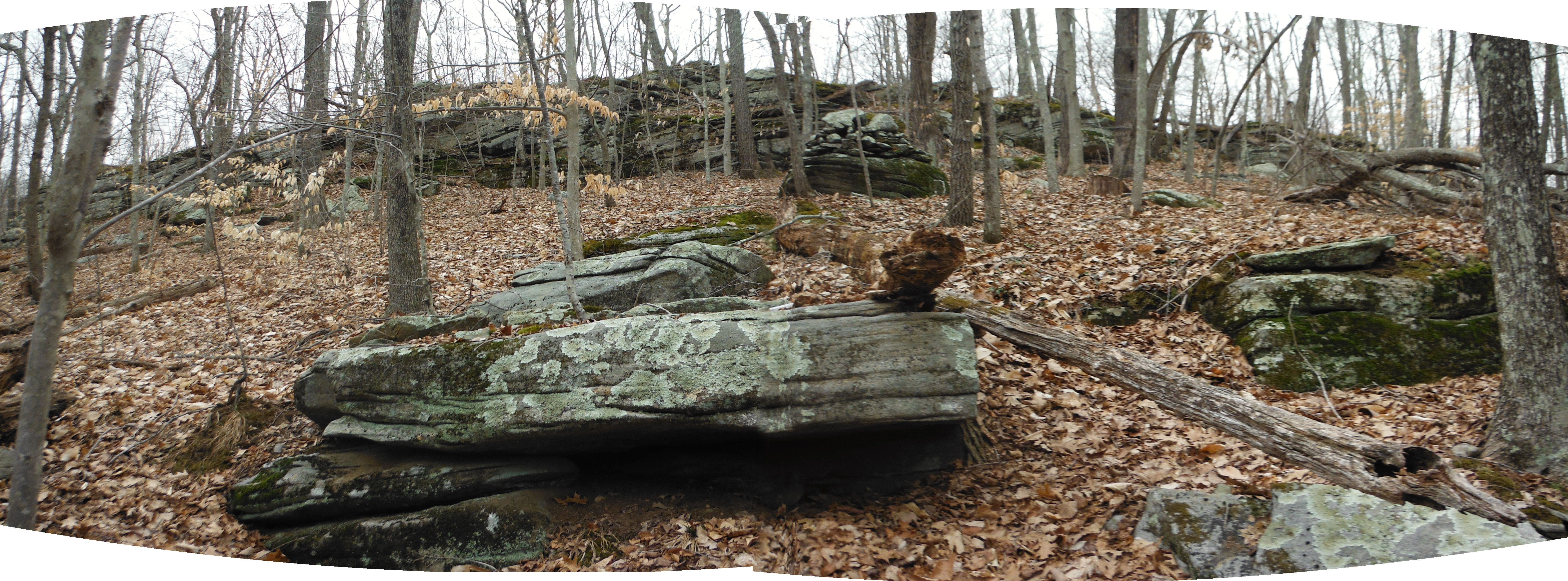
Continued to visit Tiverton, RI with a walk around Wildcat Rock. Felt like I spent a lot of time in the lowland bushes. Although these are pretty woods, they were astoundingly empty of signs of ceremonial activity. I expected more. 

What I did find were examples of quartz rock-on-rock. This is an unusual feature in the parts of MA I have explored but they are common here in Tiverton for some reason.

Here is one:

other direction
another
another
further away
another
The woods were pretty empty of other features. Why? Had they been destroyed? These woods have seen a lot of activity. Or were they never here? Perhaps Tiverton was a no-man's land of some sort.

Sunday, August 14, 2022

A walk in Tiverton RI

I parked on Progress Way, behind the Longplex Family Sport Center and dove into the woods, heading south. 

Rt 24 cuts across the upper left of the map fragment and I think I was following the dotted line, indicating an old road, that starts in the middle of where Rt 24 bends to the northeast. There were magnificent walls, mostly cast down and varying greatly in height. [Something wrong with my writing today...sorry].
I was confident that this was good hunting territory and, sure enough, that looked like a mound - not a wall - over behind there:

You see:
From the other direction:
And a closeup:
You can see this as two parallel ridges with a lower place in between - in the spectrum of "rectangular"; possibly with a "hollow".  Another angle:

Continuing my walk, here was a little gateway:

And here was a little knoll, crossed by a wall, and I thought I should climb and look beyond that wall:
Ah! A small site with groupings of piles-on-support:


Some of the piles and boulders seemed to define small spaces:

And then one of the most interesting things was some spurs coming out from the stone wall that also defined spaces (but this might be a different kind of "space"):
I have not seen too many of these but this is my first foray into Rhode Island . It is an hour's drive from Falmouth but I think it is worth it. There are lots of other woods in Tiverton to explore.

"Soaring With Eagles" - stone mounds in Georgia

[via Norman Muller]

Soaring With Stone Eagles - Archaeology Magazine 

Friday, August 12, 2022

Summer....it was nice to see you....sad to see you go

Tiverton Appetizer

 
I decided I needed a hike and drove an hour off-Cape to get to someplace interesting. Tiverton turned out to be a good choice and, as I study the map, I see five or so other hikes that look interesting in that town. There is a lot of conservation land, hard bedrock, and water. So I think I'll go back and get to know the place a little.

Thursday, August 11, 2022

Tuesday, August 02, 2022

37K old site found in New Mexico

New Mexico mammoths among best evidence for early humans in North America (phys.org)

I note a couple of bits of sloppiness in the reporting. Clovis is only around after 14K years ago and there is no mention of the White Sands footprints - also in New Mexico. Finally the idea that it is now OK to accept a second group of "first Americans" to supplement the failing story of "Clovis First" is no less absurd than having a single such group.

Update: It is almost like a "Clovis Second" concept.

Sunday, July 10, 2022

Rest in peace Larry Harrop

Our community will be sad to hear that Larry Harrop died. No details are available, other than that he died in early June.

Larry was an occasional contributor to this blog and, although I only met him once, I always thought Larry took the best rock pile photographs. He did a wonderful job capturing the mystery, atmosphere, lighting, color, and beauty, of rock pile sites- mostly in Rhode Island. When I think of Larry I will always think of rock piles in the fog. His photos remain imprinted in my mind. 

His photo albums disappeared quickly from the internet but we have a few here to remind us of his work. See here.

Monday, June 27, 2022

A hole, trailing cobbles, and adjacent mound.

https://youtu.be/R4mDAq3Gzwo

This is in Wheeler Woods, west side of the new trail made by the Buzzard's Bay Coalition, who bought a heck of a lot of archeology without realizing it. You can see these things from the trail, above the main kettle hole.

Bullseyes and Rings

 I saw a couple of ring-inside-ring structures a year or so ago, at Quisset Harbor on Cape Cod (see here), mixed in with some other examples of simpler rings. Here are the photo's I took:


And


Since these are below high tide, I guess they were used when the water was still several feet lower. It gives you a sense of age.

Anyway, I saw another one, not so much a ring in a ring, but you be the judge:

These are all coastal facing, along this eastern edge of Buzzard's Bay.

Just for fun: A friend of mine climbed Mt San Gorgonio in southern California. Which drew my attention to the aerial view of that mountain top. One imagines the "ring of stones" concept was pretty universal:

You could probably write a book about what kind of archeology is found on American mountain tops. Possibly similar things were practiced at the other extreme - at the edge of the sea.

A little "spell" in stones

Just being a contrarian, I think there is a slight different between a "spell" and a "prayer". The latter suggests something that is always benevolent; where the former might be malevolent as well.

Nowadays, when I see a little structure like this, I believe it is worth looking carefully at the individual rocks.

I see an old friend here, the cashew/boat rudder that is sometimes called a "manitou" but I beg to differ. As long-time readers may remember, I speculate that this has to do with making an agreement.

The middle rock is pretty non-descript.
The lower rock has a bit of shape too. Is that a Manitou? A Cashew? Something else?
It may all be nothing, or a meaningful little combination of elements.

This is left of the entrance to the WHOI Quisset campus, about 30 yards from the main road. I would mention that the valley to the right of the entrance is full of dumped rocks. Small rocks, compatible with being from disturbed mounds, I could not quite convince myself the piles were anything other than mundane. On the other hand, this part of Woods Hole is where most of the genuine mounds are, so that suggests they might be worth a closer look.

Sunday, June 26, 2022

Eagle Rock 4H Mounds (GA)

(Replaces a removed post from 6/2016)

Mound Report: The following chapters are excerpts from a larger report titled: “Archeological and Historical Investigations for the Proposed Rock Hawk Trail Corridor Adjoining Lawrence Shoals Park and Little Rock Eagle Mound in Putnam County, Georgia” written by Jerald Ledbetter:

"Standard survey field methods were employed in accordance to the scope of work prepared by the Office of Historic Preservation in consultation with the principal investigator. Information on 28 sites, four isolated artifact occurrences, and more than a hundred rock piles was recorded within and near the project area."

 https://archaeology.uga.edu/gasf/report/3598

Tuesday, June 21, 2022

Removing stones from rock piles for "safekeeping"

In the previous post [see here] Norman describes a "Gorget on a Rock Pile" and mentions that there was an unusual "gorget" stone found in the pile. Later the State Archaeologist removed the stone for safekeeping.

I think the ethics of removing a special rock from a pile for "safekeeping" needs some discussion. Does anyone have any opinions about this? I remember Doug Harris, in a YouTube video talking about how removing a rock breaks the "prayer"  - only to then watch him remove a rock and put it back. Clearly removing a rock permanently, and taking it off to a place where they have presided over the destruction of many wonderful things, hardly qualifies as "safekeeping". 

Like any ethical question, I doubt there is a good answer. I just think the state carting off treasures should be done with reluctance. And who the heck is the State Archaeologist anyway? Why does he get to destroy the rock pile? To me it is inconceivable that these are the right people to make that call, or to be the keepers of special ceremonial rocks. Generally such objects are poorly documented, not accessible to the public and, basically, lost for good. I would give you odds, that a member of the public, today, would have trouble even getting to see the "gorget".

Comments?

Saturday, June 18, 2022

Gorget on a rock pile

From NormanMuller:

In 2011 I was with a small group of NEARA members in Rochester, VT, which was led by Ernie Clifford.  We visited site R7-8, which is called the Beaver Pond site, near the larger Smith site.  We walked about a bunch of platform cairns and then came upon a low, long cairn on a rise overlooking a small brook and swampy area.  One member of our group saw a stone object resting on top of a large stone in the cairn  (`02-1702), and lifted it out for all to see (0060).  It turned out to be a preform slate gorget.  There was a bit of lichen at one end, and the surface that had been resting on the boulder had a rust color, evidently from the fact that slate contains some iron and it had oxidized out over time.  The gorget was also of poor quality, and had a number of deep scratches on it.  Obviously it was discarded because of this.  Most gorgets are perforated, but this one was not. 


I returned to the site the following weekend to photograph and study the gorget more carefully, placing it on a grey cloth and photographing top and bottom and one of the sides (0026).  I then placed the gorget back to where it was originally found.  Later, the National Forest archaeologist removed the gorget for safekeeping in Rutland.

This simply emphasizes that one should study cairns carefully.  You never know what you'll find.


Monday, June 13, 2022

“Stonewalls in a Gully” (VT)


Josh Smart
 Hidden Vermont


Why don't they have stone arrowheads in Europe?

I cannot find any pictures of elegant stonework from -say- France that is any more recent than those fine Solutrean blades. But what were the Europeans doing around 10K years ago? Just a little puzzle. I did see some fine things from Spain, so what is true?

Saturday, June 04, 2022

Our Vanishing Ceremonial Stone Landscape (CT)

    Apparently, I’m documenting Our Vanishing Ceremonial Stone Landscape more than anything else these days. Similar to Eric Sloane writing and sketching about a romantic colonial past, I’m instead blogging about and photographing disappearing features of an Indigenous Cultural Landscape that only a tiny percentage of people are aware of, think is somehow “interesting,” much less worthy of recognition, study, and preservation. I’ve been documenting for years the disappearing Nonnewaug Stone Fish Weir, miles and miles of stonework under power lines being ground up for road beds, stones popping out of retaining walls at the family home, and now a simple tree fall that knocked apart a formerly very beautiful “Stone Prayer” on a hillside somewhere close to the Madison/Killingworth town line.

    In a recent Face Book post, Karen Lucibello Daigle recorded a bit of video, perhaps in late winter or early spring, of some tree damage to this KáhtĂ´quwuk or Stone Prayer that I took a look at once back in 2016:

Captures from Karen’s video, cobbled into an image:


Some more images of mine from 2016:
(Note the Manitou Stone above, the "Healing Diamond" below.)


A couple other images in my most recent "K-WORTH 2022" folder:

Thursday, June 02, 2022

A last word about Canonchet

In the previous post, we saw a low rectangular mound that was different from the nicely built biscuits surrounding it. I forgot to mention one other out-of-sync pile, consisting of a layer of small rocks on a support boulder:

When you are extracting rocks from the ground, there will always be smaller ones. A characteristic of field clearing is that there are many smaller rocks mixed in with larger ones. That same size distribution was present pre-historically and it seems there was something that could be built from smaller rocks. I think I have seen this before without noticing it - a special, solitary, pile made from much smaller rocks.