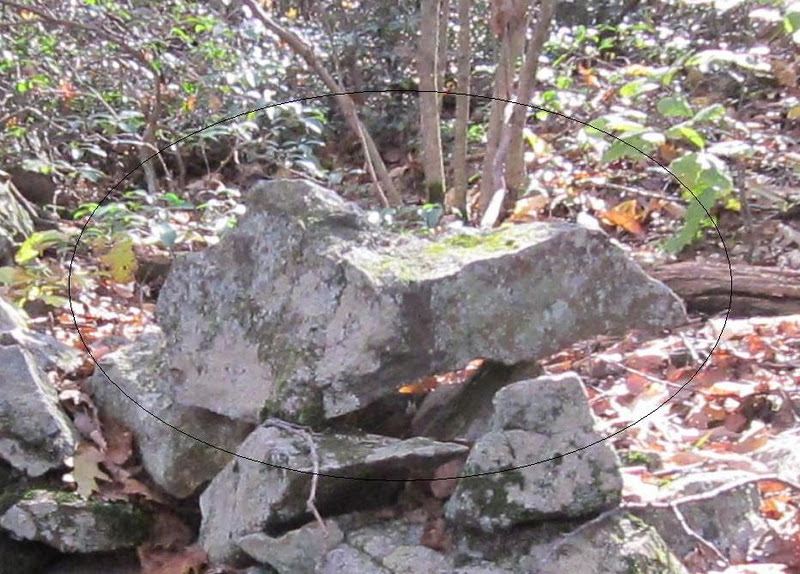
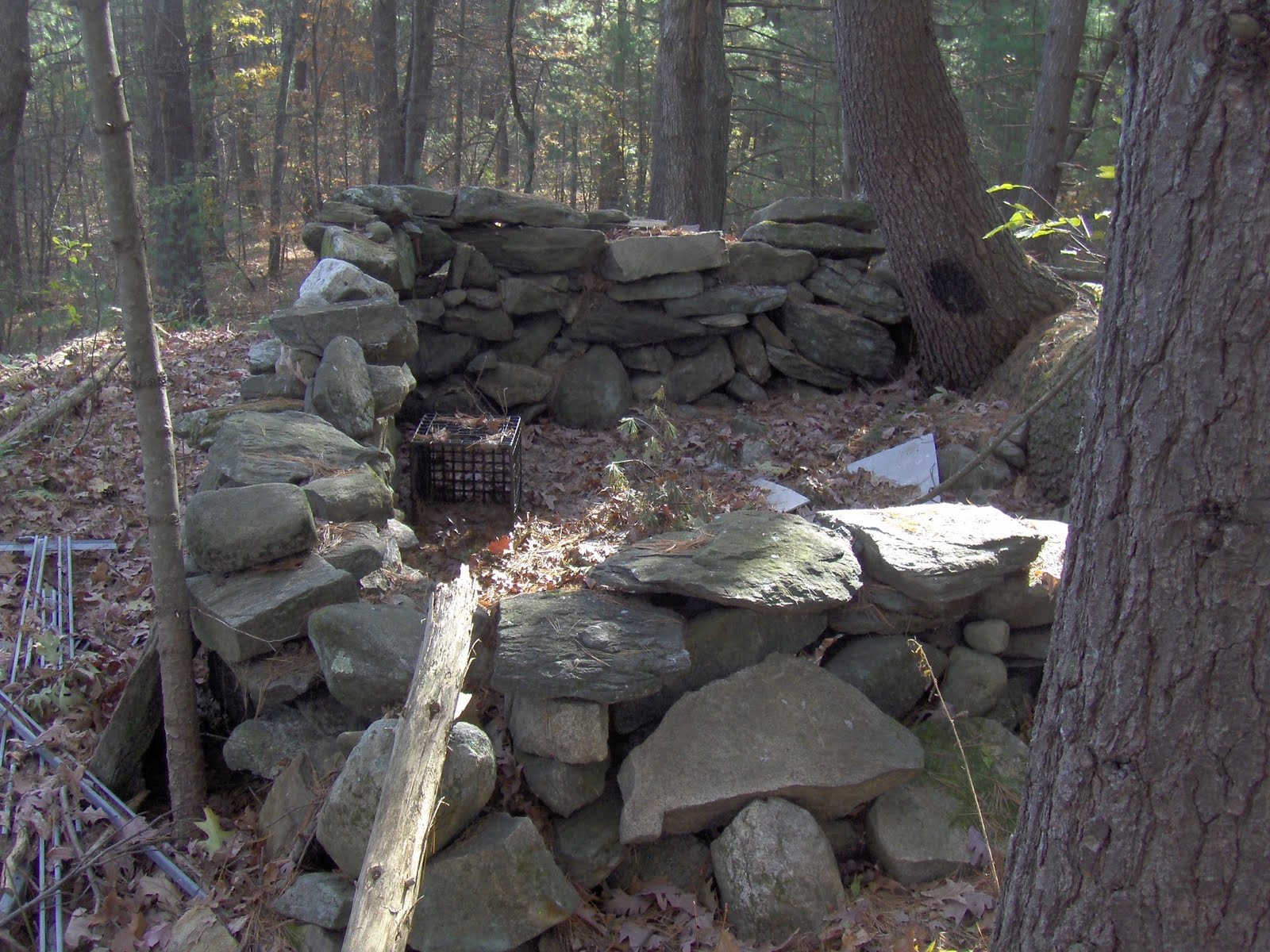
Here are a couple that I have found. Near the base of a small hill:
At the top of that same hill:
Peeking through the leaves in the foreground, near the top of the hill: a rock pile.
Friday, November 18, 2011
Looking for Bird Stones Online
So I start the day like I usually do. I make some coffee and turn on the computer.
When the coffee's done, I sit down at the computer desk and click the "Rock Piles" icon on my Desktop.
I'm happy because there's some new posts and some new comments, some of them continuing a conversation with me.
Who doesn't like that, a little validation on a subject most people consider just to be a symptom of mental illness, the delusion that common ordinary rocks are in fact artifacts of an ancient civilization?
I see Peter has posted up some links to "Bird Stones." Photos I've seen before, some I remember and others I don't, take on new meaning this morning because I've been doing some "Google Image" surfing and have just seen the same forms in smaller scale as well as in a more polished style. So I try to re-create the search to find those images and return the favor to my friend, validate his observations.
I find the first one and save it, along with some information as to where it was found, both physically and virtually (which website):
Bird Stone - Indian Relic - American Indian Artifact: This Bird Stone was found in Ohio. It measures 1 1/2" tall x 2 7/8" long x 1 5/16 thick.
http://www.mulewagon.com/product/bird-stone-indian-relic-american-indian-artifact
And then I come across a couple that are less polished and more greatly resemble our bigger cobbles - and boulders, now that I think about it:
"Kalamazoo Valley Museum; The carved bird-shape stone, called a birdstone, was found in the yard of Donald Myers of Comstock. Experts are not sure of their use but know they were made by inhabitants as many as 2,500 years ago. Myers gave the birdstone to the Museum in 2010." And it's a "Duck Stone" in a museum in Michigan, made by Algonquian speakers, the language group, a fact that validates our thoughts a little more. I see I've forgotten the space between "bird" and "stone." That's why I didn't see it before...
http://kvm.kvcc.edu/localhistory/thecollection/highlights/recent_aquisitions/donor_windows/native_american_artifacts.html

"Native American Indian Birdstone, pecked porphyry. 5 1/2" long. Ex. Dr. Warren Baker Collection." http://www.antiquehelper.com/item/308607
And then I see this in the images search page and I just have to click on it:
"This massive Indian thunderbird statue and egg has more color than most of the figurines we've found. Extraordinarily beautiful when wet, but shown here dry. The green color is the shade of the summer sky just before a big thunderstorm - when icy hail lurks above and reflects the greenery below. Rare green olivine quartzite with equally rare pink conglomerated quartzite egg (glacier ground), 3 parts. 6.3”h; 1762 gm"
And I just have to find out where it was found and just who this obviously crazy person is at http://www.iceageartifacts.com/index.htm. "Washed out af a hilltop cornfield in Illinois, overlooking the Spoon River," I find. And there's photo after photo, unusual stones sorted by color and type of stone, stacked up to make little petroforms, even this one of an "egg laying turtle:"
"Oh," I say to myself, realizing I've recreated a similar thing or two (or more), found in a "stone wall" (or three or more) or "pile of clearing stones" I think is a mound (or a hundred as well as in other peoples photos). And I think of a story stone that is a bird when viewed one way, and a fish and a turtle and a man and a dog and a snake, found in a cornfield across the street after a flood. And I think "Maybe they are not so crazy after all..."
When the coffee's done, I sit down at the computer desk and click the "Rock Piles" icon on my Desktop.
I'm happy because there's some new posts and some new comments, some of them continuing a conversation with me.
Who doesn't like that, a little validation on a subject most people consider just to be a symptom of mental illness, the delusion that common ordinary rocks are in fact artifacts of an ancient civilization?
I see Peter has posted up some links to "Bird Stones." Photos I've seen before, some I remember and others I don't, take on new meaning this morning because I've been doing some "Google Image" surfing and have just seen the same forms in smaller scale as well as in a more polished style. So I try to re-create the search to find those images and return the favor to my friend, validate his observations.
I find the first one and save it, along with some information as to where it was found, both physically and virtually (which website):

http://www.mulewagon.com/product/bird-stone-indian-relic-american-indian-artifact
And then I find a new one I hadn't seen before but "Hokey Smokes!" I think, "I'll be durned if that doesn't look just like that one Peter's linked to!"
"THIS BIRDSTONE WAS FOUND IN PIKE COUNTY OHIO AND IS MADE FROM QUARTZITE. IT MEASURES 2 1/2 INCHES X 1 3/4 INCHES. IT COMES WITH COA."
http://www.j-and-dee-artifacts.com/axes_bannerstones_birdstones.htm#birdstonesAnd then I come across a couple that are less polished and more greatly resemble our bigger cobbles - and boulders, now that I think about it:
"Kalamazoo Valley Museum; The carved bird-shape stone, called a birdstone, was found in the yard of Donald Myers of Comstock. Experts are not sure of their use but know they were made by inhabitants as many as 2,500 years ago. Myers gave the birdstone to the Museum in 2010." And it's a "Duck Stone" in a museum in Michigan, made by Algonquian speakers, the language group, a fact that validates our thoughts a little more. I see I've forgotten the space between "bird" and "stone." That's why I didn't see it before...
http://kvm.kvcc.edu/localhistory/thecollection/highlights/recent_aquisitions/donor_windows/native_american_artifacts.html
And there's a rougher one:

"Native American Indian Birdstone, pecked porphyry. 5 1/2" long. Ex. Dr. Warren Baker Collection." http://www.antiquehelper.com/item/308607
And an even rougher one, this time made of the material we find many of our stones are made of, in larger form:
grey/white granite with felspar, 3"x2"...more
And then I see this in the images search page and I just have to click on it:
"This massive Indian thunderbird statue and egg has more color than most of the figurines we've found. Extraordinarily beautiful when wet, but shown here dry. The green color is the shade of the summer sky just before a big thunderstorm - when icy hail lurks above and reflects the greenery below. Rare green olivine quartzite with equally rare pink conglomerated quartzite egg (glacier ground), 3 parts. 6.3”h; 1762 gm"
And I just have to find out where it was found and just who this obviously crazy person is at http://www.iceageartifacts.com/index.htm. "Washed out af a hilltop cornfield in Illinois, overlooking the Spoon River," I find. And there's photo after photo, unusual stones sorted by color and type of stone, stacked up to make little petroforms, even this one of an "egg laying turtle:"
"Oh," I say to myself, realizing I've recreated a similar thing or two (or more), found in a "stone wall" (or three or more) or "pile of clearing stones" I think is a mound (or a hundred as well as in other peoples photos). And I think of a story stone that is a bird when viewed one way, and a fish and a turtle and a man and a dog and a snake, found in a cornfield across the street after a flood. And I think "Maybe they are not so crazy after all..."
Thursday, November 17, 2011
Bird Stone
Here's a "new to me" Native American Cultural Motif found on a "stone wall" that sections off an area of several mounds on property that was part of my Great Granfather's farm, presently owned by my Uncle Bob. Now that I've seen it once, I'll know I'll be looking for more examples. Since it's so widespread, perhaps you'll see one too (if you look for it, that is). It's thought to be a "seated bird," important because it can fly and get close to the Creator...
A much smaller polished Red Slate Bird Stone
A few more photos of the stone row birdstone can be found at: http://wakinguponturtleisland.blogspot.com/2011/11/bird-stone.htmlThe site is described and pictured at: http://wakinguponturtleisland.blogspot.com/2011/11/old-horse-field-and-outcrops.html
Still looking for a job
[Not rock pile related]
Does anyone within earshot have any C++, math, or writing I can do for them?
I am going to go out in support of the the 99% today.
Does anyone within earshot have any C++, math, or writing I can do for them?
I am going to go out in support of the the 99% today.
Back to Fitchburg, with Friends
Wanted to show people those flat topped, rectangular, "pyramid", mounds. Also tried to take some 3D photos. Brought my normal camera also. Note the quartz on the right hand side.
Here, people are getting excited by the way the quartz is clustered:
A friend finds an outlier pile at the edge of the site:
Another view. This pile had a lot of lateral symmetry, suggesting an effigy:
Also spotted some new piles next to the trail on the way back out. Easy to miss.

Wednesday, November 16, 2011
Wall and old Laurel
History of wildland fires
By Gary W. Mullins - BLM/National Interagency Fire Center
November 16, 2011
"Where do we start discussing wildland fire history-with the beginning of the Earth, with the first hominoid use of fire, which may have occurred well over a million years ago, or with the evolution of prescribed fire beginning in the 1930s in the United States? Or do we define prescribed fire in terms of the Australian Aborigine ancient "firestick" land management practices where fires were started continuously to cleanse the land...The earliest European settlers to North America noted indigenous peoples' use of fire for clearing land, hunting and gathering activities, and in warfare. The American Bison (buffalo) arrived on the eastern shores of what is now the United States about the time of the arrival of the Mayflower. This migration of bison has been attributed in some part to the opening of grazing areas by Native American practices of burning the land. Native American oral history is rich with stories about fire and how fire came to humans; their drawings depict the use of fire. William Bartrum, noted naturalist, during his travels in Florida in the 1700s, reported fires burning somewhere every day. While Native Americans had fire firmly rooted in their way of life, post-Columbian immigrants in the new world sought a new order which did not embrace fire as a natural process. Suppression became the call..."
http://www.federalobserver.com/archive.php?aid=5410
Just another quote added to my files, seeing "stone walls" as Native American Fire Breaks on the Sacred Cultural Landscape of Turtle Island.
Monday, November 14, 2011
A new site
It has been a few months since I have found a new place to look for Indian artifacts. I have found a lot of stuff lately by being thorough and patiently searching and re-searching in places where I have found things in the past, but I have been yearning for the thrill of finding something in a new and different place. I am also always hoping to find a place in a different setting where I can find different sorts of artifacts as I continue to study these old stone tools. Lately, I have been looking for new places that might be classified as coastal sites, thinking that maybe here I could find things that I have not come across in the mostly inland places I have had luck in so far.
Last week I put in some time and identified three new places that seemed likely, in an area where I have never looked before. After a little road trip on Saturday morning I could spend some pleasant hours outdoors looking. The first place was all rocks and gravel, stones of all sizes mixed with broken glass and trash. I carefully looked there for a while but the amount of rocks to sort through was just overwhelming. In the second place, I was surprised to see a couple of other people with sticks out there flipping over rocks, also looking for arrowheads. They were there first so I got back in the car and drove somewhere else, some distance away, and the conditions were not so bad, and there was nobody else there, and no indication that anyone else had searched there. I found this after a short while:
It is a mostly intact quartz point, fairly crude. I am not sure what to call this shape, or how old it is. I might speculate that this shape might have been used to spear fish or frogs, but I am just guessing. I spotted this just a few feet away:
After I wiped the dirt off:
This is the same shape as the other one, a little nicer. It is asymmetrical and probably reworked from something bigger. I was very pleased to spot this:
I don't get to find too many with nice visible flaking like this. I really like this shape and material, I think this is a type of rhyolite. This was a lot of fun to find. I think it is what is called a Lamoka point, perhaps 3500-5500 years old.
Here is what they looked like after I got them home and washed them off.
That night I agonized over the thought that I might have missed something. Looking at a satellite view, I could see some adjacent spots I had not explored, that seemed like good places to look. Sunday was a busy day for me but I realized that if I planned my day just right I could return to this place, but would only have 30 minutes to look. I raced there and ran from spot to spot, everywhere I wanted to search was either simply too choked with thick weeds, or was sticky mud and ooze with no rocks visible. But I did spot this:
This is the same shape as the ones from the day before, but about twice as long. It is missing the tip. I'm very pleased with these finds and look forward to learning more about these lanceolate points. I will return to this place and hope that with time I will make more finds that will help me understand what went on in this place, centuries ago.
Last week I put in some time and identified three new places that seemed likely, in an area where I have never looked before. After a little road trip on Saturday morning I could spend some pleasant hours outdoors looking. The first place was all rocks and gravel, stones of all sizes mixed with broken glass and trash. I carefully looked there for a while but the amount of rocks to sort through was just overwhelming. In the second place, I was surprised to see a couple of other people with sticks out there flipping over rocks, also looking for arrowheads. They were there first so I got back in the car and drove somewhere else, some distance away, and the conditions were not so bad, and there was nobody else there, and no indication that anyone else had searched there. I found this after a short while:
This is the same shape as the other one, a little nicer. It is asymmetrical and probably reworked from something bigger. I was very pleased to spot this:
I don't get to find too many with nice visible flaking like this. I really like this shape and material, I think this is a type of rhyolite. This was a lot of fun to find. I think it is what is called a Lamoka point, perhaps 3500-5500 years old.
Here is what they looked like after I got them home and washed them off.
That night I agonized over the thought that I might have missed something. Looking at a satellite view, I could see some adjacent spots I had not explored, that seemed like good places to look. Sunday was a busy day for me but I realized that if I planned my day just right I could return to this place, but would only have 30 minutes to look. I raced there and ran from spot to spot, everywhere I wanted to search was either simply too choked with thick weeds, or was sticky mud and ooze with no rocks visible. But I did spot this:
This is the same shape as the ones from the day before, but about twice as long. It is missing the tip. I'm very pleased with these finds and look forward to learning more about these lanceolate points. I will return to this place and hope that with time I will make more finds that will help me understand what went on in this place, centuries ago.
Bourne Hill, Wareham - ALERT
Tim Fohl emailed that this hill is about to get some of its stones "re-arranged" by a trail committee. Usually this is not a good idea on a hill and rumor has it that there is a ceremonial site up there. Anyone living in the area might get involved with this.
Friday, November 11, 2011
Tom Warrups' Rock
"Tom (Warrups) had a house on the high ridge back of Captain Isaac Hamilton's, now owned by William Sherwood. It was built, it is said, in primitive Indian style, of poles set firmly in the ground, then bent and fastened together at the top. This framework was covered with bark, and roofed with reeds and rushes. Its furniture consisted of framework bedsteads, with bedding of skins, wooden bowls fashioned from pepperage knots, huge wooden spoons, baskets made of rushes or long grass, pails of birch bark, and an iron pot and skillet begged or borrowed from the settlers. His sister Eunice was his housekeeper...Except in war he was a worthless, shiftless fellow, and lived chiefly by begging; hunting and trapping were his recreations. He would often absent himself from his hut for weeks at a time, sleeping in barns or in the forest. A huge overhanging rock about a mile north of Georgetown often sheltered him on these occasions, and is still known as Warrup's rock."
http://www.historyofredding.com/HRearlysettlers.htm#Chicken Warrup
It may be what became known as Sarah Bishop's Cave. Some of the images I found say it was in Redding CT, others, North Salem NY. The cave appears to have a rock wall in front of it, much like two sweat lodges I've posted about (that are known as "caves")...
Image source: http://www.ridgefielddiscovery.org/ContentPage.php?page=SarahBishop
http://www.historyofredding.com/HRearlysettlers.htm#Chicken Warrup
Image source: http://www.ridgefielddiscovery.org/ContentPage.php?page=SarahBishop
Bright Sun Light
Sometimes it happens
that a place you walked by a thousand times
looks different in the bright sun light.
And you say to yourself,
"Well of course!
These things were meant to be seen
In every kind of light."
Testudinate Poetry excerpt from: http://wakinguponturtleisland.blogspot.com/2011/11/bright-sun-light.html
Thursday, November 10, 2011
Forest Hill Dunstable
Too big a place to explore thoroughly, I did a sweep that passed over the three summits and exhausted myself. Saw one faint trace of the Wachusett Tradition and come away mostly with the memory of a single perfect brook crossing.The drive north on Rt 3 had a sort of aesthetic:
Later, parking on Dunstable Rd and walking in westward towards the hill, I was confronted with a flooded trail and had to go upstream around the bend of the hill to the north, looking for a place narrow enough to cross.About half-way up the hill, facing north, I found something by sheer luck, I was not expecting anything midway up the hill. But here was a rectangular rock pile outline:
(from the other direction)
This pile was 10 feet uphill from the corner of a short L-shaped stretch of stone wall dis-connected from other walls:
A bit further west on the hillside was another L-shaped stretch of wall but it connected to other walls running along the hill:
I remember seeing other L-shaped short stretches of walls not too far away at a place called "Elbow Meadow" (click here).And that was about all I saw on this large hill. I would have explored more of it but found myself tiring more rapidly than expected, so I headed downhill back in the direction of my car. Ran into the same flooded area and was circling the wet area back towards where I first crossed the brook. But I took a chance and headed into a muddy area and found a place where a thin slippery log crossed the brook. Made a cane from a branch, planted it in mid brook. Took a first cautious step on the wet log, planned my next step carefully, swung my foot smoothly up to this spot, and stepped once more onto the muddy grass at the other side. The log was thin enough that it could have snapped and put me thigh deep into the brook but it all went smoothly - a memorable crossing.
What you learn in 10 years: revisiting an Acton site
This site in Acton, on private property, is one of the first I ever photo'd and tried to study. This was the place where I tried, unsuccessfully, to measure the distribution of size for rocks in the piles. I hoped to show the sizes were more uniform than in field clearing piles but for one reason or another it did not work out.
So I went back there to take a look (part of my schedule for hiking near home during the week) and saw two large rock piles, with hollows, surrounded by lots of smaller piles that maybe should be thought of as marker piles. I remember noticing one of these big piles in the past and being specifically confused by it. What was this larger pile and how did it fit in with the much more visible and numerous small piles?
I am pleased that in the intervening 10 years I have learned an answer to this question. It is very routine to find small outliers around large burial mounds in the Wachusett Tradition. They are always there. So the main change between the past and present is the recognition that the large mounds are conceptually, the center of the site, and the small piles are more like attributes associated to these centers. Here are some pictures.
Views of one rectangular mound:


In this last view, let me highlight the "spine" of remaining structure. In the form of a number "2".
Obscured by ferns and debris, this is still the typical remnant of a doubly-chambered mound, or a "rock pile with a tail". A first example from Acton. These are comparatively rare in towns around Concord, but appear to get more common further west and north.
Taking a closer look at the first and second pictures, note that there are sort of two layers to the rock pile. A lower layer, made from smaller rocks, projects out beyond the edges of an upper layer made from larger rocks. I do not think those projections are from the smaller rocks tumbling out of place from above. Rather the pile seems to have been constructed in separate layers. This two layer structure was also noticeable in the large pile I saw at Peppercorn Hill (click here for a discussion or here for a video). It makes me wonder about the pile being constructed in two stages where the first stage creates a platform and the second stage builds up a chamber on top of the platform. There was one large chunk of quartz on top:
Here are some of the smaller piles surrounding this central mound:


Quite a beautiful scene, on a shoulder overlooking Nashoba Brook from the west.
Here is a view of a second large mound:
Pretty big, it rises well above ground level:
I explored the woods much more systematically than in the past taking only a few pictures of really fine pile construction. Out at one edge of the site I found a recently constructed sod hut.
At the opposite edge of the site, someone had re-arranged the stone walls into an enclosure for some purpose - perhaps hunting, perhaps something else.
So these woods are STILL in use by someone. Call 'em "hobos" to suggest their impermanence or think that maybe they know something we don't; something quite permanent about this place.
So I went back there to take a look (part of my schedule for hiking near home during the week) and saw two large rock piles, with hollows, surrounded by lots of smaller piles that maybe should be thought of as marker piles. I remember noticing one of these big piles in the past and being specifically confused by it. What was this larger pile and how did it fit in with the much more visible and numerous small piles?
I am pleased that in the intervening 10 years I have learned an answer to this question. It is very routine to find small outliers around large burial mounds in the Wachusett Tradition. They are always there. So the main change between the past and present is the recognition that the large mounds are conceptually, the center of the site, and the small piles are more like attributes associated to these centers. Here are some pictures.
Views of one rectangular mound:
Taking a closer look at the first and second pictures, note that there are sort of two layers to the rock pile. A lower layer, made from smaller rocks, projects out beyond the edges of an upper layer made from larger rocks. I do not think those projections are from the smaller rocks tumbling out of place from above. Rather the pile seems to have been constructed in separate layers. This two layer structure was also noticeable in the large pile I saw at Peppercorn Hill (click here for a discussion or here for a video). It makes me wonder about the pile being constructed in two stages where the first stage creates a platform and the second stage builds up a chamber on top of the platform. There was one large chunk of quartz on top:
Here is a view of a second large mound:
Pretty big, it rises well above ground level:I explored the woods much more systematically than in the past taking only a few pictures of really fine pile construction. Out at one edge of the site I found a recently constructed sod hut.
Wednesday, November 09, 2011
Correction: I meant "MHC" not "MAS"
I wrote about "MAS" not knowing about Indian ceremonial features. I made a mistake and should have written "MHC" for Massachusetts Historical Commission. Fred Martin and Tim Fohl correct me. Fred writes:
You should post an important correction to your statement to avoid confusion and hurt feelings, because the MAS and the MHC are totally different bodies. The MAS (Masachusetts Archaeological Society) is the amateur society presently influenced by Curtiss Hoffman, who is an opponent of the MHC policies; NEARA held a joint meeting with them some years ago. The MHC (Massachusetts Historical Commission) is a state agency primarily in charge of nominations of post-contact buildings to the National Register, with 3 bureaucrats in charge of pre-contact archaeology, who insist that Indians do not build in stone. Those 3 have survived through more than 5 state governors, and countless land developers have benefitted from their (sincerely held) opinion.
I am sorry I made the mistake.
Highfield Zigzag Rows
Photos of a few segments of Zig Zag stone rows along a now closed road - or a part of road now closed - that has become part of Highfield Country Club. It's another of many Indian trails bordered on both sides by zigzag row firebreaks.
Subscribe to:
Posts
(
Atom
)