Wednesday, February 15, 2017

Arrowheads - Winter 2016/2017

I haven't posted anything here since October. I'm sorry for that. I have had some lucky days and found some stone tools. The snow is piled high now. When it melts, there will be more to find.
1. October 29, 2016
I had high hopes for a little area in the fall. Unfortunately, others had the same thought; when I got there it was a sea of footprints. I returned late in October after a good, hard rain. The rain exposed some items that had been buried when others had searched there before. This was fun to spot.
It is more narrow than most of the points I find in this shape. Squibnocket Stemmed, I would call this. I am very pleased with this find despite the damage to the tip.

I found a little triangle too. Typical shapes and material for southern New England.
2. November 14, 2016
I found a broken stemmed arrowhead, along with many relics of more recent men. I don't usually keep little ceramic pieces but I do keep the buttons. I find a lot more arrowheads than I do old glass buttons. All of my finds are surface finds in disturbed contexts, so prehistoric stone tools, 18th century pipe stem pieces, 19th century porcelain, and crushed beer cans are all found together.
3. Thanksgiving Day 2016
I spent some time searching in the morning before having dinner with my family. For me, Thanksgiving is in part a commemoration of historical events. Looking for arrowheads is a good time to contemplate those who came before. The broken triangle at top would have been a nice point when it was made. At right, the tip of something made from rhyolite. This material may have come from Maine.
4. December 11, 2016
This is one of those days that I will remember as a good day. There is an area where I go that is very hit-or-miss. A lot of the time I find nothing but then sometimes I find a lot, and on this day... Well. The conditions were very good and I didn't see any footprints from others. I got there early and had a good feeling. This was the first thing I spotted out there. I wasn't sure about it, a pointy rock, maybe something, maybe nothing.
 It was not nothing!

Very pleased with that. Complete, nice, the tip razor sharp. This thing could still be used. A good find for me. Not long after that, I spotted a broken stemmed point.
 Most of it is there, anyway
 Then I found this. Beautiful material, and complete. Not very aerodynamic. A knife, perhaps.
 A broken tip...
 More broken things. The stemmed base at right would have been a nice big point.
 What a day!
Here is everything cleaned up at home.
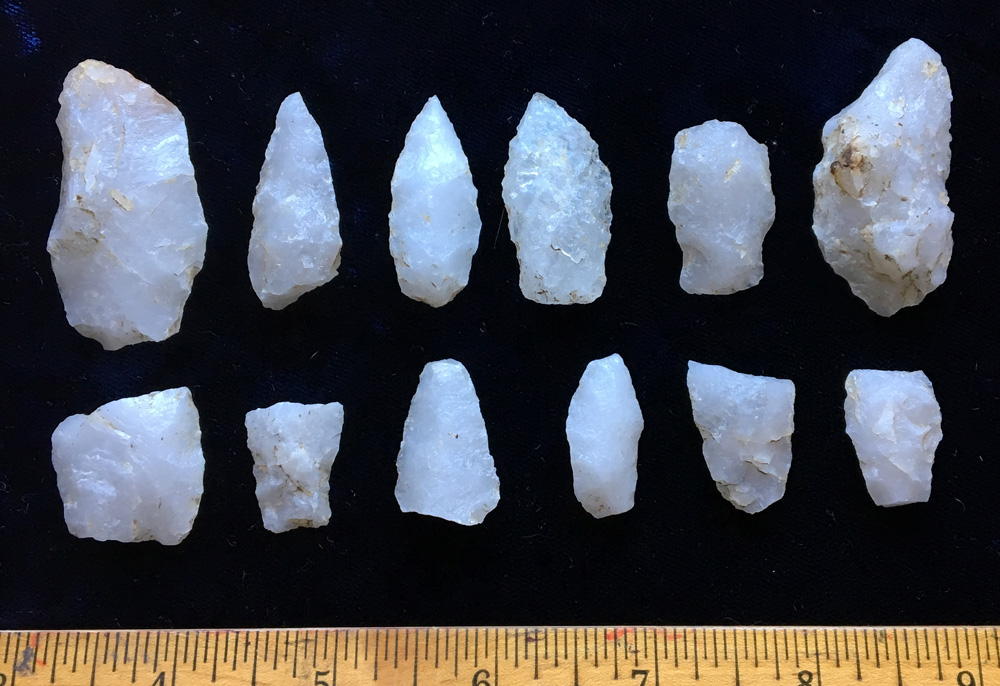
 That "knife" is partially transparent, just gorgeous material.
 I love this thing. I don't find many like this.
5. December 14, 2016
On December 11 I had searched nearly the whole area I was walking in. I had ignored a nearby area that is less productive. Back at home, looking at a handful of finds, I found myself wondering over and over about the area I had skipped. Perhaps I should have been more thorough. So, a few days later- back I went. I'm glad I did! This was fun to spot:
 I love the shape of this one. A classic "arrowhead" shape.
And there was this, just waiting to be picked up, impossible to miss.
Yet another handful of stuff! Persistence pays off with a lucky streak.
6. December 18, 2016
Heavy rains swept the ground as the region was hit by a winter storm. I knew that the torrents of water were churning the ground and washing out more rocks, stone tools among them. I eagerly returned to the area where I was having so much luck, only to find it a soupy and nearly impassable morass of mud. With every step, I sank deep into the mire. 100 feet from my car, I found myself in despair, wondering if I would make it back to safety. The mud was so deep, so sticky, I feared that if I fell forward I might drown. It was the worst mud I have ever encountered while looking for arrowheads. I was relieved to get out of there. In the few minutes I was floundering around, I found a couple of projectile point fragments, both stemmed bases. I drove to a different area where I searched for a while but found only one corner of a triangular point.
7. December 23, 2016
Back to the productive spot. Had the mud subsided? Only partially. I found a couple of big chunky artifacts. I don't know if these are preforms or scrapers, or some other kind of crude tool. I have not been back to this spot since, it is now covered with snow. When the snow melts I will be there again.
8. Christmas Day 2016
There is an area that once produced many arrowheads for me, that now yields very little. I found what there was to find; the ground keeps its secrets, and what is below the surface remains buried. I still walk there and remember the fine points I once spotted on the gentle slope and at the hilltop. I study the ground and think of the people who once lived here as I turn over flakes I left behind on previous visits. This was kind of fun to spot. But it is just a fragment.
Besides this, I found a broken piece of a scraper and another fragment of a triangular point. Better than nothing. I will keep these and record these finds together with the others from that place. Perhaps some future archaeologist will appreciate the assemblage I have collected from this site.
Back in the car, headed home, I drove by an area where I have found some things in the past. Not a lot, but some decent points. The vegetation on the ground there is thick, conditions generally poor. To my shock, on this occasion, all of the vegetation was gone. In its place- bare earth. I could not believe my eyes. A lucky thing to find. I knew the chances of finding an arrowhead in those conditions were extremely high. I found this, not much to look at but this is part of a Stark point, made of red felsite.
Not long after that...
It was, for me, a merry Christmas.
I'm not sure what type this is. Atlantic, perhaps, or maybe a Neville. It is a bit beat up but I love it.
9. January 15, 2017
Back in that same place again. Hoping that rain might have exposed something new. But, there is not a lot to find here. This tiny little quartz triangle was my first and (so far) only projectile point find of 2017. It is complete and interesting because it is so small. I can't know what the year will hold in store for me, it is impossible to predict. I am optimistic but for now, until the thaw, I have to wait.

Tuesday, February 14, 2017

PRESERVE COUNCIL OAK

PLEASE COME OUT TO CONTINUE TO SUPPORT ROGER DESROSIERS TO PRESERVE COUNCIL OAK
THE MEETING SCHEDULED FOR WEDNESDAY, FEBRUARY 15, 2017 HAS BEEN CANCELLED
THE NEW DATE IS: MARCH 1, 2017 @ 6:00 PM

DIGHTON MIDDLE SCHOOL
1250 SOMERSET AVE (138 NORTH) –REAR
DIGHTON, MA

Image above from “Fighting for future of Dighton Council Oak site” - News - Wicked Local ...

Feb 23, 2012 - “It's no respect for our culture,” said Paul Pittsley — “Gray Wolf” — another sub-chief of the council. “. ... The Council Oak was a sacred meeting place for the Wampanoag ... to Roger Desrosiers — “Gray Fox” — steward of the Council Oak. ... The oak was also the site where Wampanoag leader King

Monday, February 13, 2017

Padding the horizon with a stone wall

Light and shadow are important concepts in understanding the possible archaeoastronomy of a site. I find myself wondering: where is the horizon at sunrise and what shadows will cross this site during the day?

I recently visited a site with some stone walls that were on the horizon and had the thought that those walls could be changing how light falls across the site. I'll call this "padding" the horizon. Here is how the idea came up.
There is a big conservation land in Upton, north of Grafton Rd. In the past I found rock piles along one tributary brook in there (see here and here) , and wanted to go back and cement my understanding of the upper and lower areas I saw on different occasions. The blue outline is correct and there are a number of different clusters of rock piles in there.
With my wife along, we headed north from the entrance at "Oak Knoll Ln" (right of center at the bottom) until we came to the brook, and then explored up along it. It should come as no surprise that there are rock piles up along in there.
The first thing you see is a group of three short stretches of stone wall, lined up as if they were all one wall. Here is the first
 Here is the 2nd and third in the distance. Note a trail following along.
 Closeup of 2nd
 closer view of 3rd
view back towards the 2nd. I noticed a boulder at the center of the picture, in the background but capable of throwing a shadow onto these walls.
[If you click in to examine this photo, you can see some interesting trail highlights with the snow. It confirms that the standing stone back there is part of the site]

Then some pretty damaged piles:
A couple of typical burial mounds (I assume because of the conspicuous hollow and vague rectangular shape):

Some of the piles were only a few rocks shy of being "short stretches of wall":

The main features of interest were the many short stretches of wall. Here was another:
I was having trouble telling one bit of wall from another. Was it three or four examples or perhaps twice that number? Here is the one I want to talk about:
I was babbling about how these walls could make shadows, and tune the moment when the light appears over the hill.
I was explaining to my wife, how this wall would be on the horizon if you were below (where most of the rock piles are located). Here is one end of this neat "horizon" wall:
 At the other end, a pretty noticeable little enclosure. A place to sit and watch the play of light?
Anyway, you can see how this wall could be on the horizon from below. It only appears for a short stretch perhaps because that was the only bit of horizon that needed tuning. Or perhaps it is simply about the wall making a nice shadow with something else? Have you ever seen the stone wall get taller as it crosses a height of land? [I know I have pictures of this but cannot find them at the moment] I never had a hypothesis about why. Now I can at least suppose: enhancing the high point changes its shadow.

So there were other little bits of wall in there and lots of weirdness under foot (look closely at the right hand side of the photo -right click to magnify):
I could not tell if I was re-photoing the same short walls:
Please note the notch and short extension of the wall at the far end.

Certainly an interesting place. I was looking for some explanation for the short stretches and concluded that: once their job is done there is no reason to continue the wall. What is the job? Maybe something to do with light.

Saturday, February 11, 2017

Sanguache Stone (Snake) Walls (CO)

"Secrets of the Saguache stone snakes: A remarkable mystery endures"
 Andrew Gulliford -  Thursday, Feb. 9, 2017


    “As we walked down the hill following the snake, I spoke with former Saguache County Commissioner and ranch manager Mike Spearman. He told me, “The creation of walls took an incredible amount of hard labor. I have yet to observe a wall that created an enclosure, so it is hard for me to believe that they were built by Spanish sheepherders. The serpent was revered by Native American cultures. Snakes were messengers who connected them with their ancestors who had returned to the ‘underworld.’”

Andrew Gulliford is a professor of history and environmental studies at Fort Lewis College. He can be reached at gulliford_a@fortlewis.edu.

Friday, February 10, 2017

Snow...no rock piles

Ah! but wait! I have got a story to tell about this.
Saw some good stuff in the last few weekends.

Wednesday, February 08, 2017

Rockwood

Never saw this before:
https://commons.wikimedia.org/wiki/File:Rock_pile_in_Rockwoods.JPG

Added: If individual rock piles get Wikimedia attention does that mean I can get some media attention for cool sites, then post them on Wikimedia? Seems like another way to promote the subject.

Friday, February 03, 2017

Continuining to walk clockwise around Sandy Pond

Walking clockwise on the north side of Sandy Pond, Lincoln the account left off here:
Continuing as the trail nears the northern end of a little wetland, on the  right is a small rectangular  horseshoe-shaped pile.
Hard to photo:
It wasn't until we got around to the northeast side of Sandy Pond, along the edges of that wetland, that more extensive mounds started to show up. This gives you an idea:
This whole side of the wetland has a "debris" of stones piles along it.  I have seen very similar things at Woodbridge Rd in Carlisle. This was more extensive.
I am looking over the photos, trying to decide what to post. How about this:

I am pretty sure that is what a pile looks like when it has been deconstructed. It's what a vandalized pile looks like. But actually, there were so many other things:
View back up towards the path:
These are long mounds with hollows. Sometimes it seemed an extended complex, sometimes a collection of separated features. Here the view is to the west or northwest:
Let's take another look at that first example:
Again:
It is almost a spiral.
Here some little "chambers" going along the same wetland edge:
It is clear these are deliberate structures.

Thursday, February 02, 2017

Council Oak in Dighton MA - under threat

[Not rock pile related] I got an email from George Gustafson:

The Council Oak in Dighton MA is an important location.  A meeting is being held on Feb 15 to discuss the building of housing adjacent to this site, Any suggestions to prevent this?

If the reader wants to help, I am happy to forward emails.