Thursday, December 01, 2011

Parker Hill - Fitchburg, MA

I picked this hill in western Fitchburg for my Sunday walk. Drove up the road next to it until the pavement gave way to dirt, parked, and continued on foot up the road. Lots of dumped rubbish consisting - curiously - of lots of chairs and old TVs. It was like graveyard for couch potato accessories.

One dirt road goes up and crosses the hill east-west just below the summit - a stone wall actually crosses the summit. From there I took another smaller dirt road down the north side of the hill. I wanted to get into the flatter valley in that direction (hoping to find some traces of the "Wachusett Tradition") and wanted to get away from the dumped rubbish. This turned out to be a good move. Half way down the north side of the hill, the road passes through a gap in a stone wall and passes what looked like a donation boulder (because of the sense of random rocks falling off the sides):
I was worried, though, that it was an isolated pile and was only slightly re-assured when I saw something else on the other side (downhill) of the wall. But I was not too sure of this:
Let me parse this view. We are looking at a low, curved mound of cobbles, mostly of the size that you could carry in one hand. On the left, at each end of the curve, are two larger cobbles/boulders and you can see some symmetry of the curved mound between these larger endpoints. Looking carefully there is also a piece of quartz at the center of the curve, just to the right of the center of the photo. There is a second piece of quartz to the right of that. Here is a view towards the center of the pile, taken in a line perpendicular to the above photo:I was still a little worried that this was not a "real" site. The worry started to fade when I came to a "real" rock pile - real because it is carefully built up.
This manifests the ideal of "rock piles poking up out of the laurel". My worries that this was not a site evaporated as I entered a boulder field, with lots of rocks and small rock pile clusters.
So I combed the area, traversing the hill at the same level until I ran out of rock piles, then traversing back, a few feet lower down on the hill. Lots of examples of piles with two larger rocks in a pair:Some pretty old piles - love it when they are moss covered and hiding in the bushes this way:
Now, that first pile with quartz would make a decent example of an older Wachusett mound. But everything else I was seeing felt more like marker piles - evenly spaced, and the kinds of things I expect to see as outliers around Wachusett mounds. Or perhaps each cluster represents an individual little ceremony.The question was: are there any other of the larger mounds in here? I think I found a couple but they were too far gone to photograph well. You see, here the laurel is growing around the edges of the rock pile:Is this cool or what? I'll just show you some more pictures, hoping to convey the atmosphere of the place:Note in the distance is a pile built into the corner of a stone wall. I wonder if this came later or if the walls and piles are from the same date as the rest of this site?

It was a pretty, but somewhat forlorn, place. This is the first decent new site I have found in a while, so I was glad for that also. The location corresponds with the larger blue outline on the map fragment above.

After spending a while at this first site, I continued into the flatter area beyond north and west of the hill. There was a brook, and a large pile of rocks badly re-arranged and driven over by multiple ATV. My guess is that this is just what it looks like: a multiple chambered mound right next to the water. But who can tell? There was a little quartz in the right place:
Not that this pile is of any interest by itself. Perhaps another dot on the site map? But overall another site in Fitchburg, much like the others I have found here.

Update: I want to mention two other sites this site reminds me of: the northern slope of North Manoosnoc and downhill from Fenton Rd - both places a few miles south of here in Leominster. From my point of view this site is pretty typical of what I would expect to find in these hills. The sites are pretty common if you go looking and cover enough territory. That requires curiosity and a car. But how likely would it be for someone to spot a pattern when they only see one site? How inclined would someone be to hitch up the horse and wagon and go looking for something similar, further afield? Not very. I think getting a real sense of rock pile sites is only possible because of the having a car and having reasonably affordable gasoline.

Wednesday, November 30, 2011

Woody Blackwell - spectacular modern stone tools

Not rock pile related but very pretty stuff [click here]

Bird, Turtle, Fish, Rattlesnake Story Stone

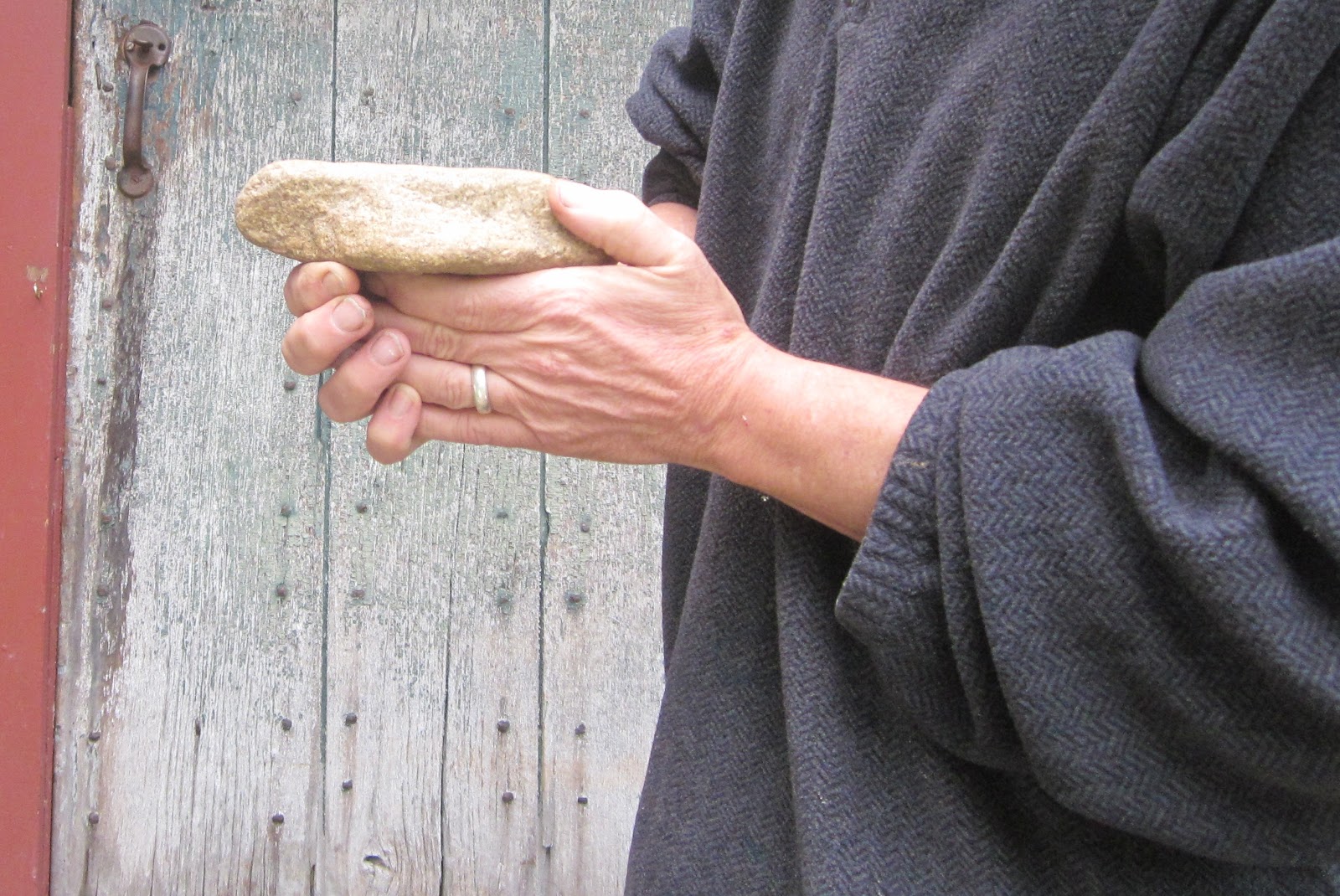
I wanted to get this up before the bird stone talk "flies away." I have one - sort of - but just have never been able to photograph it well and these photos are no exception. Anyway, there was a hundred year type flood that happened back in the middle of the 1990's (1994?) when a locally heavy thunder storm hit in August. In the Nonnewaug Floodplain the water level reached that of the ancient glacial lake shore, a one in a life time visual I'll probably never see again. In the photo above the river is in the distance and the end of this cornfield closest to it was flooded, seconds after I witnessed a huge wall of water rushing and roaring down into the valley.   When things dried out, I walked over there looking to see what might have washed in or eroded out, possibly to find projectile points or anything interesting. I found no points (not that I've ever found any there ever) but did find a curious stone.
It did sort of look "birdy" but then from another angle it looked rather "fishy."

If I remember right, I puzzled about it off and on, and then one day went up to the Institute for American Indian Studies at the suggestion of Shaghticoke Elder Trudie Lamb-Richmond to see a presentation by this guy John Cucinello on "Story Stones and Other Interesting Rocks." I'd been pestering her about my stone finds for a few years and I guess she figured to distract me by introducing me to this other crazy white guy who sees things in stones.
Turns out that "Cooch" has thousands of stones he's collected, just over the state line in New York. I recall in particular one of the stones that he presented, not telling the audience what it was, but asking us to just shout out what we thought it was. A couple kids said "Cobra!" but this Grizzly Adams looking guy and I said, "Eastern hog nosed snake." Cooch looked surprised and asked us to explain that one, never having gotten that answer before. So we hicks told the New York City School Teacher that there is a local snake whose other "common" name is "Puff Adder." Turns out both Griz and I had been both been scared as young boys by a hog nose protecting itself by puffing up and posturing not unlike a Cobra. Another stone was very small, a polished little mammoth that turned just right was also a hunter with a spear, which led into talk about story stones, complete with so many examples in stone that it makes me dizzy to think about.
Anyway, I thought of that stone I found after the flood and thought about it as a Story Stone. I eventually saw more suggestions of forms and developed a story that I have actually performed in front of various groups in a couple schools, a library or two,  and Scouting groups. I'm out of practice now, but could do it fluidly when in good form, the illusion created that I'm changing the shape of the stone before the audience's eyes.
So let's say that one morning, a guy named "Big Belly" was sleeping in late...  
He got up and yawned:

Nobody was around, off to work, busy a'hunting and a'gathering and all. He saw one of the dogs (image I'm waggling that index finger like a doggy tongue, my thumb like a doggy ear) and said "Hello Dog!"...

...but the dog ran away. (I'd bring the stone behind me and change it's position, making use of what feel like "finger holds" pecked into the stone)  Looking for someone to talk to, Big Belly saw a bird on it's nest over in a tree by a pond (and I'd bring the stone forward and pan the audience):
(Actually, my fingers should be interlaced to better imitate a nest, and then I'd swing the bird around behind me and say, "But the bird flew away," again sweeping the stone behind and changing finger holds.
Big Belly looks down at a branch, sees a turtle sunning itself, says "Hello," but the turtle glides into the water:
Looking into the water BB sees a fish (the view in the 4rd photo from the top):

 and the same thing happens and the fish swims away too, bringing the stone behind me again.
"Nobody will talk to me this morning," Big Belly says, but then, grabbing my turtle shell rattle with my left and shaking it, while changing grip and bring the stone forward once again, pointing the stone at the closest person paying closest attention and saying:
"I'll talk to you, little boy," says the Rattlesnake in an evilish tone - and Big Belly runs away!
  

Tuesday, November 29, 2011

The Tour de Mink Pond

The Tour de Mink Pond is a once around circuit of Mink Pond in Concord's Estabrook Woods (the woods that Thoreau walked in) which is supposed to pass all the rock pile sites A-H. I have already written about F,G,and H (here and here) but I went out to explore in that vague area between Mink Pond and Hubbard Hill and ended by completing a circuit but skipping F,G, and H. The whole walk would be a mile or a mile and a half. [All locations are approximate.]

A - passed it without stopping this time. In the past, blogged about here.
B - an isolated pile consisting of an oblong with a separate single stone on its axis. Have seen this before:C - I got down into a gully between the drumlin/esker formations in there, spotted water and saw the shadow under a rock that is the telltale clue:
A new Concord rock pile. Suspicious that it might be isolated, I gave credit to a small cluster of larger rocks nearby:Then I saw a number of pretty scrappy rock piles along the water's edge. It bothered me that in some cases they seemed to overlap. A very strong attribute of field clearing is that the piles are built on top of each other and overlap. Here are three "bumps" that are sort of separate and sort of overlapping - at the water's edge:Although smeared, this is still a very organized pile:These are so far gone, I suppose it is hard to care for such things except these happen to be in my hometown. I am not sure they are ancient but I think one could make the case. There was no field nearby just the tail end of a glacial cobble deposit, where it drops off into a brook.

Across the way we are looking at the lower southwestern slopes of Hubbard Hill:
I walked over there.
D - A couple of traces, perhaps nothing.E - More cobbles at the edge of a cobble ridge, next to the water, perhaps nothing but a bit more clustered into piles than random. I could not tell:After that, I circled around the northern end of Mink Pond and returned towards my car on the main path ("Estabrook Rd"). I think I found a new site at C but things became increasingly indistinct. You could make a nice tour of the place, including A,B, and C as a mid-point on your way to F where things get interesting again. I'll have to work on the leg that goes from H back to the entrance.

Adena Rock Mounds

Don't remember if I linked to this before, from Ancient Wisconsin [click here]

Blue Deer Center

Found this backtracking a recent visitor.

I am mostly opposed to selling spirituality but this appears to sell actual information such as medicinal plant use - which I suspect is of interest to most rock pile enthusiasts. Also I have to agree that the natural world is sacred. You can judge for yourself. [Click here]

Cairn Photos from RI

Jeff from RI has a fair number of pictures of rock piles on his blog [click here and scroll down].

Field Trip Notice - Sunday Dec 11, 2011

I'll be leading a NEARA field trip to some favorite sites in the Groton/Westford MA region. Anyone interested, who is not a member of NEARA, is welcome to come as my guest. Details and directions available by emailing this blog.

Monday, November 28, 2011

Etiquette, Inquiry and Proper Practice around rock piles

Reader Jeff in RI writes:

In just the past month or so (since I opened my eyes) I've come upon at least 150 cairns and constructions that are definitely not of colonial origin. If you ever find yourself nearby, I'd gladly show some to you. These are all over the place here in RI. Would it be possible to start a thread of conversation on RockPiles concerning etiquette, inquiry and proper practice around these very important relics? Is it safe or proper removing debris? Before/After photos? Sharing or not revealing locations? Are there registries for these? Or possibly starting one. Because I myself have found so many (and I'm a newbie at this) I can't imagine how many have been ruined by disregard and development. Here in RI there is building/logging in Canonchet and Exeter. It is important that these be protected. RockPiles is a good first step for that advocacy. If you're interested, hopefully this LINK will connect you to my Cairn Collection on flickr. Thanx.

----------------------------------------------------
These are good questions and a good opportunity to review and re-discuss these topics. I'll lead off. Comments are strongly encouraged - I know people do not agree with me on all of this.

PWAX Comment: First it should be remembered that these sites are relics of specific expressions of people now gone. You don't want to walk on the rock piles (or at least not carelessly) and you do not want to use them in combination with your own religious and artistic expressions. Cleaning piles occasionally is OK if you do not move stones, and limit the cleaning to piles that are not next to paths. Use restraint, do not clear off all piles, and be respectful.

The discoverer of a rock pile site has the original right to decide who they are going to tell. I tried to capture some guidelines I follow in "To Publish or not to Publish?". The general arguments are:
CON:
Vandalism is brought about by publishing.
PRO:
Heedless destruction is brought about by failure to publish.

I have seen vandalism but the vandals found the site on their own, not from reading about it. I have seen quite a lot more site destruction by careless logging and housing developments. So I am firmly in the camp of wanting to publish as often as possible unless a site is fragile or if I think it a reasonably recent burial ground. I do keep some places to myself. I have heard Tribal Historic Preservation Officers say that publicizing sites is the proper thing to do, today.

Note: NEARA keeps a registry of sites that they do not publicize. Various efforts have been made to use Google Maps to create a common repository of public sites. If you want to maintain it, good luck! This blog has no decent Index; which I am sorry about and hope to remedy someday. Also, I would like to put all my maps online. I have no fear of vandals because even enthusiasts rarely track down any of the places I do publish. I have to drag you guys out there by the ear! [see NEARA field trips, Dec 11]

Update: I believe some readers think it should be up to the Indians to decide what is public.

Roadside Attractions - Justice Hill Rd Stirling

If you happen to be driving southeast on this road, just after the junction with Upper North Row Rd, there are scattered rock piles in the woods to the right (south). I stopped where some were visible from the road, that I had not noticed before:Back towards my car:I parked and took a walk that was kept very short by my current lack of breath and by the large number of downed trees. There are many piles in there that seem clearly ceremonial, what with the use of quartz and all:These look "ceremonial" enough to me. But the area is full of large messy piles at the edge of a drop-off that look considerably more like rock disposal.

Slightly intriguing: a stone wall with a pile next to it, so deeply buried, that you only guess it is there.What with the hard going and the ambiguity, I could not face slogging deeper into an area that I already knew was pretty barren. So I turned back and drove away, to explore somewhere else, in a different part of Stirling. Also with no result.

Rock Art around Paris - and a modern cairn

Bruce McAleer writes from Paris:

...just by accident a few weeks ago I stumbled on a website talking about the prehistoric rock art in the ÃŽle-de-France region and started poking around. Turns out the area around Paris is loaded with the stuff. It can't be found everywhere but as you would expect it is found where there is an abundance of rocky outcrops, usually inside rock shelters. I don't have a car (or license) and the area closest to me where it is found in abundance (relatively speaking) is about a 1 hour train journey. I have to take my bike on the train and then ride to the areas where I want to look. I've only been out once so far but I had success on my first hunt. There is a rock art association which I plan on joining and I'm hoping to go out on a field trip with them in a couple of weeks.

As you might imagine, the locations of these sites aren't publicized so you're on your own if you want to find them. The websites I've found do mention some general locations so I bought a topo map of the area I wanted to search and went out to see what I could find. I spent a while in one area and found nothing and moved on to another area. The next area had the telltale signs of a former rock quarry. Interestingly enough, on an outcrop at the top of the quarried area was a well constructed cairn.Obviously modern but interesting nonetheless. I'm attaching some photos of what I found. I'll send them in a few e-mails so they're not too heavy. I think I told you that I started my own company doing bike tours into the countryside near Paris and for the upcoming season I'm going to offer a combo biking/hiking tour to see some of these sites. If you're interested here is a link to one of the websites that talks about the rock art in the area. http://www.savoirs.essonne.fr/dossiers/le-patrimoine/archeologie/a-la-decouverte-de-lart-rupestre-en-essonne/
And if you know anyone coming to Paris who might be interested in one of my tours my website is www.frenchmystiquetours.com.

A few more:

Saturday, November 26, 2011

Huyck Preserve

Reader Cully writes:
Discovered this one on a hike today around the Huyck Preserve in Rensselaerville, New York. http://www.huyckpreserve.org/visit/trailmap.pdf. It is located on the Partridge Path Loop 1 Trail just before the trail turns to the West from North as one hikes the trail in a counter clockwise direction. Didn’t have my GPS but the approximate coords are 42° 32.367 N, 74° 08.979W. The area is a young forest of about 50 years and is laced with great stone walls.