Got out in the blazing sun for a few hours this morning. I got a sunburn but found some things that made it worth it. Here's a stemmed quartz arrowhead.
I also found this.
I cleaned them up when I got home. Some people will use water and a brush to remove any trace of dirt, I just rinse the pieces off and wipe off whatever dirt will come off with my finger when they are wet. I don't want to disturb the suface patina, in fact I try not to handle them too much.
My favorite reference for finding out more about the things I have found is "A New England Typology of Native American Projectile Points" by Jeff Boudreau. The quartz arrowhead is a type that this reference identifies as "Wading River." These may be impossible to date when found in disturbed contexts, Boudreau indicates that this point type may not have been a cultural manifestation but rather "a technological manifestation that transcended cultural boundaries."
The other artifact I found today is kind of a mystery object. I'm not sure if this is felsite or flint. From one side it looks like an asymmetrial Levanna point with a missing tip.
From the other side it looks like a Brewerton Eared Triangle with a broken "ear" and a chipped tip.
If it is a Brewerton it would have a very crude beveled base that appears to retain part of the cortex or "rind" of the stone from which it is chipped, this would be atypical and not something I have seen before.
Perhaps this is an unfinished point, maybe something that failed during manufacture. Or it might be more extensively damaged than it appears to be, a fragment of something. In any event it is definitely worked as a tool, not just a chip or flake. Any ideas on this thing?
Saturday, May 12, 2012
Indian Mound found in Cumberland RI
Reader j ryan writes:
[I] stumbled on what I am pretty sure is an Indian mound....it was pretty impressive. Perhaps 8-10 feet tall, easily 20-25 feet long, apparently all carefully placed stone. I didn't dig, but pulled up one rock on the top and it appeared to be nothing but stone down 3 feet or more.
Also, here's a link to where the site is...roughly!
http://g.co/maps/pf6at
[I] stumbled on what I am pretty sure is an Indian mound....it was pretty impressive. Perhaps 8-10 feet tall, easily 20-25 feet long, apparently all carefully placed stone. I didn't dig, but pulled up one rock on the top and it appeared to be nothing but stone down 3 feet or more.
Also, here's a link to where the site is...roughly!http://g.co/maps/pf6at
Thursday, May 10, 2012
More Elmore G Raymond Memorial Park, Pelham NH
I followed the path to the left, west, and up the southern edge of a brook. Saw what I thought was a nice mound, at the end of an alluvial shoulder, overlooking the brook:
But as I mentioned in the video, this "mound" turned out to be the end of a ramp that came up from the other side. Here we are looking down the ramp, with the natural land to the left and a drop-off to the brook on the right.Wave?
Photo credits: (A. Alexandria 2012 http://www.ancientpathsofshastina.com/)
Two Tsektsel/Prayer Seats (and other possiblities) a mile apart, same sort of "cobbles across a boulder top" thing going on -
What's the Rock Piles consensus? This is a "wave?"
Similar to this:Or this:
Not the best examples, I know - that's the trouble with having six hundred and fifty thousand photos or more to sift thru to find what you want.
Larry has some excellent examples, I think...
Wednesday, May 09, 2012
Its a berm! It's a mound! It's super-old!
First of a couple posts about Elmer G Raymond Memorial Park in Pelham NH. Found this up the brook that runs below the parking lot and goes upstream west of the playing fields. At the time I thought it was a well placed mound but it turned out to be a berm of cobbles running up the side of the ridge like a ramp, ending at the lookout over the brook. The beginnings of this berm were up the valley, where it merged with more conventional stone walls.
A few moments later:
Losing one for the Gipper
Went out to explore near Parker Hill Fitchburg, including taking pictures of some mounds I found before when I did not have a camera [see here]. Here is the scene I described then:
It looked as I remembered - those gray spots on the hill below the power lines. But for some reason, having a camera got me to look more carefully and I cannot convince myself that these are ceremonial rock piles. Closer:
There was a nearby field and there were larger rocks strewn around. So I'll subtract this site from the maps. (The lowest left blue outline here).
Tuesday, May 08, 2012
Grey Feather Gallery
Raise your hand if you said "Prayer Seat" when you saw this image. Take a look at the rest of the photos at Alyssa Alexandria's website ~ http://www.ancientpathsofshastina.com/gallery/gray-feather/
"When the novice had recovered she was taken into the high mountains in the summertime by her mentor and her male relatives (as many as ten of them). They went to a prayer seat, cekce>l, a semicircular enclosure of rock – sometimes river rock brought from below ... . ... the novice and her teacher swept the seat carefully [http://texts.00.gs/Standing_Ground,_5.htm]." ~ Thomas Buckley : Standing Ground : Yurok Indian Spirituality. U of CA Pr, Berkeley, 2002.
Insider information: the photos in the gallery were taken in response to questions from Norman Muller, who one commented that "The Yurok Indians weren't the only tribe in the West to construct prayer seats, so the question is, among which tribe in the West did they originate? Plus, they weren't always oriented toward a celestial feature, as many here in the Northeast believe. A sacred mountain or simply a spectacular vista, one that would lead to a successful vision quest, was sufficient." (See: http://rockpiles.blogspot.com/2008/09/yurok-karok-and-rocks.html)
There are more images of other tsektsel in the other galleries. Alyssa writes, "All are connected; woven into a single network by Andesite rock walls. Elders have called these walls "Spirit Paths."
And you may note the "Links to Friends of APOS" on the side bar; it mentions "A great blog on RockPiles: http://rockpiles.blogspot.com/2012/01/photos-to-compare.html
"When the novice had recovered she was taken into the high mountains in the summertime by her mentor and her male relatives (as many as ten of them). They went to a prayer seat, cekce>l, a semicircular enclosure of rock – sometimes river rock brought from below ... . ... the novice and her teacher swept the seat carefully [http://texts.00.gs/Standing_Ground,_5.htm]." ~ Thomas Buckley : Standing Ground : Yurok Indian Spirituality. U of CA Pr, Berkeley, 2002.
Insider information: the photos in the gallery were taken in response to questions from Norman Muller, who one commented that "The Yurok Indians weren't the only tribe in the West to construct prayer seats, so the question is, among which tribe in the West did they originate? Plus, they weren't always oriented toward a celestial feature, as many here in the Northeast believe. A sacred mountain or simply a spectacular vista, one that would lead to a successful vision quest, was sufficient." (See: http://rockpiles.blogspot.com/2008/09/yurok-karok-and-rocks.html)
There are more images of other tsektsel in the other galleries. Alyssa writes, "All are connected; woven into a single network by Andesite rock walls. Elders have called these walls "Spirit Paths."
Image from: http://www.ancientpathsofshastina.com/
And you may note the "Links to Friends of APOS" on the side bar; it mentions "A great blog on RockPiles: http://rockpiles.blogspot.com/2012/01/photos-to-compare.html
Monday, May 07, 2012
Rocky Pond Brook - Hollis NH
The red dot is about where the short wall and boulder were (see here). At about the location of the red "?" there were rock piles, well holes, what looked like foundation holes, and some mounds. Not sure what to make of such a site.At first, you are looking down along the brook, with scattered rock piles:
Arrowhead on a rainy evening
Last week I spent some evenings after work out searching for arrowheads. The wet and cloudy weather we have been having has created great conditions for this- bright overcast skies and wet dirt make small artifacts easier to spot. Friday during the day it was raining and did not seem ideal for searching but as it happened, it didn't really rain much at all while I was out and though I heard some thunder, the rain held off and I was actually able to put in some time looking, more than two hours. Shortly after I arrived I found a broken quartz triangular arrowhead but then I searched fruitlessly for a long time, picking up hundreds of rocks but not finding any tools. It was humid and I was sweating, a reminder that summer is not far away. I found this as I was heading back toward the car, on the way out. It has a nick on the edge but was still a great find that I will treasure.
Thursday, May 03, 2012
Wednesday, May 02, 2012
Tuesday, May 01, 2012
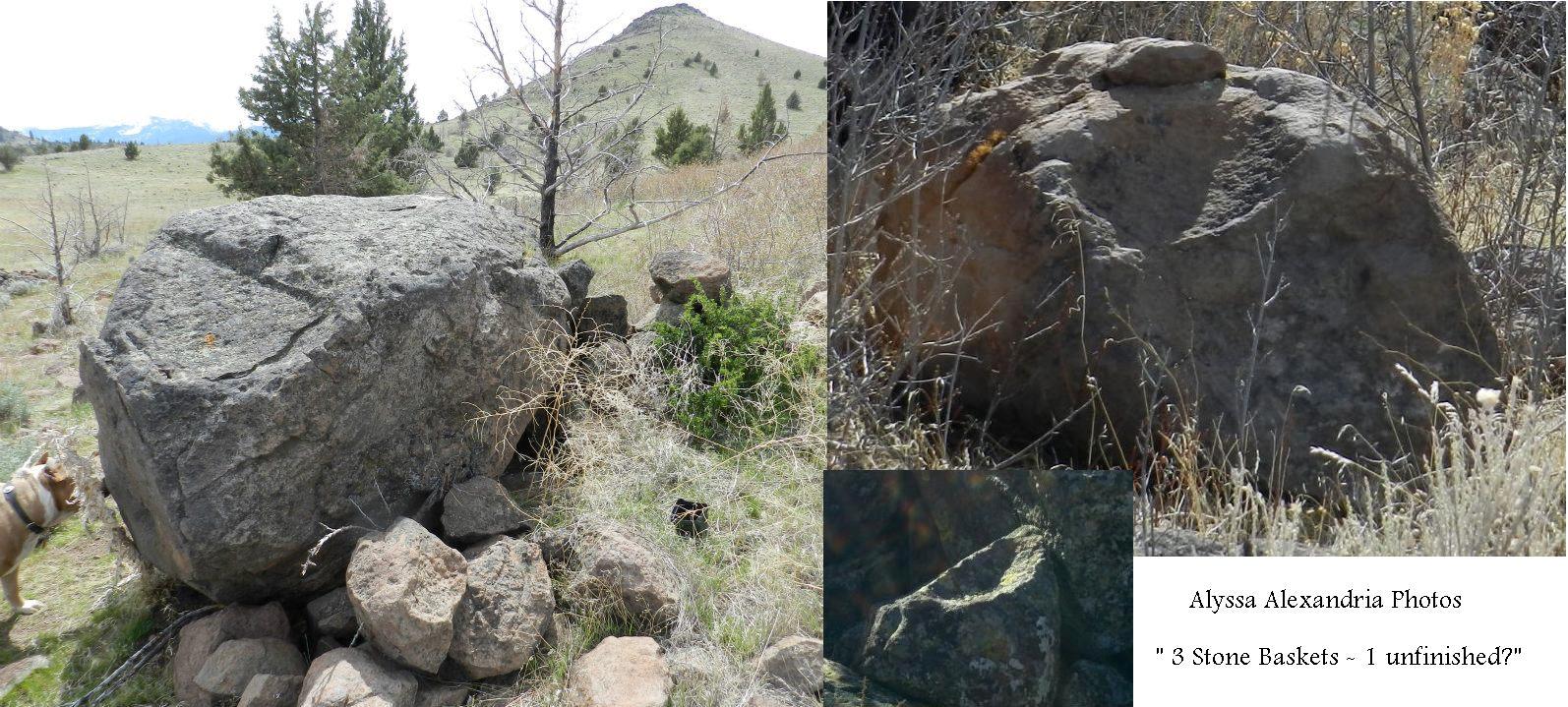
3 Stone Baskets
I found a little bit about Stone/Rock Baskets and posted it up here: http://wakinguponturtleisland.blogspot.com/2010/09/what-is-it.html , wrote something more recently about similar stones in CT here:
Recently Alyssa Alexandria (these are all her photos, taken by Lake Shastina in Northern California) came upon a "newer" looking stone row with this boulder that I think looks as if someone started working on a stone basket, like the two on the right above, but for some reason never finished it.
Another view that includes the stone row - and distant mountains:
And the next morning, I find I can 'edit" this photo above into place and continue writing:
I came across the following in a Bulletin of the American Museum of Natural History, Volume 17 by Joel Asaph Allen
"The question of mortars is one which presents some difficulty. The almost unanimous testimony of the Indians is to the effect that neither they nor their ancestors, within their recollection, ever made the finished, globular mortars of which so many hundreds have been found within the area occupied by the stock. In the manufacture of acorn-flour, they were accustomed to use either the smooth, flat surface of some large bowlder or ledge, or else a flat slab or block of stone of irregular shape sunk into the floor of their houses... the statement is made, moreover, by the Indians, that finished, widely and deeply excavated globular mortars (like these shown above) were found by them in certain localities in considerable numbers. These localities were gravel-banks along the edges of streams, the stream-beds themselves, or the surface of the ground in certain stony places . They claim that in a few spots large numbers of mortars were to be found; and some declare that the shamans know where these spots are, and go there at times to secure mortars, which, as will be seen later in speaking of religious ceremonials, were used for various mysterious and sacred purposes. Everywhere throughout the Northern Maidu area these mortars are regarded with considerable awe and veneration, and are feared quite keenly in many instances..." but then Joel leaps into describing yet another type of "mortar," even including this drawing: 
"Mortars were used by the shamans as receptacles in which to keep their most powerful and precious charms, especially the "pains" which they shot at people to cause disease or death. Such "pains" were kept in a mortar, with another mortar inverted over the first, the whole carefully secreted in a hollow log or under a large stone at a considerable distance from all habitations or trails. In the initiation ceremonies of the Secret Society the sacred meal used for sprinkling the novices must similarly be kept in a mortar. Lastly, the mortars are generally known by the name of ku'kinim to'nior i'tum to'ni ("spirit or pain baskets"), and are often supposed to be themselves the abiding-places of powerful spirits; although the belief in the mortars' animation, and their ability to move of their own accord from place to place, is not held here, as it is among the Shasta. By some the mortars are said to have been made by the Creator, or the Coyote, at the time of the creation, and scattered over the world for the use of mankind. By others they are supposed to have been people originally, during the bSte'ito, or time of the "first people," who were turned into stone in this form at the coming of the Indian people, when the other "first people" became animals."
"Does Alyssa have any photos of this type of motar stone?" you might ask.
I'll show you two spectacular photos as an answer:
Above is the stone "pain basket" (and its displaced cover),
while below is the view of Mt. Shasta above it. Before a dam was built around 1930, there would have been a river in the valley where Lake Shastina presently is located...
The last of Buck Hill
This next site, from the northern foot of Buck Hill in Fitchburg, was more interesting to me because of how I found it than because of what was there. I was beating a retreat around the eastern edges of the hill and was bopping along and saw this almost underfoot:
I was going to skip it but thought I should document it, for better or worse. So, as I am photo'ing it I think "there is probably another pile around here somewhere". Nothing at first, then I see another, a few feet away.
(Two fingers means the second site of the day - actually there were at least three clusters earlier, up nearer the summit.)
Then I continued working my way downhill and the piles kept appearing, and actually got bigger and clearer.

As I said in an earlier post about these piles, they are bigger than they look. This one continues well below the layer of leaves.
These piles are a similar to marker piles. There was a lot of brush and it is hard to see any layout or relationship between them but the spacing is reasonably even. In my experience such piles can often be the satellite piles around a larger mound. I started wondering "Where are the big mounds? Are they down here at the bottom of the site?"
The site was up in a corner of stone walls and at the lower edge of the site, the corner was filled with a large bulge. This almost necessitates the question: Are wall bulges ever burials? Here it is. I give up trying to get the new blogger software to put this picture in the center. Don't get me started on how BAD THIS NEW BLOGGER SOFTWARE IS. ITS A NIGHTMARE!
.....and it won't let me type anymore. So I left that site, by the upper wall corner and there was another smaller bulge up there.
I am at my wits ends. It took and hour to type and insert what should have been 15 minutes of content. I am furious!
Giant Animal Shaped Mounds in South America
Reader dc writes:
FYI, an interesting article on effigy mounds visible in Google Earth in South America. dc.
http://www.antiquity.ac.uk/ projgall/benfer329/
http://www.antiquity.ac.uk/
Subscribe to:
Posts
(
Atom
)